
Attending a trade show can be a very effective method of promoting your company and its products. And one of the most effective ways to optimize your trade show display and increase traffic to your booth is through the use of banner stands.

Balamani
Author
Enterprise HR technology buying has entered a new phase. Almost every Human Capital Management (HCM) platform now claims to offer artificial intelligence capabilities, from AI-assisted recruitment and workforce planning to employee self-service and predictive analytics.
Yet, for enterprise HR leaders, the challenge is no longer identifying vendors that use AI. The real challenge is determining whether their AI-powered HCM software can deliver measurable business value while supporting the complexity of multi-country workforces, regulatory obligations and long-term HR transformation.
This is particularly relevant for organizations operating across Asia Pacific, the Middle East and Africa. HR teams often manage multiple payroll regulations, multi-lingual employees, varying levels of digital maturity and rapidly changing workforce expectations. In these environments, AI only creates value when it is supported by accurate data, effective governance and workflows designed for local realities.
Instead of asking vendors "What AI features do you have?", enterprise buyers should ask "How does your AI improve HR decisions, productivity and employee experience while remaining trustworthy and scalable?"
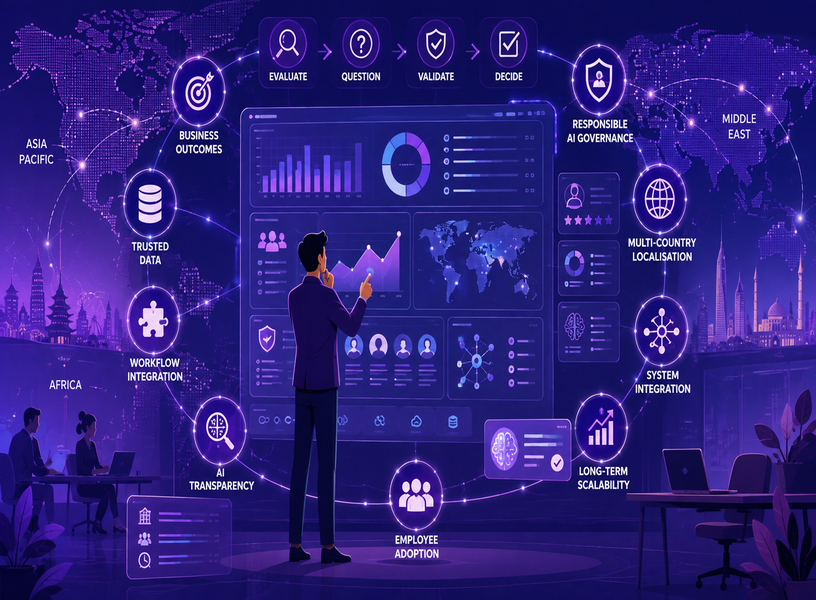
The following nine questions provide a practical framework for evaluating AI-powered HCM software beyond marketing demonstrations.
Artificial intelligence is quickly becoming embedded across Human Capital Management platforms. AI can automate repetitive administrative work, assist employees through conversational interfaces, identify workforce trends and support managers with data-driven recommendations.
However, AI is not a standalone capability. Its effectiveness depends on:
· Data quality
· Process consistency
· Governance
· Integration with HR workflows
· Security
· Compliance
· Human oversight
Research consistently shows that organisations realise greater value from AI when it complements existing business processes rather than replacing them. For HR leaders, this means assessing how AI fits into day-to-day operations rather than focusing solely on technical innovation.
The first question should always focus on business outcomes rather than technology. Many vendors showcase AI-generated summaries, chatbots or predictive dashboards. These features may appear impressive, but buyers should understand which HR challenges they address.
Examples include:
· Reducing recruitment time
· Improving employee self-service
· Increasing manager productivity
· Supporting workforce planning
· Identifying skills gaps
· Improving retention
· Reducing administrative workload
Ask vendors to demonstrate measurable customer outcomes rather than simply listing AI capabilities.
Key follow-up questions
· Which HR processes improve the most?
· How is ROI measured?
· What productivity improvements have customersachieved?
· Which AI features are most widely adopted?
AI is only as reliable as the data it analyses. Poor-quality employee records, fragmented payroll systems or inconsistent job data can significantly reduce AI accuracy.
Enterprise HR leaders should understand:
· Which datasets train the AI
· Whether customer data is isolated
· How inaccurate data affects recommendations
· How duplicate or incomplete records are managed
· Whether the platform provides data quality monitoring
For organizations operating across multiple countries, data standardization becomes even more important because employee information often originates from different HR systems. Without trusted data, AI recommendations quickly lose credibility.
AI should simplify work, not create additional steps.
During demonstrations, ask vendors to show AI supporting real HR processes such as:
· Recruiting
· Onboarding
· Leave management
· Performance reviews
· Succession planning
· Learning recommendations
· Workforce planning
Avoid evaluating AI as a separate module. Instead, assess how naturally AI integrates into everyday HR activities for employees, managers and HR teams.
Questions to ask include:
· Does AI require switching between applications?
· Can recommendations be acted on immediately?
· Does AI automate approvals where appropriate?
· Can workflows be customized for different countries or business units?
HR decisions directly affect people's careers, compensation and development.
Enterprise organizations should therefore understand how AI reaches its conclusions.
Ask vendors:
· Can users see why recommendations were made?
· Are confidence scores available?
· Can managers override AI suggestions?
· Are recommendations auditable?
· Are decision histories retained?
Transparency is especially important when AI influences hiring, promotions or performance discussions. Employees and regulators increasingly expect organizations to demonstrate fairness and accountability in automated decision-making.
As AI becomes more embedded in Human Capital Management, governance is no longer just an IT concern. HR leaders are increasingly accountable for ensuring that AI supports fair, transparent and compliant people decisions.
A credible AI-powered HCM software vendor should be able to explain how its AI models are governed throughout their lifecycle, from development and testing to deployment and ongoing monitoring.
Rather than accepting broad claims about "responsible AI", ask vendors to explain the policies, controls and oversight mechanisms they have in place.
Key questions to ask
· How are AI models tested for bias and fairness?
· What governance framework guides AI development?
· How frequently are AI models reviewed and updated?
· Can organizations configure approval workflows before AI-generated recommendations are acted upon?
· Are AI-generated decisions always subject to human review where appropriate?
For organizations operating across Asia Pacific, the Middle East and Africa, governance also extends to varying national regulations, internal ethics policies and industry-specific compliance requirements. AI capabilities should support, not complicate these obligations.
What good looks like
A mature vendor should provide:
· Clear governance documentation
· Human-in-the-loop controls
· Audit logs for AI recommendations
· Configurable approval workflows
· Ongoing monitoring of model performance
· Transparent explanations of AI outputs
One of the most overlooked aspects of vendor selection is localization. Many HCM vendors have sophisticated AI capabilities but limited support for the operational realities of organizations managing employees across multiple countries.
For enterprises operating in India, Singapore, Australia, the UAE, Saudi Arabia, South Africa, Kenya or other markets, HR teams often deal with:
· Multiple payroll calendars
· Country-specific leave policies
· Local employment regulations
· Multilingual employees
· Different organizational structures
· Country-specific reporting requirements
AI recommendations are only valuable if they reflect these local workforce realities.
Questions to ask vendors
· Which countries are natively supported?
· How are local employment practices reflected in workflows?
· Can AI operate across multiple languages?
· Does the platform understand country-specific organizational structures?
· How quickly are local regulatory changes incorporated into workflows?
An AI assistant that performs well in one country may not deliver the same value across diverse regional operations unless localization has been built into the platform.
Very few enterprises operate with a single HR application. Most organizations already have payroll systems, finance platforms, identity management solutions, collaboration tools and specialized applications for learning, recruitment or workforce management.
The value of AI in HR depends heavily on how well it connects with these existing systems. Without integration, AI may only analyze a fraction of the workforce data available, reducing both accuracy and business value.
Ask vendors
· Which enterprise applications integrate out ofthe box?
· Are APIs available?
· How is data synchronised?
· Can AI access information across multiple systems?
· How are duplicate employee records managed?
Integration should also support future growth. As organizations expand into new countries or acquire new businesses, HR technology ecosystems inevitably evolve. Choosing an AI platform with flexible integration capabilities reduces future implementation effort and helps protect long-term investment.
Enterprise HR technology is typically a long-term investment. While AI capabilities may evolve rapidly, buyers should evaluate whether the overall platform can continue delivering value over the next five to ten years.
Instead of focusing solely on today's AI features, assess the vendor's broader product strategy.
Questions worth asking
· How frequently are AI capabilities updated?
· How are customers involved in product development?
· What percentage of AI innovation is available to existing customers?
· How is customer feedback incorporated?
· What is the long-term roadmap for AI across theplatform?
Also ask for customer examples that demonstrate measurable outcomes over time, such as:
· Reduced administrative effort
· Improved employee engagement
· Faster hiring cycles
· Better workforce planning
· Higher manager productivity
· Increased adoption of self-service capabilities
· Long-term value comes from continuous improvement, not one-time innovation.
Even the most advanced talent management software or AI-powered HCM software will fail to deliver value if employees and managers do not use it effectively. AI introduces new ways of working. Organizations should therefore understand not only the technical implementation effort but also the organizational changes required for successful adoption.
Ask vendors
· What implementation methodology is used?
· How is user adoption measured?
· What training is provided?
· What change management resources are available?
· How long before organisations typically realise measurable benefits?
Implementation should also include ongoing optimisation rather than ending at go-live. Successful organizations treat AI as an evolving capability that improves through continuous feedback, governance and process refinement.
Business Outcomes - Clear evidence of measurable HR improvements
Data Quality - Strong data governance and quality monitoring
Workflow Integration - AI embedded into everyday HR processes
Transparency - Explainable recommendations with human oversight
Responsible AI - Documented governance, auditability and bias controls
Localization - Multi-country support, multilingual capabilities and local compliance alignment
Integration - Open APIs and seamless connectivity across HR systems
Product Strategy - Ongoing AI innovation backed by a clear roadmap
Adoption - Comprehensive implementation, training and change management support
This checklist can serve as a practical scorecard during vendor demonstrations, request-for-proposal (RFP) evaluations and proof-of-concept exercises.
Choosing AI-powered HCM software isn't about finding the platform with the most AI features, it's about selecting one that delivers measurable business value. By asking the right questions about data quality, governance, integration, localization and long-term scalability, HR leaders can make more informed vendor decisions. A structured evaluation approach helps ensure your HCM investment supports better workforce outcomes today while remaining adaptable to future business needs.
1. What is an AI-powered HCM software?
AI-powered HCM software is a Human Capital Management platform that uses artificial intelligence to enhance HR processes such as recruitment, onboarding, workforce planning, employee self-service, learning recommendations and people analytics. Rather than replacing HR professionals, AI supports better decision-making by automating routine tasks, surfacing insights and improving employee experiences.
2. What should HR leaders prioritise when evaluating AI-powered HCM software?
Enterprise HR leaders should look beyond AI features and evaluate data quality, workflow integration, governance, security, localization, scalability and measurable business outcomes. The most effective solutions align AI capabilities with organizational processes and long-term HR strategy.
3. Why is data quality so important for AI in HR?
AI models rely on accurate, complete and consistent workforce data to generate reliable recommendations. Poor data quality can lead to inaccurate insights, reduced user trust and weaker business outcomes.Establishing strong data governance is therefore essential before expanding AI use across HR functions.
4. How does AI support talent management software?
AI enhances talent management software by assisting with skills matching, personalized learning, succession planning, internal mobility, performance insights and employee engagement analysis. When combined with human oversight, these capabilities help organizations make more informed talent decisions while improving workforce experiences.
5. Why should organizations assess AI governance before selecting an HCM vendor?
AI governance ensures that AI systems operate responsibly, transparently and consistently with organizational policies. Evaluating governance helps HR leaders understand how vendors manage bias, explain AI recommendations, protect sensitive employee data and maintain accountability throughout the AI lifecycle. This is particularly important for organisations operating across multiple countries with diverse regulatory and workforce requirements.

Many people would say that it is absolute madness to keep on doing the same thing, time after time, expecting to get a different result or for something different to happen.
Hoover Dam and the Grand Canyon: Book yourself a seat on any of the many sightseeing tours available and go and watch the architectural marvel that is Hoover Dam built over the Grand canyon which is also a grand sight to see by itself. Black Canyon is another must see as is Lake Mead which is so beautiful just because it is a body of water all surrounded by desert-like nature. Colorado River:
While looking at the Dam and Canyon is from above, to see the true beauty of the river, you have to go down. The Colorado river is excellent for river-rafting and water sports, but you do not have to take part if it is not your thing. Instead just sit back and enjoy another of nature’s marvels.


.webp)
Who can not resist going to one of the old towns like those in the Western gun slinging movies? Your destination needs to be Old Nevada. There you can delight in an old western town right in the middle of Red Rock Canyon. They host western shootouts too so come prepared, partner! I could go on and on about other attractions like the theme park in Circus Circus, the Gilcrease Nature Sanctuary, the Henderson Bird Viewing Preserve and Mt. Charleston but I think you get the picture. In Las Vegas and hate gambling? Do not despair. Just go out and have some clean un-gambling fun.
Enterprise HR technology buying has entered a new phase. Almost every Human Capital Management (HCM) platform now claims to offer artificial intelligence capabilities, from AI-assisted recruitment and workforce planning to employee self-service and predictive analytics.
Yet, for enterprise HR leaders, the challenge is no longer identifying vendors that use AI. The real challenge is determining whether their AI-powered HCM software can deliver measurable business value while supporting the complexity of multi-country workforces, regulatory obligations and long-term HR transformation.
This is particularly relevant for organizations operating across Asia Pacific, the Middle East and Africa. HR teams often manage multiple payroll regulations, multi-lingual employees, varying levels of digital maturity and rapidly changing workforce expectations. In these environments, AI only creates value when it is supported by accurate data, effective governance and workflows designed for local realities.
Instead of asking vendors "What AI features do you have?", enterprise buyers should ask "How does your AI improve HR decisions, productivity and employee experience while remaining trustworthy and scalable?"
The following nine questions provide a practical framework for evaluating AI-powered HCM software beyond marketing demonstrations.
Artificial intelligence is quickly becoming embedded across Human Capital Management platforms. AI can automate repetitive administrative work, assist employees through conversational interfaces, identify workforce trends and support managers with data-driven recommendations.
However, AI is not a standalone capability. Its effectiveness depends on:
· Data quality
· Process consistency
· Governance
· Integration with HR workflows
· Security
· Compliance
· Human oversight
Research consistently shows that organisations realise greater value from AI when it complements existing business processes rather than replacing them. For HR leaders, this means assessing how AI fits into day-to-day operations rather than focusing solely on technical innovation.
The first question should always focus on business outcomes rather than technology. Many vendors showcase AI-generated summaries, chatbots or predictive dashboards. These features may appear impressive, but buyers should understand which HR challenges they address.
Examples include:
· Reducing recruitment time
· Improving employee self-service
· Increasing manager productivity
· Supporting workforce planning
· Identifying skills gaps
· Improving retention
· Reducing administrative workload
Ask vendors to demonstrate measurable customer outcomes rather than simply listing AI capabilities.
Key follow-up questions
· Which HR processes improve the most?
· How is ROI measured?
· What productivity improvements have customersachieved?
· Which AI features are most widely adopted?
AI is only as reliable as the data it analyses. Poor-quality employee records, fragmented payroll systems or inconsistent job data can significantly reduce AI accuracy.
Enterprise HR leaders should understand:
· Which datasets train the AI
· Whether customer data is isolated
· How inaccurate data affects recommendations
· How duplicate or incomplete records are managed
· Whether the platform provides data quality monitoring
For organizations operating across multiple countries, data standardization becomes even more important because employee information often originates from different HR systems. Without trusted data, AI recommendations quickly lose credibility.
AI should simplify work, not create additional steps.
During demonstrations, ask vendors to show AI supporting real HR processes such as:
· Recruiting
· Onboarding
· Leave management
· Performance reviews
· Succession planning
· Learning recommendations
· Workforce planning
Avoid evaluating AI as a separate module. Instead, assess how naturally AI integrates into everyday HR activities for employees, managers and HR teams.
Questions to ask include:
· Does AI require switching between applications?
· Can recommendations be acted on immediately?
· Does AI automate approvals where appropriate?
· Can workflows be customized for different countries or business units?
HR decisions directly affect people's careers, compensation and development.
Enterprise organizations should therefore understand how AI reaches its conclusions.
Ask vendors:
· Can users see why recommendations were made?
· Are confidence scores available?
· Can managers override AI suggestions?
· Are recommendations auditable?
· Are decision histories retained?
Transparency is especially important when AI influences hiring, promotions or performance discussions. Employees and regulators increasingly expect organizations to demonstrate fairness and accountability in automated decision-making.
As AI becomes more embedded in Human Capital Management, governance is no longer just an IT concern. HR leaders are increasingly accountable for ensuring that AI supports fair, transparent and compliant people decisions.
A credible AI-powered HCM software vendor should be able to explain how its AI models are governed throughout their lifecycle, from development and testing to deployment and ongoing monitoring.
Rather than accepting broad claims about "responsible AI", ask vendors to explain the policies, controls and oversight mechanisms they have in place.
Key questions to ask
· How are AI models tested for bias and fairness?
· What governance framework guides AI development?
· How frequently are AI models reviewed and updated?
· Can organizations configure approval workflows before AI-generated recommendations are acted upon?
· Are AI-generated decisions always subject to human review where appropriate?
For organizations operating across Asia Pacific, the Middle East and Africa, governance also extends to varying national regulations, internal ethics policies and industry-specific compliance requirements. AI capabilities should support, not complicate these obligations.
What good looks like
A mature vendor should provide:
· Clear governance documentation
· Human-in-the-loop controls
· Audit logs for AI recommendations
· Configurable approval workflows
· Ongoing monitoring of model performance
· Transparent explanations of AI outputs
One of the most overlooked aspects of vendor selection is localization. Many HCM vendors have sophisticated AI capabilities but limited support for the operational realities of organizations managing employees across multiple countries.
For enterprises operating in India, Singapore, Australia, the UAE, Saudi Arabia, South Africa, Kenya or other markets, HR teams often deal with:
· Multiple payroll calendars
· Country-specific leave policies
· Local employment regulations
· Multilingual employees
· Different organizational structures
· Country-specific reporting requirements
AI recommendations are only valuable if they reflect these local workforce realities.
Questions to ask vendors
· Which countries are natively supported?
· How are local employment practices reflected in workflows?
· Can AI operate across multiple languages?
· Does the platform understand country-specific organizational structures?
· How quickly are local regulatory changes incorporated into workflows?
An AI assistant that performs well in one country may not deliver the same value across diverse regional operations unless localization has been built into the platform.
Very few enterprises operate with a single HR application. Most organizations already have payroll systems, finance platforms, identity management solutions, collaboration tools and specialized applications for learning, recruitment or workforce management.
The value of AI in HR depends heavily on how well it connects with these existing systems. Without integration, AI may only analyze a fraction of the workforce data available, reducing both accuracy and business value.
Ask vendors
· Which enterprise applications integrate out ofthe box?
· Are APIs available?
· How is data synchronised?
· Can AI access information across multiple systems?
· How are duplicate employee records managed?
Integration should also support future growth. As organizations expand into new countries or acquire new businesses, HR technology ecosystems inevitably evolve. Choosing an AI platform with flexible integration capabilities reduces future implementation effort and helps protect long-term investment.
Enterprise HR technology is typically a long-term investment. While AI capabilities may evolve rapidly, buyers should evaluate whether the overall platform can continue delivering value over the next five to ten years.
Instead of focusing solely on today's AI features, assess the vendor's broader product strategy.
Questions worth asking
· How frequently are AI capabilities updated?
· How are customers involved in product development?
· What percentage of AI innovation is available to existing customers?
· How is customer feedback incorporated?
· What is the long-term roadmap for AI across theplatform?
Also ask for customer examples that demonstrate measurable outcomes over time, such as:
· Reduced administrative effort
· Improved employee engagement
· Faster hiring cycles
· Better workforce planning
· Higher manager productivity
· Increased adoption of self-service capabilities
· Long-term value comes from continuous improvement, not one-time innovation.
Even the most advanced talent management software or AI-powered HCM software will fail to deliver value if employees and managers do not use it effectively. AI introduces new ways of working. Organizations should therefore understand not only the technical implementation effort but also the organizational changes required for successful adoption.
Ask vendors
· What implementation methodology is used?
· How is user adoption measured?
· What training is provided?
· What change management resources are available?
· How long before organisations typically realise measurable benefits?
Implementation should also include ongoing optimisation rather than ending at go-live. Successful organizations treat AI as an evolving capability that improves through continuous feedback, governance and process refinement.
Business Outcomes - Clear evidence of measurable HR improvements
Data Quality - Strong data governance and quality monitoring
Workflow Integration - AI embedded into everyday HR processes
Transparency - Explainable recommendations with human oversight
Responsible AI - Documented governance, auditability and bias controls
Localization - Multi-country support, multilingual capabilities and local compliance alignment
Integration - Open APIs and seamless connectivity across HR systems
Product Strategy - Ongoing AI innovation backed by a clear roadmap
Adoption - Comprehensive implementation, training and change management support
This checklist can serve as a practical scorecard during vendor demonstrations, request-for-proposal (RFP) evaluations and proof-of-concept exercises.
Choosing AI-powered HCM software isn't about finding the platform with the most AI features, it's about selecting one that delivers measurable business value. By asking the right questions about data quality, governance, integration, localization and long-term scalability, HR leaders can make more informed vendor decisions. A structured evaluation approach helps ensure your HCM investment supports better workforce outcomes today while remaining adaptable to future business needs.
1. What is an AI-powered HCM software?
AI-powered HCM software is a Human Capital Management platform that uses artificial intelligence to enhance HR processes such as recruitment, onboarding, workforce planning, employee self-service, learning recommendations and people analytics. Rather than replacing HR professionals, AI supports better decision-making by automating routine tasks, surfacing insights and improving employee experiences.
2. What should HR leaders prioritise when evaluating AI-powered HCM software?
Enterprise HR leaders should look beyond AI features and evaluate data quality, workflow integration, governance, security, localization, scalability and measurable business outcomes. The most effective solutions align AI capabilities with organizational processes and long-term HR strategy.
3. Why is data quality so important for AI in HR?
AI models rely on accurate, complete and consistent workforce data to generate reliable recommendations. Poor data quality can lead to inaccurate insights, reduced user trust and weaker business outcomes.Establishing strong data governance is therefore essential before expanding AI use across HR functions.
4. How does AI support talent management software?
AI enhances talent management software by assisting with skills matching, personalized learning, succession planning, internal mobility, performance insights and employee engagement analysis. When combined with human oversight, these capabilities help organizations make more informed talent decisions while improving workforce experiences.
5. Why should organizations assess AI governance before selecting an HCM vendor?
AI governance ensures that AI systems operate responsibly, transparently and consistently with organizational policies. Evaluating governance helps HR leaders understand how vendors manage bias, explain AI recommendations, protect sensitive employee data and maintain accountability throughout the AI lifecycle. This is particularly important for organisations operating across multiple countries with diverse regulatory and workforce requirements.


.webp)


.webp)

Passionately focused on people and fostering relationships for over 25 Years