
Attending a trade show can be a very effective method of promoting your company and its products. And one of the most effective ways to optimize your trade show display and increase traffic to your booth is through the use of banner stands.

Balamani
Author
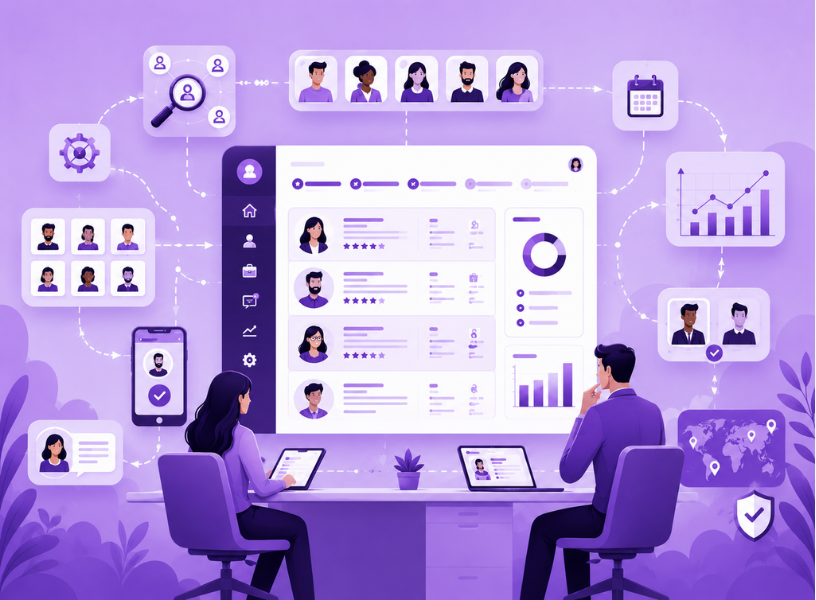
Hiring speed is rarely determined by one recruitment step. It is shaped by the friction between creating a vacancy, finding candidates, screening, interviewing, making decisions and securing acceptance.
For enterprise employers across regions this can be more complex. Recruitment may span countries, languages, workforce segments, approval structures and different operating requirements.
The key point is that talent acquisition software should be evaluated as a friction-reduction system, not simply as an applicant tracking system with more features. The right recruitment technology helps candidates move through the process faster while giving recruiters and hiring managers less administrative work.
Here are nine capabilities HR leaders should assess when evaluating talent acquisition vendors.
Talent acquisition software supports activities such as sourcing, screening, candidate engagement, interviewing, assessment, selection and hiring.
An applicant tracking system is one component. Modern recruiting software can also include workflow automation, skills matching, scheduling, analytics and AI-assisted capabilities.
The right starting question is not, “How many features does this platform have?”
It is: Where are candidates, recruiters or hiring managers currently losing time?
That answer should determine which capabilities matter most.
Workflow automation reduces repetitive recruitment administration without removing necessary human decisions.
Recruiters often spend time moving candidates between stages, requesting approvals, sending communications and coordinating next steps.
Automation can trigger these actions based on defined events, reducing unnecessary waiting.
When evaluating hiring software, assess whether workflow scan be adapted by country, role or business unit, and whether recruiters can override automated actions when needed.
Skills-based matching helps recruiters identify suitable candidates beyond exact job titles or CV keywords.
Skills requirements are changing rapidly. The World Economic Forum's Future of Jobs Report 2025 identifies AI and big data, networks and cyber security, and technological literacy among the fastest-growing skill areas.
The Asian Development Bank has also reported growing demand for digital skills across occupations in Asia and the Pacific.
For employers facing skills shortages, talent acquisition software should help recruiters identify transferable and adjacent skills rather than relying only on conventional keyword searches.
The important question is whether recruiters can understand and challenge the system's recommendations.
Candidate rediscovery can shorten hiring by helping recruiters make better use of existing talent relationships.
Large organisations accumulate candidates through previous applications, talent communities, declined offers and earlier recruitment campaigns.
Useful talent-pool capabilities should allow recruiters to search previous candidates by relevant skills and experience, segment talent pools and re-engage suitable people for new opportunities.
This can be particularly valuable when organisations repeatedly recruit for similar roles or operate in markets with limited specialist talent.
A simpler candidate experience can reduce application friction and prevent avoidable drop-off.
This matters when employers recruit frontline, mobile, remote or geographically distributed workers.
HR leaders should test the actual candidate journey on mobile devices. Look for short application processes, save-and-resume functionality, accessible interfaces, relevant language support and straight forward communication.
The principle is simple: every unnecessary step can become another point where a candidate abandons the process.
Interview scheduling is a practical opportunity to remove administrative delays.
Coordinating candidates, recruiters and interview panels becomes harder when hiring spans countries and time zones.
Recruitment technology should support candidate self-service, interviewer availability, multiple time zones, rescheduling, reminders and calendar integration.
The objective is not sophisticated scheduling for its own sake. It is reducing the time between one hiring decision and the next.
Structured interview workflows help hiring teams make decisions faster and more consistently.
When interview feedback sits across email, spreadsheets and separate systems, recruiters may spend considerable time chasing responses.
A structured workflow can bring assessment criteria, interviewer feedback and decision points together.
Technology should support human judgement rather than attempt to replace it. HR leaders should assess whether interview criteria can be tailored by role, feedback can be captured quickly and decisions remain auditable.
AI can accelerate recruitment when it reduces administration and improves access to candidate information.
Potential applications include drafting job descriptions, summarising candidate information, generating search suggestions and identifying potential matches.
However, speed should not come at the expense of accountability.
When evaluating AI capabilities, ask what data is used, how recommendations are explained, what human review is required and how candidate information is protected.
An AI feature that produces faster but less accountable decisions is not necessarily an improvement.
Recruitment analytics should reveal where hiring slows down, not simply show how many candidates are in the pipeline.
Useful analytics can identify time spent at each hiring stage, interview turnaround, candidate drop-off, offer acceptance, recruiter workload and hiring-manager delays.
For multi-country organisations, reporting should also support meaningful analysis by country, business unit, role and workforce segment.
This distinction matters because slow hiring is not always a technology problem. It may reflect approval processes, manager capacity, sourcing challenges or labour-market conditions.
Enterprise talent acquisition software must accommodate local differences without recreating fragmented processes.
Organisations operating across Asia Pacific, the Middle East and Africa may need different workflows, languages, approval structures and candidate communications.
Evaluate whether technology can support legitimate local variation while maintaining consistent governance and reporting.
Integration is equally important. Recruitment technology should connect effectively with relevant HR, assessment, communication, onboarding and other enterprise systems.
The real test is whether the platform supports the organisation's operating model rather than forcing the organisation to redesign everything around the software.
Avoid evaluating recruiting software through feature checklists alone.
Instead, test each vendor against four questions:
· Speed: Does the capability remove a measurable source of delay?
· Candidate experience: Does it make the hiring journey easier?
· Decision quality: Does it give recruiters and managers better information?
· Control: Can HR govern, audit and adapt the process?
Then ask vendors to demonstrate the technology using real hiring scenarios.
For example, test a high-volume frontline role, a specialist professional role and a cross-border recruitment process. This gives HR leaders a more realistic basis for comparison than a standard product demonstration.
Organisations do not need every capability at the same level of maturity.
Start by mapping the hiring journey and identifying the biggest sources of friction.
If applications are being abandoned, focus on candidate experience.
If recruiters spend too much time searching and screening, examine skills matching and automation.
If vacancies stall after shortlisting, assess scheduling and hiring-manager workflows.
If recruitment spans multiple countries, prioritise configurability, integration, governance and regional reporting.
The goal is to connect technology investment to a measurable recruitment problem.
The strongest talent acquisition software is not necessarily the platform with the longest feature list. It is the technology that removes meaningful friction while preserving human judgement and organisational control.
For enterprise HR leaders across operation across regions, that means looking beyond basic applicant tracking systems and assessing the wider recruitment operating model.
Prioritise the capabilities that address your biggest bottlenecks: workflow automation, skills-based matching, talent rediscovery, mobile candidate experience, scheduling, structured assessment, AI assistance, analytics and regional configurability.
Then measure whether those capabilities actually improve hiring speed and candidate experience.
The immediate step is straight forward: map where candidates and hiring teams currently wait, repeat work or lose information. Use those findings to define the capabilities and evaluation criteria that matter most.

Many people would say that it is absolute madness to keep on doing the same thing, time after time, expecting to get a different result or for something different to happen.
Hoover Dam and the Grand Canyon: Book yourself a seat on any of the many sightseeing tours available and go and watch the architectural marvel that is Hoover Dam built over the Grand canyon which is also a grand sight to see by itself. Black Canyon is another must see as is Lake Mead which is so beautiful just because it is a body of water all surrounded by desert-like nature. Colorado River:
While looking at the Dam and Canyon is from above, to see the true beauty of the river, you have to go down. The Colorado river is excellent for river-rafting and water sports, but you do not have to take part if it is not your thing. Instead just sit back and enjoy another of nature’s marvels.


.webp)
Who can not resist going to one of the old towns like those in the Western gun slinging movies? Your destination needs to be Old Nevada. There you can delight in an old western town right in the middle of Red Rock Canyon. They host western shootouts too so come prepared, partner! I could go on and on about other attractions like the theme park in Circus Circus, the Gilcrease Nature Sanctuary, the Henderson Bird Viewing Preserve and Mt. Charleston but I think you get the picture. In Las Vegas and hate gambling? Do not despair. Just go out and have some clean un-gambling fun.
Hiring speed is rarely determined by one recruitment step. It is shaped by the friction between creating a vacancy, finding candidates, screening, interviewing, making decisions and securing acceptance.
For enterprise employers across regions this can be more complex. Recruitment may span countries, languages, workforce segments, approval structures and different operating requirements.
The key point is that talent acquisition software should be evaluated as a friction-reduction system, not simply as an applicant tracking system with more features. The right recruitment technology helps candidates move through the process faster while giving recruiters and hiring managers less administrative work.
Here are nine capabilities HR leaders should assess when evaluating talent acquisition vendors.
Talent acquisition software supports activities such as sourcing, screening, candidate engagement, interviewing, assessment, selection and hiring.
An applicant tracking system is one component. Modern recruiting software can also include workflow automation, skills matching, scheduling, analytics and AI-assisted capabilities.
The right starting question is not, “How many features does this platform have?”
It is: Where are candidates, recruiters or hiring managers currently losing time?
That answer should determine which capabilities matter most.
Workflow automation reduces repetitive recruitment administration without removing necessary human decisions.
Recruiters often spend time moving candidates between stages, requesting approvals, sending communications and coordinating next steps.
Automation can trigger these actions based on defined events, reducing unnecessary waiting.
When evaluating hiring software, assess whether workflow scan be adapted by country, role or business unit, and whether recruiters can override automated actions when needed.
Skills-based matching helps recruiters identify suitable candidates beyond exact job titles or CV keywords.
Skills requirements are changing rapidly. The World Economic Forum's Future of Jobs Report 2025 identifies AI and big data, networks and cyber security, and technological literacy among the fastest-growing skill areas.
The Asian Development Bank has also reported growing demand for digital skills across occupations in Asia and the Pacific.
For employers facing skills shortages, talent acquisition software should help recruiters identify transferable and adjacent skills rather than relying only on conventional keyword searches.
The important question is whether recruiters can understand and challenge the system's recommendations.
Candidate rediscovery can shorten hiring by helping recruiters make better use of existing talent relationships.
Large organisations accumulate candidates through previous applications, talent communities, declined offers and earlier recruitment campaigns.
Useful talent-pool capabilities should allow recruiters to search previous candidates by relevant skills and experience, segment talent pools and re-engage suitable people for new opportunities.
This can be particularly valuable when organisations repeatedly recruit for similar roles or operate in markets with limited specialist talent.
A simpler candidate experience can reduce application friction and prevent avoidable drop-off.
This matters when employers recruit frontline, mobile, remote or geographically distributed workers.
HR leaders should test the actual candidate journey on mobile devices. Look for short application processes, save-and-resume functionality, accessible interfaces, relevant language support and straight forward communication.
The principle is simple: every unnecessary step can become another point where a candidate abandons the process.
Interview scheduling is a practical opportunity to remove administrative delays.
Coordinating candidates, recruiters and interview panels becomes harder when hiring spans countries and time zones.
Recruitment technology should support candidate self-service, interviewer availability, multiple time zones, rescheduling, reminders and calendar integration.
The objective is not sophisticated scheduling for its own sake. It is reducing the time between one hiring decision and the next.
Structured interview workflows help hiring teams make decisions faster and more consistently.
When interview feedback sits across email, spreadsheets and separate systems, recruiters may spend considerable time chasing responses.
A structured workflow can bring assessment criteria, interviewer feedback and decision points together.
Technology should support human judgement rather than attempt to replace it. HR leaders should assess whether interview criteria can be tailored by role, feedback can be captured quickly and decisions remain auditable.
AI can accelerate recruitment when it reduces administration and improves access to candidate information.
Potential applications include drafting job descriptions, summarising candidate information, generating search suggestions and identifying potential matches.
However, speed should not come at the expense of accountability.
When evaluating AI capabilities, ask what data is used, how recommendations are explained, what human review is required and how candidate information is protected.
An AI feature that produces faster but less accountable decisions is not necessarily an improvement.
Recruitment analytics should reveal where hiring slows down, not simply show how many candidates are in the pipeline.
Useful analytics can identify time spent at each hiring stage, interview turnaround, candidate drop-off, offer acceptance, recruiter workload and hiring-manager delays.
For multi-country organisations, reporting should also support meaningful analysis by country, business unit, role and workforce segment.
This distinction matters because slow hiring is not always a technology problem. It may reflect approval processes, manager capacity, sourcing challenges or labour-market conditions.
Enterprise talent acquisition software must accommodate local differences without recreating fragmented processes.
Organisations operating across Asia Pacific, the Middle East and Africa may need different workflows, languages, approval structures and candidate communications.
Evaluate whether technology can support legitimate local variation while maintaining consistent governance and reporting.
Integration is equally important. Recruitment technology should connect effectively with relevant HR, assessment, communication, onboarding and other enterprise systems.
The real test is whether the platform supports the organisation's operating model rather than forcing the organisation to redesign everything around the software.
Avoid evaluating recruiting software through feature checklists alone.
Instead, test each vendor against four questions:
· Speed: Does the capability remove a measurable source of delay?
· Candidate experience: Does it make the hiring journey easier?
· Decision quality: Does it give recruiters and managers better information?
· Control: Can HR govern, audit and adapt the process?
Then ask vendors to demonstrate the technology using real hiring scenarios.
For example, test a high-volume frontline role, a specialist professional role and a cross-border recruitment process. This gives HR leaders a more realistic basis for comparison than a standard product demonstration.
Organisations do not need every capability at the same level of maturity.
Start by mapping the hiring journey and identifying the biggest sources of friction.
If applications are being abandoned, focus on candidate experience.
If recruiters spend too much time searching and screening, examine skills matching and automation.
If vacancies stall after shortlisting, assess scheduling and hiring-manager workflows.
If recruitment spans multiple countries, prioritise configurability, integration, governance and regional reporting.
The goal is to connect technology investment to a measurable recruitment problem.
The strongest talent acquisition software is not necessarily the platform with the longest feature list. It is the technology that removes meaningful friction while preserving human judgement and organisational control.
For enterprise HR leaders across operation across regions, that means looking beyond basic applicant tracking systems and assessing the wider recruitment operating model.
Prioritise the capabilities that address your biggest bottlenecks: workflow automation, skills-based matching, talent rediscovery, mobile candidate experience, scheduling, structured assessment, AI assistance, analytics and regional configurability.
Then measure whether those capabilities actually improve hiring speed and candidate experience.
The immediate step is straight forward: map where candidates and hiring teams currently wait, repeat work or lose information. Use those findings to define the capabilities and evaluation criteria that matter most.


.webp)


.webp)

Passionately focused on people and fostering relationships for over 25 Years