
Attending a trade show can be a very effective method of promoting your company and its products. And one of the most effective ways to optimize your trade show display and increase traffic to your booth is through the use of banner stands.

Balamani
Author
For HR leaders, choosing payroll software in Malaysia should start with compliance requirements rather than a list of software features.
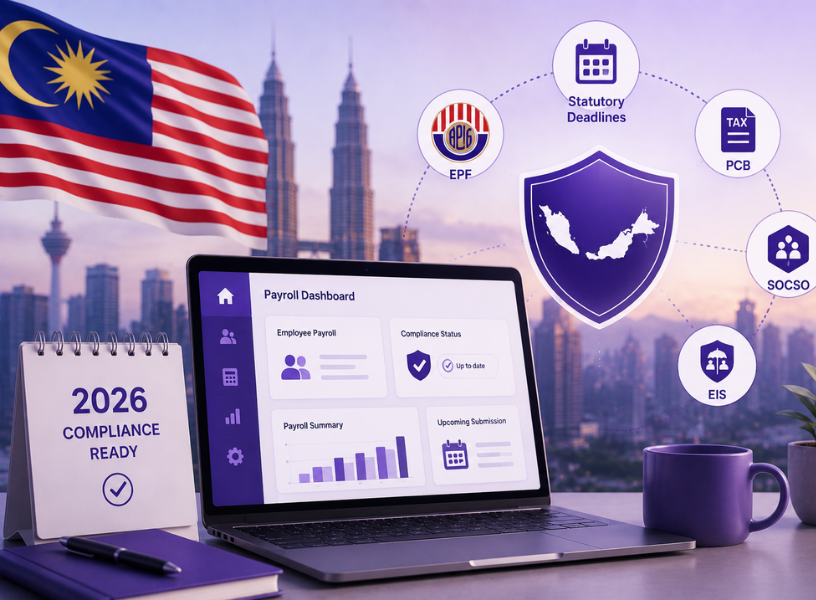
Malaysian payroll involves several statutory processes, including Employees Provident Fund (EPF) contributions, Monthly Tax Deduction (PCB), SOCSO and Employment Insurance System (EIS) contributions. These obligations also have different calculation rules, employee categories and payment deadlines.
In 2026, there is an additional reason to review payroll processes carefully: some requirements have changed or been updated recently. For example, EPF contribution requirements for applicable non-Malaysian citizen employees took effect from October 2025 salary/wage periods, while HASiL has published its 2026 computerised PCB calculation specifications.
For mid-sized and enterprise organisations, the practical question is therefore not simply whether payroll is automated. It is whether the payroll operating model can stay accurate as statutory requirements, employee circumstances and business processes change.
Here are the key compliance areas HR leaders should review before shortlisting Malaysia payroll vendors in 2026.
EPF should be one of the first areas tested when evaluating payroll management software.
Employers are responsible for deducting the employee's share and paying both employee and employer contributions to EPF. Contributions for a particular month's wages must generally be paid by the 15th of the following month.
The important point for software evaluation is that EPF is not simply a matter of applying one percentage to every employee.
The current EPF schedule includes different treatment based on factors such as:
For example, for Malaysian employees below 60, the published schedule provides an 11% employee share, with an employer share of 13% for monthly wages of RM5,000 and below and 12% for wages above RM5,000, subject to the applicable schedule and calculation method.
Payroll teams should also note that EPF says employers generally should not calculate contributions simply by applying the stated percentage to the exact wage amount, except in specified circumstances. The contribution schedule and rounding rules matter.
What to check with vendors: Ask the provider to demonstrate an EPF calculation using several employee profiles rather than showing only a standard payroll run.
This deserves separate attention for enterprises with international or migrant workforces.
EPF states that mandatory contributions for applicable non-Malaysian citizen employees who became EPF members from 1 August 1998 are set at 2% from the employer and 2% from the employee, effective from October 2025 salary/wage periods. Different rules continue to apply to permanent residents and certain employees who were EPF members before 1 August 1998.
This is a useful example of why employee master data matters to payroll compliance.
A payroll system needs to know relevant employee attributes before it can apply the correct statutory treatment.
When assessing payroll solutions for Malaysian businesses, ask whether the system can:
For organisations employing significant numbers of non-Malaysian workers, this should be part of the core payroll demonstration rather than an edge-case test.
Monthly Tax Deduction, or PCB, is another major compliance area.
HASiL states that employers must deduct PCB from employee remuneration and remit the amount by the 15th of the following month. Employers can determine PCB using the computerised payroll calculation method or the relevant electronic PCB schedule and submit information through the prescribed systems.
For 2026, HASiL has published specific computerised PCB calculation specifications, along with TP1 and TP3 forms and related explanatory material. The page was updated on 29 July 2026.
This means payroll buyers should ask vendors how their systems maintain alignment with the current specifications.
Particular attention should be paid to:
HASiL's 2026 calculation outputs demonstrate that payroll calculations can incorporate accumulated remuneration and deductions as well as additional remuneration such as bonuses, arrears and commissions.
Vendor question: How quickly does the system incorporate changes to HASiL's computerised PCB specifications, and how are customers notified and supported when the calculation rules change?
SOCSO and EIS should be assessed together with EPF and PCB rather than treated as secondary payroll functions.
PERKESO publishes contribution schedules for the applicable social security schemes and provides a contribution calculator for employers and employees. Contributions are generally due no later than the 15th day of the following month.
EIS contributions are currently set at 0.4% of the employee's assumed monthly salary, with 0.2% paid by the employer and 0.2% deducted from the employee, subject to the applicable rules and salary ceiling.
The system should therefore be able to distinguish relevant employee categories and apply the correct contribution treatment.
Ask Malaysia payroll vendors to demonstrate:
For enterprises, the ability to update statutory rules without disrupting payroll processing is particularly important.
Workforce composition can make Malaysian payroll more complex.
An enterprise may have Malaysian employees, permanent residents, non-Malaysian employees, employees of different ages and different contractual or compensation arrangements.
PERKESO's current guidance also includes specific provisions for foreign workers, including a non-employment injury protection scheme that began implementation on 1 June 2026. For foreign workers, the contribution structure includes phased rates for this protection.
This illustrates a broader principle: payroll compliance depends on employee attributes and effective dates, not just salary amounts.
HR leaders should therefore check whether their payroll platform has a sufficiently detailed employee data model.
A system that stores only basic salary and department information may not be enough to support increasingly complex statutory requirements.
Payroll data contains highly sensitive employee information, including remuneration, identification details, tax information and statutory contribution records.
Malaysia's Personal Data Protection Act 2010 applies to personal data processing in connection with commercial transactions, with the Personal Data Protection (Amendment) Act 2024 forming part of the current legislative framework.
For HR leaders, payroll security should therefore be considered alongside compliance.
When evaluating HR and payroll software, review:
Also consider internal segregation of duties.
For example, the person who prepares payroll may not need the same permissions as the person who approves payroll or manages employee master data.
Software should support these controls rather than forcing HR teams to manage them through informal processes.
Payroll compliance is easier to manage when HR teams can prove how a result was produced.
Enterprise payroll systems should provide clear records of:
This is particularly important when an organisation has multiple payroll administrators or entities.
Suppose an employee's salary changes in July. The payroll team should be able to identify the effective date, source of the change, approval and resulting impact on statutory deductions.
That is why payroll processing should be evaluated not only for speed but also for traceability.
A system that processes payroll quickly but makes exceptions difficult to investigate may create operational risk.
Perhaps the most important question to ask payroll software vendors in Malaysia is how they handle regulatory change.
A compliance-capable payroll platform needs an ongoing process for:
This matters because 2026 already includes examples of updated requirements and specifications.
EPF's current contribution information reflects rates effective from October 2025 salary/wage periods, while HASiL has published 2026 computerised PCB specifications.
A vendor should be able to explain its change-management process clearly.
Do not accept "the system is compliant" as the end of the discussion.
Ask how compliance is maintained.
For some enterprises, payroll works best as a specialist system integrated with the existing HR environment. For others, an integrated HR and payroll platform can reduce duplication by connecting employee records, attendance, leave, compensation and payroll within a common architecture.
The right choice depends on the organisation's existing technology landscape and operating model.
This is where Adrenalin HCM can be considered as an example of the integrated approach. Its current platform includes MAX Payroll alongside employee management, workforce management, talent, engagement, learning and analytics capabilities. The vendor describes MAX Payroll as supporting payroll processing, multiple pay modes, statutory compliance, an in-built tax estimator, benefits and claims administration and payslip access.
Adrenalin also describes its HR technology platform as providing API integration, workflow automation, reporting and security capabilities across its modules.
For a Malaysian enterprise considering Adrenalin HCM or another integrated platform, the same due-diligence principle applies: validate the actual Malaysian statutory requirements, configuration, update process and integration behaviour before making a decision.
The value of an integrated platform should be assessed in terms of reduced data duplication, connected workflows and stronger visibility, rather than assuming that integration automatically means better compliance.
Before shortlisting providers, HR leaders can use these questions:
A provider that answers these questions clearly is easier to evaluate than one that simply presents a long list of payroll features.
For Malaysian businesses, payroll software in Malaysia should be evaluated against the realities of 2026 payroll administration.
EPF schedules, non-Malaysian employee contributions, PCB specifications, SOCSO, EIS, data protection and statutory reporting all need to work together. More importantly, the system needs to remain maintainable when requirements change.
For HR leaders, the immediate priority should be to map the organisation's employee categories, payroll components and statutory processes. Next, turn those requirements into vendor demonstration scenarios.
Platforms such as Adrenalin HCM illustrate one possible integrated HR-and-payroll model, but the same evaluation discipline should apply to every provider: test local compliance, data flows, auditability, security and regulatory update processes rather than relying on product claims alone.
The best payroll solutions for Malaysian businesses are not simply the ones that produce a payslip quickly. They are the ones that help HR teams maintain accurate, traceable and adaptable payroll processes as workforce structures and statutory requirements evolve.
This article provides general information and should not be treated as legal, tax or regulatory advice. Organisations should validate country-specific requirements with qualified Malaysian advisers and the relevant authorities.
Malaysian businesses should review EPF, PCB, SOCSO and EIS requirements, employee classifications, payment deadlines, payroll records, data protection and the provider's process for implementing statutory changes. In 2026, particular attention should be given to the current EPF contribution schedules and HASiL's computerised PCB specifications. Organisations employing non-Malaysian employees should also verify the contribution rules applicable to their workforce. Requirements should be validated against current official guidance before payroll is processed.
Ask vendors how they maintain EPF, PCB, SOCSO and EIS rules, how quickly statutory changes are incorporated and how updates are tested before deployment. You should also ask for demonstrations involving different employee categories, bonuses, salary changes and non-Malaysian employees where relevant. The vendor should be able to explain its audit trail, reporting, statutory submission process and approach to correcting payroll if a regulatory rule changes.
HRMS integration helps ensure that payroll receives accurate employee information from connected HR processes. Changes to salary, employee status, attendance, leave or compensation can affect payroll and statutory calculations. Without reliable integration, employees' information may need to be entered manually into multiple systems, increasing the risk of discrepancies. Enterprises should therefore assess not just whether an HRMS can integrate with payroll, but whether the data transfer is validated, traceable and auditable.
EPF rules affect payroll software because contribution treatment can vary according to factors such as employee status, age and wage level. EPF's current schedule also includes specific treatment for applicable non-Malaysian citizen employees. Employers must make the applicable contributions by the required deadline and follow the relevant contribution schedule and rounding requirements. Payroll software should therefore maintain accurate employee classifications and apply the appropriate current schedule rather than relying on a single percentage calculation.
An integrated HR and payroll system can be useful when an organisation wants employee records, workforce data, compensation and payroll to operate within a connected environment, but it is not automatically the best option for every business. A standalone payroll system may be appropriate where an existing HRMS is already mature. Enterprises should compare both approaches based on compliance requirements, integration, data quality, security, reporting, implementation effort and total cost of ownership.

Many people would say that it is absolute madness to keep on doing the same thing, time after time, expecting to get a different result or for something different to happen.
Hoover Dam and the Grand Canyon: Book yourself a seat on any of the many sightseeing tours available and go and watch the architectural marvel that is Hoover Dam built over the Grand canyon which is also a grand sight to see by itself. Black Canyon is another must see as is Lake Mead which is so beautiful just because it is a body of water all surrounded by desert-like nature. Colorado River:
While looking at the Dam and Canyon is from above, to see the true beauty of the river, you have to go down. The Colorado river is excellent for river-rafting and water sports, but you do not have to take part if it is not your thing. Instead just sit back and enjoy another of nature’s marvels.


.webp)
Who can not resist going to one of the old towns like those in the Western gun slinging movies? Your destination needs to be Old Nevada. There you can delight in an old western town right in the middle of Red Rock Canyon. They host western shootouts too so come prepared, partner! I could go on and on about other attractions like the theme park in Circus Circus, the Gilcrease Nature Sanctuary, the Henderson Bird Viewing Preserve and Mt. Charleston but I think you get the picture. In Las Vegas and hate gambling? Do not despair. Just go out and have some clean un-gambling fun.
For HR leaders, choosing payroll software in Malaysia should start with compliance requirements rather than a list of software features.
Malaysian payroll involves several statutory processes, including Employees Provident Fund (EPF) contributions, Monthly Tax Deduction (PCB), SOCSO and Employment Insurance System (EIS) contributions. These obligations also have different calculation rules, employee categories and payment deadlines.
In 2026, there is an additional reason to review payroll processes carefully: some requirements have changed or been updated recently. For example, EPF contribution requirements for applicable non-Malaysian citizen employees took effect from October 2025 salary/wage periods, while HASiL has published its 2026 computerised PCB calculation specifications.
For mid-sized and enterprise organisations, the practical question is therefore not simply whether payroll is automated. It is whether the payroll operating model can stay accurate as statutory requirements, employee circumstances and business processes change.
Here are the key compliance areas HR leaders should review before shortlisting Malaysia payroll vendors in 2026.
EPF should be one of the first areas tested when evaluating payroll management software.
Employers are responsible for deducting the employee's share and paying both employee and employer contributions to EPF. Contributions for a particular month's wages must generally be paid by the 15th of the following month.
The important point for software evaluation is that EPF is not simply a matter of applying one percentage to every employee.
The current EPF schedule includes different treatment based on factors such as:
For example, for Malaysian employees below 60, the published schedule provides an 11% employee share, with an employer share of 13% for monthly wages of RM5,000 and below and 12% for wages above RM5,000, subject to the applicable schedule and calculation method.
Payroll teams should also note that EPF says employers generally should not calculate contributions simply by applying the stated percentage to the exact wage amount, except in specified circumstances. The contribution schedule and rounding rules matter.
What to check with vendors: Ask the provider to demonstrate an EPF calculation using several employee profiles rather than showing only a standard payroll run.
This deserves separate attention for enterprises with international or migrant workforces.
EPF states that mandatory contributions for applicable non-Malaysian citizen employees who became EPF members from 1 August 1998 are set at 2% from the employer and 2% from the employee, effective from October 2025 salary/wage periods. Different rules continue to apply to permanent residents and certain employees who were EPF members before 1 August 1998.
This is a useful example of why employee master data matters to payroll compliance.
A payroll system needs to know relevant employee attributes before it can apply the correct statutory treatment.
When assessing payroll solutions for Malaysian businesses, ask whether the system can:
For organisations employing significant numbers of non-Malaysian workers, this should be part of the core payroll demonstration rather than an edge-case test.
Monthly Tax Deduction, or PCB, is another major compliance area.
HASiL states that employers must deduct PCB from employee remuneration and remit the amount by the 15th of the following month. Employers can determine PCB using the computerised payroll calculation method or the relevant electronic PCB schedule and submit information through the prescribed systems.
For 2026, HASiL has published specific computerised PCB calculation specifications, along with TP1 and TP3 forms and related explanatory material. The page was updated on 29 July 2026.
This means payroll buyers should ask vendors how their systems maintain alignment with the current specifications.
Particular attention should be paid to:
HASiL's 2026 calculation outputs demonstrate that payroll calculations can incorporate accumulated remuneration and deductions as well as additional remuneration such as bonuses, arrears and commissions.
Vendor question: How quickly does the system incorporate changes to HASiL's computerised PCB specifications, and how are customers notified and supported when the calculation rules change?
SOCSO and EIS should be assessed together with EPF and PCB rather than treated as secondary payroll functions.
PERKESO publishes contribution schedules for the applicable social security schemes and provides a contribution calculator for employers and employees. Contributions are generally due no later than the 15th day of the following month.
EIS contributions are currently set at 0.4% of the employee's assumed monthly salary, with 0.2% paid by the employer and 0.2% deducted from the employee, subject to the applicable rules and salary ceiling.
The system should therefore be able to distinguish relevant employee categories and apply the correct contribution treatment.
Ask Malaysia payroll vendors to demonstrate:
For enterprises, the ability to update statutory rules without disrupting payroll processing is particularly important.
Workforce composition can make Malaysian payroll more complex.
An enterprise may have Malaysian employees, permanent residents, non-Malaysian employees, employees of different ages and different contractual or compensation arrangements.
PERKESO's current guidance also includes specific provisions for foreign workers, including a non-employment injury protection scheme that began implementation on 1 June 2026. For foreign workers, the contribution structure includes phased rates for this protection.
This illustrates a broader principle: payroll compliance depends on employee attributes and effective dates, not just salary amounts.
HR leaders should therefore check whether their payroll platform has a sufficiently detailed employee data model.
A system that stores only basic salary and department information may not be enough to support increasingly complex statutory requirements.
Payroll data contains highly sensitive employee information, including remuneration, identification details, tax information and statutory contribution records.
Malaysia's Personal Data Protection Act 2010 applies to personal data processing in connection with commercial transactions, with the Personal Data Protection (Amendment) Act 2024 forming part of the current legislative framework.
For HR leaders, payroll security should therefore be considered alongside compliance.
When evaluating HR and payroll software, review:
Also consider internal segregation of duties.
For example, the person who prepares payroll may not need the same permissions as the person who approves payroll or manages employee master data.
Software should support these controls rather than forcing HR teams to manage them through informal processes.
Payroll compliance is easier to manage when HR teams can prove how a result was produced.
Enterprise payroll systems should provide clear records of:
This is particularly important when an organisation has multiple payroll administrators or entities.
Suppose an employee's salary changes in July. The payroll team should be able to identify the effective date, source of the change, approval and resulting impact on statutory deductions.
That is why payroll processing should be evaluated not only for speed but also for traceability.
A system that processes payroll quickly but makes exceptions difficult to investigate may create operational risk.
Perhaps the most important question to ask payroll software vendors in Malaysia is how they handle regulatory change.
A compliance-capable payroll platform needs an ongoing process for:
This matters because 2026 already includes examples of updated requirements and specifications.
EPF's current contribution information reflects rates effective from October 2025 salary/wage periods, while HASiL has published 2026 computerised PCB specifications.
A vendor should be able to explain its change-management process clearly.
Do not accept "the system is compliant" as the end of the discussion.
Ask how compliance is maintained.
For some enterprises, payroll works best as a specialist system integrated with the existing HR environment. For others, an integrated HR and payroll platform can reduce duplication by connecting employee records, attendance, leave, compensation and payroll within a common architecture.
The right choice depends on the organisation's existing technology landscape and operating model.
This is where Adrenalin HCM can be considered as an example of the integrated approach. Its current platform includes MAX Payroll alongside employee management, workforce management, talent, engagement, learning and analytics capabilities. The vendor describes MAX Payroll as supporting payroll processing, multiple pay modes, statutory compliance, an in-built tax estimator, benefits and claims administration and payslip access.
Adrenalin also describes its HR technology platform as providing API integration, workflow automation, reporting and security capabilities across its modules.
For a Malaysian enterprise considering Adrenalin HCM or another integrated platform, the same due-diligence principle applies: validate the actual Malaysian statutory requirements, configuration, update process and integration behaviour before making a decision.
The value of an integrated platform should be assessed in terms of reduced data duplication, connected workflows and stronger visibility, rather than assuming that integration automatically means better compliance.
Before shortlisting providers, HR leaders can use these questions:
A provider that answers these questions clearly is easier to evaluate than one that simply presents a long list of payroll features.
For Malaysian businesses, payroll software in Malaysia should be evaluated against the realities of 2026 payroll administration.
EPF schedules, non-Malaysian employee contributions, PCB specifications, SOCSO, EIS, data protection and statutory reporting all need to work together. More importantly, the system needs to remain maintainable when requirements change.
For HR leaders, the immediate priority should be to map the organisation's employee categories, payroll components and statutory processes. Next, turn those requirements into vendor demonstration scenarios.
Platforms such as Adrenalin HCM illustrate one possible integrated HR-and-payroll model, but the same evaluation discipline should apply to every provider: test local compliance, data flows, auditability, security and regulatory update processes rather than relying on product claims alone.
The best payroll solutions for Malaysian businesses are not simply the ones that produce a payslip quickly. They are the ones that help HR teams maintain accurate, traceable and adaptable payroll processes as workforce structures and statutory requirements evolve.
This article provides general information and should not be treated as legal, tax or regulatory advice. Organisations should validate country-specific requirements with qualified Malaysian advisers and the relevant authorities.
Malaysian businesses should review EPF, PCB, SOCSO and EIS requirements, employee classifications, payment deadlines, payroll records, data protection and the provider's process for implementing statutory changes. In 2026, particular attention should be given to the current EPF contribution schedules and HASiL's computerised PCB specifications. Organisations employing non-Malaysian employees should also verify the contribution rules applicable to their workforce. Requirements should be validated against current official guidance before payroll is processed.
Ask vendors how they maintain EPF, PCB, SOCSO and EIS rules, how quickly statutory changes are incorporated and how updates are tested before deployment. You should also ask for demonstrations involving different employee categories, bonuses, salary changes and non-Malaysian employees where relevant. The vendor should be able to explain its audit trail, reporting, statutory submission process and approach to correcting payroll if a regulatory rule changes.
HRMS integration helps ensure that payroll receives accurate employee information from connected HR processes. Changes to salary, employee status, attendance, leave or compensation can affect payroll and statutory calculations. Without reliable integration, employees' information may need to be entered manually into multiple systems, increasing the risk of discrepancies. Enterprises should therefore assess not just whether an HRMS can integrate with payroll, but whether the data transfer is validated, traceable and auditable.
EPF rules affect payroll software because contribution treatment can vary according to factors such as employee status, age and wage level. EPF's current schedule also includes specific treatment for applicable non-Malaysian citizen employees. Employers must make the applicable contributions by the required deadline and follow the relevant contribution schedule and rounding requirements. Payroll software should therefore maintain accurate employee classifications and apply the appropriate current schedule rather than relying on a single percentage calculation.
An integrated HR and payroll system can be useful when an organisation wants employee records, workforce data, compensation and payroll to operate within a connected environment, but it is not automatically the best option for every business. A standalone payroll system may be appropriate where an existing HRMS is already mature. Enterprises should compare both approaches based on compliance requirements, integration, data quality, security, reporting, implementation effort and total cost of ownership.


.webp)


.webp)

Passionately focused on people and fostering relationships for over 25 Years