
Attending a trade show can be a very effective method of promoting your company and its products. And one of the most effective ways to optimize your trade show display and increase traffic to your booth is through the use of banner stands.

Balamani
Author
India’s new Indian Standard Time rules may sound like a change to the clock. For employers, the implications go much deeper – into attendance, payroll, employee records, digital transactions, cybersecurity and the architecture of enterprise systems.
For most organizations, time has traditionally been treated as an invisible technology setting. Servers have clocks. Attendance devices record punches. HR platforms timestamp approvals. Payroll systems determine cut-offs. Employees see local time on their screens.
If these systems broadly agree, few people think much about the underlying time source.
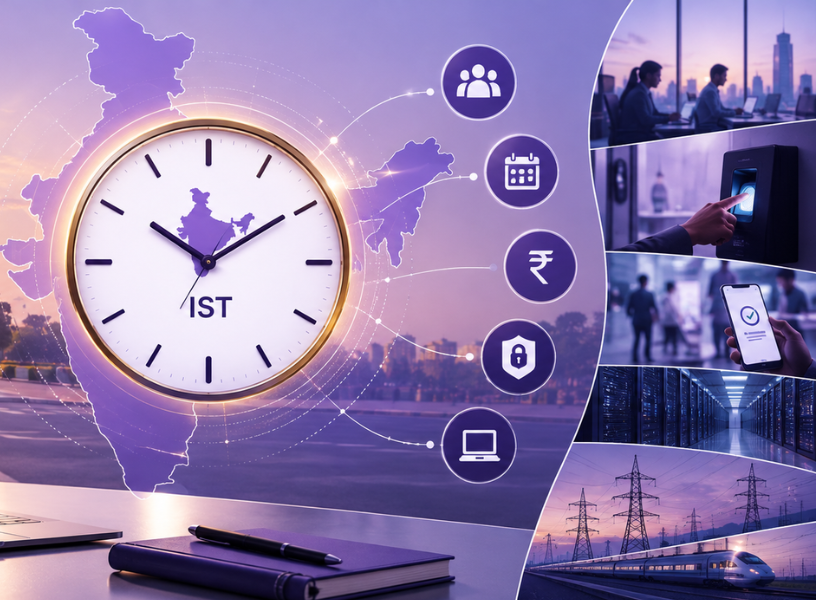
India’s new Legal Metrology (Indian Standard Time) Rules, 2026 could change that.
Notified on 27 August 2026 and published in the Official Gazette on 29 August, the Rules establish Indian Standard Time (IST) as the common, legally recognized and traceable reference for civil, commercial, legal, administrative and other official purposes. They come into force 180 days after Gazette publication, giving government departments, businesses and institutions a transition period to make necessary system changes. Calendar arithmetic places the 180-day point on 25 February 2027, although organizations should follow any subsequent official implementation guidance.
At first glance, this can look like a relatively simple requirement: use IST.
But the more important words in the new framework are arguably accuracy, synchronization and traceability.
That makes the change relevant not only to IT teams, but also to employers, HR leaders, payroll teams, and employees.
India has, of course, used IST for decades. What is changing is the legal and technological infrastructure behind it.
Modern economies increasingly operate on timestamps.
A digital payment has a timestamp. A stock market order has a timestamp. A cybersecurity event has a timestamp. Telecommunications networks, electricity grids, transport systems, data centers and government platforms all depend on machines being able to agree precisely when something happens.
The Government has specifically identified banking and digital payments, telecommunications, power systems, transportation, computer networks, government information systems and critical services as areas where accurate synchronization matters.
There is also a national resilience dimension.
India’s official time is maintained by CSIR-National Physical Laboratory (CSIR-NPL) using an ensemble of atomic clocks and is traceable to Coordinated Universal Time. The national architecture is being expanded through Regional Reference Standards Laboratories, ISRO’s NavIC satellite system, NIC and other authorized timing sources. The intent is to make accurate Indian time available through multiple technologies and locations rather than depending excessively on external timing infrastructure.
The Government has explicitly connected the initiative with time sovereignty, cybersecurity and reducing dependence on foreign sources such as GPS. Risks such as jamming and spoofing have also been highlighted.
In other words, this is not primarily an HR regulation.
It is a digital-infrastructure and national-resilience regulation whose consequences extend into the workplace.
Workforce systems contain far more time-dependent transactions than we often realize.
An employee clocks in at 8:58 a.m. The shift officially starts at 9:00. Overtime starts after a defined number of hours. A leave application is submitted before a cut-off. A manager approves a transaction. Payroll is locked. An offer expires. A resignation is acknowledged. An employee’s last working day is recorded.
Each of these can eventually affect pay, benefits, statutory records, employee entitlements or an employment dispute.
That means time is not simply metadata around an HR transaction. In some circumstances, it is part of the transaction itself.
The Rules make IST the standard reference across sectors including commerce, transport, public administration, legal contracts and financial operations. They also place responsibility on the entity using an authorized time signal for maintaining the accuracy, stability and traceability of time within its own systems, including monitoring deviations and maintaining auditable information.
For HR leaders, that creates several important implications.
Attendance is probably the most obvious intersection between the new rules and HR.
A large employer may capture attendance through biometric terminals, mobile applications, factory access systems, browser-based punches, field-force applications and third-party devices.
These devices do not necessarily obtain time from the same source.
A biometric terminal can drift. A mobile device may use network time. An application server may operate on UTC. An integration layer may apply its own conversion. The HCM platform may then apply business rules for shifts, grace periods, overtime or loss of pay.
Usually, these differences are invisible.
But consider an overnight shift where one system records a punch just before midnight and another one records it just after midnight. Or an overtime calculation where two systems disagree by several minutes.
Once timestamps influence compensation, working hours or statutory records, the ability to demonstrate which clock was authoritative becomes much more important.
The future requirement for workforce technology therefore goes beyond displaying “IST” next to a timestamp. Organizations should be able to understand how attendance devices are synchronized, whether clocks have drifted, how deviations are detected and how the resulting event flows into payroll.
Payroll may not appear to be a timekeeping system, but many payroll outcomes begin with time.
Paid days, overtime, shift premiums, lateness, weekly offs, attendance incentives, and loss-of-pay calculations can all depend on workforce-management data.
This creates an important principle for HR technology:
Payroll calculation is only as defensible as the workforce data feeding it.
If attendance comes from several clocks with different levels of accuracy or synchronization, an organization may end up with technically correct payroll calculations based on inconsistent source data.
Employers should therefore examine the entire chain:
attendance capture → workforce rules → approved time → payroll input → payroll calculation → employee record
The new IST framework provides an opportunity to make that chain more consistent and auditable.
Most enterprise HR applications already record:
Who performed an action, what changed and when it happened.
The new environment raises a further question:
How do we know that “when” is trustworthy?
That suggests a more sophisticated concept of time provenance.
For important HR transactions, organizations may increasingly need to know not just the timestamp, but the system that generated it, its time zone or official reference, its synchronization status and whether that record was subsequently modified.
The Rules explicitly place responsibility on end entities to monitor deviations and maintain auditable data demonstrating traceability to the national time standard.
For HR systems, this could make timestamp integrity an increasingly important component of the broader audit trail.
Although much of the implementation will happen behind the scenes, employees also stand to benefit.
Workplace disputes around attendance, overtime, shift timings, missed punches, payroll cut-offs, or submission deadlines often depend on determining exactly when an event occurred.
A consistent and traceable reference can reduce ambiguity.
An employee and employer should ideally not be looking at three different versions of the same event – one from a biometric terminal, another from an HR application and a third from payroll.
Greater synchronization therefore has the potential to improve not merely compliance but also trust in workforce records.
That does not eliminate disputes or incorrect HR rules. It does, however, create a stronger foundation for establishing the chronology of events.
For global employers, the issue becomes more nuanced.
Enterprise applications often store timestamps internally in UTC and convert them into an employee’s local time zone for display. A global organization may also need employees in India, Singapore, Dubai, London and New York to collaborate using local time.
The Rules contain a broad prohibition on using, displaying or recording time references other than IST, while providing for clearly labelled foreign time zones where permitted by applicable law, orders, directions or guidelines, as well as specific exceptions for areas such as scientific research, navigation and astronomy.
This is one area where employers and HCM providers should watch for detailed implementation guidance.
For example, organizations may need legal and technical clarity on how the Rules apply to backend UTC storage, global SaaS architecture, cross-border workflows, calendar integrations and employee-facing displays of foreign time zones.
It would be premature to assume that every established global software architecture must simply be rewritten. But it would be equally risky to assume that changing the label on an HR screen is sufficient.
The biggest architectural lesson may be to stop treating time as an isolated configuration within each application.
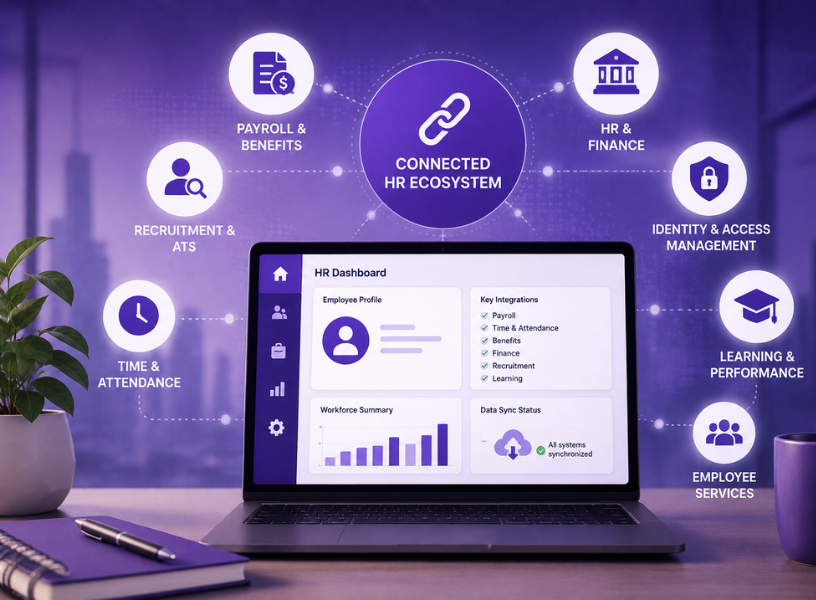
An enterprise workforce ecosystem can include biometric hardware, access-control systems, rostering software, HCM, payroll, mobile applications, ERP, identity platforms and third-party integrations.
If every system independently decides what time it is, organizations create unnecessary inconsistency.
A more resilient model is for these systems to obtain or derive time from an enterprise timing architecture ultimately traceable to an authorized IST source.
The Rules identify sources including CSIR-NPL, Regional Reference Standards Laboratories, NavIC, NIC and other authorized timing providers, and contemplate protocols including Network Time Protocol (NTP) and Precision Time Protocol (PTP). They also require redundancy, cybersecurity measures and contingency planning for disruptions affecting time synchronization.
For HCM vendors, this could translate into stronger capabilities around device synchronization, timestamp standardization across APIs, clock-drift monitoring, auditable time provenance and consistent application of IST across workforce and payroll processes.
Governments and regulators elsewhere already recognize that trustworthy time is essential in high-consequence digital environments.
In the United States, for example, FINRA requires regulated financial firms to synchronize business clocks used for certain reportable activities to a time source linked to the NIST atomic clock. It prescribes tolerance levels, requires checks and re-synchronization, and requires firms to retain clock-synchronization logs.
European financial-market rules similarly require trading venues and participants to synchronize the clocks used for reportable events.
India’s direction is therefore part of a wider recognition that digital trust requires trusted time.
What is noteworthy is the horizontal scope of India’s framework across legal, administrative, commercial and official activity, rather than limiting precise time requirements to a single regulated sector.
The transition period should be treated as an opportunity for discovery before remediation. HR should not attempt to solve this independently; the exercise requires HR, payroll, IT, information security, legal/compliance and technology vendors to work together.
A practical readiness review should cover six questions:
1. Map the systems that generate workforce timestamps. Identify HCM, payroll, attendance devices, mobile applications, access systems, integrations and third-party workforce platforms.
2. Identify their current time sources. Determine which systems use server time, device time, internet NTP, GPS, cloud-provider time or other references.
3. Find where time affects employee outcomes. Prioritize attendance, shifts, overtime, payroll, statutory records, employment documents, approvals and cut-offs.
4. Assess synchronization and drift controls. Establish whether devices and applications can detect discrepancies, re-synchronize automatically and retain evidence of deviations.
5. Review auditability and integrations. Check whether timestamps remain consistent as transactions move between systems and whether the source and history of important events can be reconstructed.
6. Engage technology vendors early. Ask HCM, payroll, workforce-management and device providers how they intend to support authorized IST sources, traceability, redundancy and the final implementation requirements.
Perhaps the most important implication of India’s new IST Rules is conceptual.
For years, organizations have thought about timestamps as something computers generate automatically.
The new framework encourages a different mindset.
Time can be a governed enterprise data point.
It needs a trusted source. It can drift. It can be manipulated. It can affect financial and employment outcomes. And when an event matters, an organization may need to prove that the timestamp associated with it can be trusted.
The Government’s “One Nation, One Time” initiative began with the requirements of increasingly digital critical infrastructure. But as work itself becomes more digital, connected and automated, the same principle inevitably reaches the workplace.
For employers, the question is therefore no longer simple:
“Does our HR system show the correct time?”
A better question for 2027 is:
“Can we trust, trace and defend the time behind every workforce transaction that matters?”
This article is intended as a perspective on the technology and workforce implications of the Legal Metrology (Indian Standard Time) Rules, 2026 and should not be treated as legal advice. Organizations should review the final Rules and subsequent implementation guidance with their legal, compliance and technology teams.

Many people would say that it is absolute madness to keep on doing the same thing, time after time, expecting to get a different result or for something different to happen.
Hoover Dam and the Grand Canyon: Book yourself a seat on any of the many sightseeing tours available and go and watch the architectural marvel that is Hoover Dam built over the Grand canyon which is also a grand sight to see by itself. Black Canyon is another must see as is Lake Mead which is so beautiful just because it is a body of water all surrounded by desert-like nature. Colorado River:
While looking at the Dam and Canyon is from above, to see the true beauty of the river, you have to go down. The Colorado river is excellent for river-rafting and water sports, but you do not have to take part if it is not your thing. Instead just sit back and enjoy another of nature’s marvels.


.webp)
Who can not resist going to one of the old towns like those in the Western gun slinging movies? Your destination needs to be Old Nevada. There you can delight in an old western town right in the middle of Red Rock Canyon. They host western shootouts too so come prepared, partner! I could go on and on about other attractions like the theme park in Circus Circus, the Gilcrease Nature Sanctuary, the Henderson Bird Viewing Preserve and Mt. Charleston but I think you get the picture. In Las Vegas and hate gambling? Do not despair. Just go out and have some clean un-gambling fun.
India’s new Indian Standard Time rules may sound like a change to the clock. For employers, the implications go much deeper – into attendance, payroll, employee records, digital transactions, cybersecurity and the architecture of enterprise systems.
For most organizations, time has traditionally been treated as an invisible technology setting. Servers have clocks. Attendance devices record punches. HR platforms timestamp approvals. Payroll systems determine cut-offs. Employees see local time on their screens.
If these systems broadly agree, few people think much about the underlying time source.
India’s new Legal Metrology (Indian Standard Time) Rules, 2026 could change that.
Notified on 27 August 2026 and published in the Official Gazette on 29 August, the Rules establish Indian Standard Time (IST) as the common, legally recognized and traceable reference for civil, commercial, legal, administrative and other official purposes. They come into force 180 days after Gazette publication, giving government departments, businesses and institutions a transition period to make necessary system changes. Calendar arithmetic places the 180-day point on 25 February 2027, although organizations should follow any subsequent official implementation guidance.
At first glance, this can look like a relatively simple requirement: use IST.
But the more important words in the new framework are arguably accuracy, synchronization and traceability.
That makes the change relevant not only to IT teams, but also to employers, HR leaders, payroll teams, and employees.
India has, of course, used IST for decades. What is changing is the legal and technological infrastructure behind it.
Modern economies increasingly operate on timestamps.
A digital payment has a timestamp. A stock market order has a timestamp. A cybersecurity event has a timestamp. Telecommunications networks, electricity grids, transport systems, data centers and government platforms all depend on machines being able to agree precisely when something happens.
The Government has specifically identified banking and digital payments, telecommunications, power systems, transportation, computer networks, government information systems and critical services as areas where accurate synchronization matters.
There is also a national resilience dimension.
India’s official time is maintained by CSIR-National Physical Laboratory (CSIR-NPL) using an ensemble of atomic clocks and is traceable to Coordinated Universal Time. The national architecture is being expanded through Regional Reference Standards Laboratories, ISRO’s NavIC satellite system, NIC and other authorized timing sources. The intent is to make accurate Indian time available through multiple technologies and locations rather than depending excessively on external timing infrastructure.
The Government has explicitly connected the initiative with time sovereignty, cybersecurity and reducing dependence on foreign sources such as GPS. Risks such as jamming and spoofing have also been highlighted.
In other words, this is not primarily an HR regulation.
It is a digital-infrastructure and national-resilience regulation whose consequences extend into the workplace.
Workforce systems contain far more time-dependent transactions than we often realize.
An employee clocks in at 8:58 a.m. The shift officially starts at 9:00. Overtime starts after a defined number of hours. A leave application is submitted before a cut-off. A manager approves a transaction. Payroll is locked. An offer expires. A resignation is acknowledged. An employee’s last working day is recorded.
Each of these can eventually affect pay, benefits, statutory records, employee entitlements or an employment dispute.
That means time is not simply metadata around an HR transaction. In some circumstances, it is part of the transaction itself.
The Rules make IST the standard reference across sectors including commerce, transport, public administration, legal contracts and financial operations. They also place responsibility on the entity using an authorized time signal for maintaining the accuracy, stability and traceability of time within its own systems, including monitoring deviations and maintaining auditable information.
For HR leaders, that creates several important implications.
Attendance is probably the most obvious intersection between the new rules and HR.
A large employer may capture attendance through biometric terminals, mobile applications, factory access systems, browser-based punches, field-force applications and third-party devices.
These devices do not necessarily obtain time from the same source.
A biometric terminal can drift. A mobile device may use network time. An application server may operate on UTC. An integration layer may apply its own conversion. The HCM platform may then apply business rules for shifts, grace periods, overtime or loss of pay.
Usually, these differences are invisible.
But consider an overnight shift where one system records a punch just before midnight and another one records it just after midnight. Or an overtime calculation where two systems disagree by several minutes.
Once timestamps influence compensation, working hours or statutory records, the ability to demonstrate which clock was authoritative becomes much more important.
The future requirement for workforce technology therefore goes beyond displaying “IST” next to a timestamp. Organizations should be able to understand how attendance devices are synchronized, whether clocks have drifted, how deviations are detected and how the resulting event flows into payroll.
Payroll may not appear to be a timekeeping system, but many payroll outcomes begin with time.
Paid days, overtime, shift premiums, lateness, weekly offs, attendance incentives, and loss-of-pay calculations can all depend on workforce-management data.
This creates an important principle for HR technology:
Payroll calculation is only as defensible as the workforce data feeding it.
If attendance comes from several clocks with different levels of accuracy or synchronization, an organization may end up with technically correct payroll calculations based on inconsistent source data.
Employers should therefore examine the entire chain:
attendance capture → workforce rules → approved time → payroll input → payroll calculation → employee record
The new IST framework provides an opportunity to make that chain more consistent and auditable.
Most enterprise HR applications already record:
Who performed an action, what changed and when it happened.
The new environment raises a further question:
How do we know that “when” is trustworthy?
That suggests a more sophisticated concept of time provenance.
For important HR transactions, organizations may increasingly need to know not just the timestamp, but the system that generated it, its time zone or official reference, its synchronization status and whether that record was subsequently modified.
The Rules explicitly place responsibility on end entities to monitor deviations and maintain auditable data demonstrating traceability to the national time standard.
For HR systems, this could make timestamp integrity an increasingly important component of the broader audit trail.
Although much of the implementation will happen behind the scenes, employees also stand to benefit.
Workplace disputes around attendance, overtime, shift timings, missed punches, payroll cut-offs, or submission deadlines often depend on determining exactly when an event occurred.
A consistent and traceable reference can reduce ambiguity.
An employee and employer should ideally not be looking at three different versions of the same event – one from a biometric terminal, another from an HR application and a third from payroll.
Greater synchronization therefore has the potential to improve not merely compliance but also trust in workforce records.
That does not eliminate disputes or incorrect HR rules. It does, however, create a stronger foundation for establishing the chronology of events.
For global employers, the issue becomes more nuanced.
Enterprise applications often store timestamps internally in UTC and convert them into an employee’s local time zone for display. A global organization may also need employees in India, Singapore, Dubai, London and New York to collaborate using local time.
The Rules contain a broad prohibition on using, displaying or recording time references other than IST, while providing for clearly labelled foreign time zones where permitted by applicable law, orders, directions or guidelines, as well as specific exceptions for areas such as scientific research, navigation and astronomy.
This is one area where employers and HCM providers should watch for detailed implementation guidance.
For example, organizations may need legal and technical clarity on how the Rules apply to backend UTC storage, global SaaS architecture, cross-border workflows, calendar integrations and employee-facing displays of foreign time zones.
It would be premature to assume that every established global software architecture must simply be rewritten. But it would be equally risky to assume that changing the label on an HR screen is sufficient.
The biggest architectural lesson may be to stop treating time as an isolated configuration within each application.
An enterprise workforce ecosystem can include biometric hardware, access-control systems, rostering software, HCM, payroll, mobile applications, ERP, identity platforms and third-party integrations.
If every system independently decides what time it is, organizations create unnecessary inconsistency.
A more resilient model is for these systems to obtain or derive time from an enterprise timing architecture ultimately traceable to an authorized IST source.
The Rules identify sources including CSIR-NPL, Regional Reference Standards Laboratories, NavIC, NIC and other authorized timing providers, and contemplate protocols including Network Time Protocol (NTP) and Precision Time Protocol (PTP). They also require redundancy, cybersecurity measures and contingency planning for disruptions affecting time synchronization.
For HCM vendors, this could translate into stronger capabilities around device synchronization, timestamp standardization across APIs, clock-drift monitoring, auditable time provenance and consistent application of IST across workforce and payroll processes.
Governments and regulators elsewhere already recognize that trustworthy time is essential in high-consequence digital environments.
In the United States, for example, FINRA requires regulated financial firms to synchronize business clocks used for certain reportable activities to a time source linked to the NIST atomic clock. It prescribes tolerance levels, requires checks and re-synchronization, and requires firms to retain clock-synchronization logs.
European financial-market rules similarly require trading venues and participants to synchronize the clocks used for reportable events.
India’s direction is therefore part of a wider recognition that digital trust requires trusted time.
What is noteworthy is the horizontal scope of India’s framework across legal, administrative, commercial and official activity, rather than limiting precise time requirements to a single regulated sector.
The transition period should be treated as an opportunity for discovery before remediation. HR should not attempt to solve this independently; the exercise requires HR, payroll, IT, information security, legal/compliance and technology vendors to work together.
A practical readiness review should cover six questions:
1. Map the systems that generate workforce timestamps. Identify HCM, payroll, attendance devices, mobile applications, access systems, integrations and third-party workforce platforms.
2. Identify their current time sources. Determine which systems use server time, device time, internet NTP, GPS, cloud-provider time or other references.
3. Find where time affects employee outcomes. Prioritize attendance, shifts, overtime, payroll, statutory records, employment documents, approvals and cut-offs.
4. Assess synchronization and drift controls. Establish whether devices and applications can detect discrepancies, re-synchronize automatically and retain evidence of deviations.
5. Review auditability and integrations. Check whether timestamps remain consistent as transactions move between systems and whether the source and history of important events can be reconstructed.
6. Engage technology vendors early. Ask HCM, payroll, workforce-management and device providers how they intend to support authorized IST sources, traceability, redundancy and the final implementation requirements.
Perhaps the most important implication of India’s new IST Rules is conceptual.
For years, organizations have thought about timestamps as something computers generate automatically.
The new framework encourages a different mindset.
Time can be a governed enterprise data point.
It needs a trusted source. It can drift. It can be manipulated. It can affect financial and employment outcomes. And when an event matters, an organization may need to prove that the timestamp associated with it can be trusted.
The Government’s “One Nation, One Time” initiative began with the requirements of increasingly digital critical infrastructure. But as work itself becomes more digital, connected and automated, the same principle inevitably reaches the workplace.
For employers, the question is therefore no longer simple:
“Does our HR system show the correct time?”
A better question for 2027 is:
“Can we trust, trace and defend the time behind every workforce transaction that matters?”
This article is intended as a perspective on the technology and workforce implications of the Legal Metrology (Indian Standard Time) Rules, 2026 and should not be treated as legal advice. Organizations should review the final Rules and subsequent implementation guidance with their legal, compliance and technology teams.


.webp)


.webp)

Passionately focused on people and fostering relationships for over 25 Years