

Attending a trade show can be a very effective method of promoting your company and its products. And one of the most effective ways to optimize your trade show display and increase traffic to your booth is through the use of banner stands.

Balamani
Author
Artificial intelligence is rapidly reshaping how organizations manage their workforce. From accelerating recruitment to delivering personalised learning and workforce insights, AI is becoming a core capability of modern Human Capital Management (HCM) platforms.
However, not every solution marketed as AI-powered HCM software is truly AI-first. Some vendors simply layer AI features onto existing systems, while others have embedded AI across the employee lifecycle to automate processes, support decision-making, and enhance employee experiences.
For enterprise HR leaders evaluating HCM vendors in 2026, the focus should be on understanding how AI creates measurable business value,not just which platform has the most AI features.
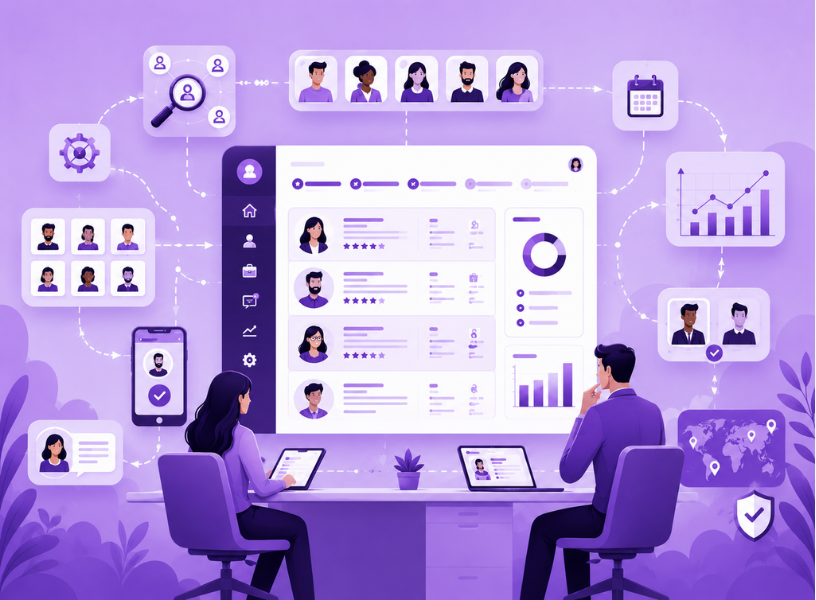
Recruitment remains one of the most impactful applications of AI in HCM.
An AI-powered HCM platform should help recruiters identify, engage, and hire qualified candidates faster by automating repetitive tasks and improving candidate matching.
Look for capabilities such as:
• AI-assisted candidate sourcing
• Resume screening
• Skills-based candidate matching
• Automated interview scheduling
• Intelligent talent pool recommendations
• Candidate engagement automation
Rather than replacing recruiters, AI should enable them to focus on relationship building and strategic hiring decisions.
Questions to ask HCM vendors
• How does the AI rank or recommend candidates?
• Can recruiters review and override AI recommendations?
• Does the platform support skills-based hiring?
Enterprise HR teams generate vast amounts of workforce data, but data alone doesn't drive better decisions.
AI-powered analytics should transform workforce information into actionable insights by identifying trends, predicting workforce risks, and supporting strategic planning.
Look for dashboards that provide insights into:
• Employee turnover risks
• Hiring performance
• Workforce productivity
• Skills availability
• Absenteeism patterns
• Diversity and workforce composition
The goal isn't simply reporting,it is enabling HR leaders to make faster, evidence-based decisions.
Employees increasingly expect HR interactions to be as intuitive as consumer technology.
AI-powered employee self-service can simplify everyday HR tasks through conversational assistants and intelligent automation.
Capabilities may include:
• HR virtual assistants
• Leave balance enquiries
• Payslip access
• Policy search
• Attendance queries
• Payroll FAQs
• Guided HR processes
These tools reduce routine HR enquiries while improving employee satisfaction and accessibility.
Performance management is evolving from annual reviews to continuous development.
Modern AI-first HR software should support managers and employees by identifying growth opportunities throughout the employee lifecycle.
Look for capabilities such as:
• Personalised learning recommendations
• Career path suggestions
• Skills gap analysis
• Succession planning insights
• Goal recommendations
• Internal mobility suggestions
These features help organizations build a more agile workforce while supporting employee development.
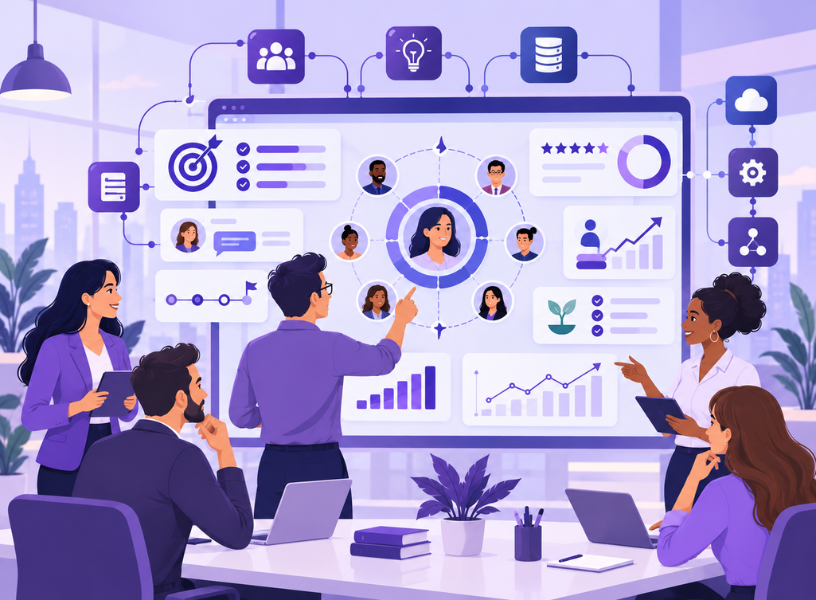
One of the greatest benefits of AI is its ability to automate repetitive HR processes.
An AI-powered HCM platform should streamline tasks including:
• Employee onboarding
• Document generation
• Approval workflows
• Payroll approvals
• Leave administration
• Employee lifecycle notifications
• HR case management
Automation allows HR teams to focus on strategic initiatives rather than manual administration.
• Which HR processes are fully automated?
• Can workflows be customised?
• Does AI recommend workflow improvements over time?
As AI becomes more deeply embedded in HR, governance is becoming just as important as functionality.
Enterprise organizations should understand how AI recommendations are generated and how employee data is protected.
Ask vendors whether the platform provides:
• Transparent AI recommendations
• Human review of AI-generated decisions
• Role-based access controls
• Audit trails
• Data encryption
• Configurable AI governance policies
Responsible AI helps organizations build trust while supporting compliance and ethical decision-making.
Many organizations invest in standalone AI tools only to discover they create disconnected employee data and fragmented HR processes.
A unified AI-powered HCM software platform connects recruitment, onboarding, payroll, performance, learning, workforce analytics, and employee experience within a single ecosystem.
This enables AI to deliver more meaningful insights because it can analyse workforce data across the entire employee lifecycle rather than within isolated systems.
For organizations looking to modernise HR operations, platforms such as Adrenalin AI Native HCM embed AI across talent acquisition, core HR, payroll, performance management, employee engagement, and workforce analytics. Rather than adding AI as a standalone feature, the platform applies AI capabilities throughout the employee lifecycle to improve decision-making, automate routine processes, and deliver a more connected employee experience.
Before selecting an AI-powered HCM platform, ask these questions:
• Is AI embedded across the HCM platform or limited to individual features?
• How transparent are AI recommendations?
• Can HR teams configure AI workflows and business rules?
• How does the platform protect employee data?
• Which HR processes can AI automate?
• Does AI support skills-based hiring and internal mobility?
• How does the platform integrate with our existing HR ecosystem?
• What measurable business outcomes has the AI delivered for customers?
These questions help organizations evaluate AI capabilities based on practical business value rather than marketing claims.
Artificial intelligence is transforming Human Capital Management, but successful adoption depends on choosing technology that aligns with your organization's HR strategy, governance requirements, and workforce goals.
Rather than focusing on standalone AI features, enterprise HR leaders should evaluate how AI improves recruitment, workforce planning, employee experience, talent development, and operational efficiency across the entire employee lifecycle.
By assessing HCM vendors against these seven AI-first capabilities, organizations can invest in a platform that not only supports today's HR priorities but is also equipped to adapt as AI continues to shape the future of work.
AI-powered HCM software uses artificial intelligence to automate HR processes, improve decision-making, deliver workforce insights, and enhance employee experiences across recruitment, payroll, talent management, and workforce planning.
Look for AI capabilities in talent acquisition, workforce analytics, employee self-service, talent management, HR automation, responsible AI governance, and seamless integration across the employee lifecycle.
Traditional HCM software digitises HR processes, while AI-first HR software uses artificial intelligence to automate tasks, generate insights, personalise employee experiences, and support strategic workforce decisions.
Assess how AI is embedded across the platform, the transparency of AI recommendations, workflow automation, analytics, governance controls, integration capabilities, and measurable business outcomes.
A unified platform connects recruitment, core HR, payroll, learning, and performance management, allowing AI to deliver richer insights, reduce data silos, improve operational efficiency, and create a consistent employee experience across the organization.

Many people would say that it is absolute madness to keep on doing the same thing, time after time, expecting to get a different result or for something different to happen.
Hoover Dam and the Grand Canyon: Book yourself a seat on any of the many sightseeing tours available and go and watch the architectural marvel that is Hoover Dam built over the Grand canyon which is also a grand sight to see by itself. Black Canyon is another must see as is Lake Mead which is so beautiful just because it is a body of water all surrounded by desert-like nature. Colorado River:
While looking at the Dam and Canyon is from above, to see the true beauty of the river, you have to go down. The Colorado river is excellent for river-rafting and water sports, but you do not have to take part if it is not your thing. Instead just sit back and enjoy another of nature’s marvels.


.webp)
Who can not resist going to one of the old towns like those in the Western gun slinging movies? Your destination needs to be Old Nevada. There you can delight in an old western town right in the middle of Red Rock Canyon. They host western shootouts too so come prepared, partner! I could go on and on about other attractions like the theme park in Circus Circus, the Gilcrease Nature Sanctuary, the Henderson Bird Viewing Preserve and Mt. Charleston but I think you get the picture. In Las Vegas and hate gambling? Do not despair. Just go out and have some clean un-gambling fun.
Artificial intelligence is rapidly reshaping how organizations manage their workforce. From accelerating recruitment to delivering personalised learning and workforce insights, AI is becoming a core capability of modern Human Capital Management (HCM) platforms.
However, not every solution marketed as AI-powered HCM software is truly AI-first. Some vendors simply layer AI features onto existing systems, while others have embedded AI across the employee lifecycle to automate processes, support decision-making, and enhance employee experiences.
For enterprise HR leaders evaluating HCM vendors in 2026, the focus should be on understanding how AI creates measurable business value,not just which platform has the most AI features.
Recruitment remains one of the most impactful applications of AI in HCM.
An AI-powered HCM platform should help recruiters identify, engage, and hire qualified candidates faster by automating repetitive tasks and improving candidate matching.
Look for capabilities such as:
• AI-assisted candidate sourcing
• Resume screening
• Skills-based candidate matching
• Automated interview scheduling
• Intelligent talent pool recommendations
• Candidate engagement automation
Rather than replacing recruiters, AI should enable them to focus on relationship building and strategic hiring decisions.
Questions to ask HCM vendors
• How does the AI rank or recommend candidates?
• Can recruiters review and override AI recommendations?
• Does the platform support skills-based hiring?
Enterprise HR teams generate vast amounts of workforce data, but data alone doesn't drive better decisions.
AI-powered analytics should transform workforce information into actionable insights by identifying trends, predicting workforce risks, and supporting strategic planning.
Look for dashboards that provide insights into:
• Employee turnover risks
• Hiring performance
• Workforce productivity
• Skills availability
• Absenteeism patterns
• Diversity and workforce composition
The goal isn't simply reporting,it is enabling HR leaders to make faster, evidence-based decisions.
Employees increasingly expect HR interactions to be as intuitive as consumer technology.
AI-powered employee self-service can simplify everyday HR tasks through conversational assistants and intelligent automation.
Capabilities may include:
• HR virtual assistants
• Leave balance enquiries
• Payslip access
• Policy search
• Attendance queries
• Payroll FAQs
• Guided HR processes
These tools reduce routine HR enquiries while improving employee satisfaction and accessibility.
Performance management is evolving from annual reviews to continuous development.
Modern AI-first HR software should support managers and employees by identifying growth opportunities throughout the employee lifecycle.
Look for capabilities such as:
• Personalised learning recommendations
• Career path suggestions
• Skills gap analysis
• Succession planning insights
• Goal recommendations
• Internal mobility suggestions
These features help organizations build a more agile workforce while supporting employee development.
One of the greatest benefits of AI is its ability to automate repetitive HR processes.
An AI-powered HCM platform should streamline tasks including:
• Employee onboarding
• Document generation
• Approval workflows
• Payroll approvals
• Leave administration
• Employee lifecycle notifications
• HR case management
Automation allows HR teams to focus on strategic initiatives rather than manual administration.
• Which HR processes are fully automated?
• Can workflows be customised?
• Does AI recommend workflow improvements over time?
As AI becomes more deeply embedded in HR, governance is becoming just as important as functionality.
Enterprise organizations should understand how AI recommendations are generated and how employee data is protected.
Ask vendors whether the platform provides:
• Transparent AI recommendations
• Human review of AI-generated decisions
• Role-based access controls
• Audit trails
• Data encryption
• Configurable AI governance policies
Responsible AI helps organizations build trust while supporting compliance and ethical decision-making.
Many organizations invest in standalone AI tools only to discover they create disconnected employee data and fragmented HR processes.
A unified AI-powered HCM software platform connects recruitment, onboarding, payroll, performance, learning, workforce analytics, and employee experience within a single ecosystem.
This enables AI to deliver more meaningful insights because it can analyse workforce data across the entire employee lifecycle rather than within isolated systems.
For organizations looking to modernise HR operations, platforms such as Adrenalin AI Native HCM embed AI across talent acquisition, core HR, payroll, performance management, employee engagement, and workforce analytics. Rather than adding AI as a standalone feature, the platform applies AI capabilities throughout the employee lifecycle to improve decision-making, automate routine processes, and deliver a more connected employee experience.
Before selecting an AI-powered HCM platform, ask these questions:
• Is AI embedded across the HCM platform or limited to individual features?
• How transparent are AI recommendations?
• Can HR teams configure AI workflows and business rules?
• How does the platform protect employee data?
• Which HR processes can AI automate?
• Does AI support skills-based hiring and internal mobility?
• How does the platform integrate with our existing HR ecosystem?
• What measurable business outcomes has the AI delivered for customers?
These questions help organizations evaluate AI capabilities based on practical business value rather than marketing claims.
Artificial intelligence is transforming Human Capital Management, but successful adoption depends on choosing technology that aligns with your organization's HR strategy, governance requirements, and workforce goals.
Rather than focusing on standalone AI features, enterprise HR leaders should evaluate how AI improves recruitment, workforce planning, employee experience, talent development, and operational efficiency across the entire employee lifecycle.
By assessing HCM vendors against these seven AI-first capabilities, organizations can invest in a platform that not only supports today's HR priorities but is also equipped to adapt as AI continues to shape the future of work.
AI-powered HCM software uses artificial intelligence to automate HR processes, improve decision-making, deliver workforce insights, and enhance employee experiences across recruitment, payroll, talent management, and workforce planning.
Look for AI capabilities in talent acquisition, workforce analytics, employee self-service, talent management, HR automation, responsible AI governance, and seamless integration across the employee lifecycle.
Traditional HCM software digitises HR processes, while AI-first HR software uses artificial intelligence to automate tasks, generate insights, personalise employee experiences, and support strategic workforce decisions.
Assess how AI is embedded across the platform, the transparency of AI recommendations, workflow automation, analytics, governance controls, integration capabilities, and measurable business outcomes.
A unified platform connects recruitment, core HR, payroll, learning, and performance management, allowing AI to deliver richer insights, reduce data silos, improve operational efficiency, and create a consistent employee experience across the organization.


.webp)


.webp)

Passionately focused on people and fostering relationships for over 25 Years