
Attending a trade show can be a very effective method of promoting your company and its products. And one of the most effective ways to optimize your trade show display and increase traffic to your booth is through the use of banner stands.

Balamani
Author
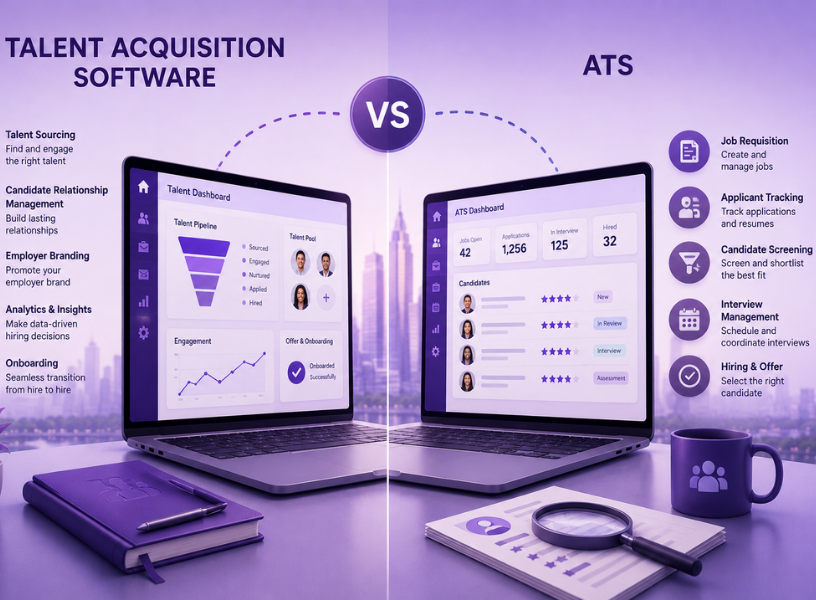
For enterprise hiring teams, the difference between talent acquisition software and an applicant tracking system (ATS) is becoming less straightforward.
An ATS traditionally focuses on managing job requisitions, applications and candidate selection. Broader talent acquisition platforms can extend beyond that core workflow into candidate sourcing, relationship management, engagement, analytics, onboarding and increasingly AI-enabled recruitment capabilities. Gartner's 2026 research describes talent acquisition suites as encompassing capabilities such as applicant tracking, candidate relationship management and onboarding, while noting that vendors differ considerably in feature depth and innovation.
That distinction matters when choosing recruitment technology.
The right question for an enterprise is not simply,
"Do we need an ATS?"
It is:
"How much of our talent acquisition operating model do we need technology to support?"
For organisations hiring across multiple business units, countries, talent segments and hiring volumes, the answer can significantly influence the platform architecture, integrations and long-term cost.
An applicant tracking system primarily manages candidates once they enter the formal hiring workflow. It typically supports requisition management, job posting, applications, screening, interview coordination, selection and related reporting.
Talent acquisition software is a broader category that can include ATS functionality while extending into activities such as candidate sourcing, talent pools, candidate relationship management, employer branding, recruitment marketing, onboarding and advanced analytics.
In practice, the categories increasingly overlap. Gartner's market definition notes that ATSs manage requisition, job posting, application and candidate selection workflows, while candidate relationship management tools focus more on engaging, sourcing and building candidate pipelines before application.
So the distinction is best understood as scope rather than a strict technology boundary.
An ATS primarily focuses on managing the core hiring process, including job requisitions, job postings, application tracking, candidate screening and interview management. It gives recruiters and hiring managers a structured way to move candidates through the selection process. Broader talent acquisition software typically covers these same core capabilities but extends further into candidate sourcing, talent pools and candidate relationship management. This broader approach can help enterprises build talent pipelines and engage candidates before they formally apply. The key difference is therefore the breadth of the hiring lifecycle covered, rather than a completely separate set of technologies.
The first decision criterion is workflow scope.
If your main challenge is organising applications and ensuring recruiters and hiring managers follow a consistent selection process, an ATS may provide the functionality you need.
If the problem begins much earlier, such as building talent pipelines, engaging passive candidates or managing employer-brand interactions, a broader platform may be more appropriate.
Enterprise hiring leaders should map the workflow from:
Workforce demand → requisition → sourcing → engagement → application → screening → interview → selection → offer → onboarding
Then identify which stages require technology support.
This prevents the common mistake of purchasing an ATS to solve a problem that actually exists upstream in sourcing or candidate engagement.
Hiring volume is an important differentiator.
A business recruiting hundreds of employees annually through a relatively standard process may have very different requirements from an enterprise recruiting thousands of employees across corporate, frontline and specialist roles.
Evaluate:
Gartner's current talent acquisition research specifically distinguishes capabilities such as high-volume hiring, core ATS functionality, extended CRM functionality and AI innovation when evaluating talent acquisition suites.
This reinforces an important point: enterprise hiring scale should influence the technology architecture.
This is often where broader talent acquisition software begins to differentiate itself from a traditional ATS.
An ATS generally becomes most valuable after a candidate enters the application process.
Candidate relationship management, by contrast, is designed to help organisations build and maintain relationships before a formal application.
This can include:
If your organisation repeatedly recruits for the same skills, locations or job families, these capabilities can become strategically important.
For example, an enterprise may not want to start from zero every time it opens a technology, engineering or sales vacancy. A maintained talent pipeline can provide a reusable source of potential candidates.
Recruitment technology affects candidates as well as recruiters.
Enterprise organisations should assess the candidate journey from the first interaction through application, interview, offer and onboarding.
Ask:
A technically powerful recruiting system can still create a poor candidate experience if the workflow is complicated or communication is fragmented.
Recruiters are only one group of users.
Enterprise hiring usually involves recruiters, hiring managers, HR business partners, interviewers, candidates and sometimes external agencies.
The platform should make collaboration easier rather than simply centralising candidate records.
Evaluate:
Ask a vendor to demonstrate the process from the hiring manager's perspective.
If managers need to navigate a complex system just to review candidates or submit feedback, adoption may become a problem.
An ATS can provide useful operational metrics such as applications, interviews, offers and time to hire.
Broader talent acquisition software may extend analytics into sourcing effectiveness, candidate pipelines, recruiter productivity, hiring-funnel conversion and workforce planning.
Enterprise leaders should ask whether the platform can answer questions such as:
Analytics become more valuable when recruiting data can be connected with broader HR and workforce information.
Gartner's 2025 research describes recruiting as increasingly connected to workforce needs, labour-market data and future skills requirements rather than simply processing applications.
AI is rapidly changing recruitment technology, but enterprise buyers should evaluate use cases rather than buying based on an AI label.
Potential applications include:
The critical questions are:
What is automated? What data is being used? Who remains accountable for the decision? Can recruiters understand or review the output?
Gartner's 2026 research highlights the growing importance of AI and agentic AI capabilities in talent acquisition suites.
For enterprise organisations, governance should be evaluated alongside functionality. Automated recommendations should not become a substitute for appropriate human oversight, particularly when they influence candidate selection.
Talent acquisition should not become another isolated system.
The platform may need to connect with:
The integration question is particularly important when comparing a standalone ATS with broader hiring software or HCM platforms.
A standalone ATS may offer specialist recruitment capabilities while requiring additional integrations. A broader HCM platform may provide greater continuity between recruitment and the employee lifecycle.
Neither approach is automatically better.
The right choice depends on whether your organisation values specialist recruiting depth, broader process integration, or a combination of both.
One of the biggest strategic differences between standalone applicant tracking systems and broader HCM-oriented talent acquisition software is what happens after the candidate accepts the offer.
A disconnected workflow can require HR teams to move information manually from recruitment into core HR.
A connected platform can potentially carry candidate information into onboarding and employee records, reducing duplicate data entry.
This is one reason enterprise organisations should evaluate recruitment technology as part of the broader employee lifecycle.
For example, Adrenalin HCM positions recruitment within a wider HCM environment through its MAX Recruit application, alongside employee lifecycle capabilities such as onboarding and workforce administration. Its current platform describes recruitment capabilities including candidate microsites, AI resume parsing, candidate ranking, selection and interview workflows and offer generation.
That makes Adrenalin HCM an example of the integrated HCM approach, rather than a reason to assume that every enterprise should choose a suite over a specialist ATS.
Technology selection should include the operating model required to run it.
Ask talent acquisition vendors about:
A specialist ATS may require additional systems to complete the broader hiring journey. A suite may provide broader integration but potentially involve a larger platform implementation.
Enterprise leaders should therefore calculate the cost of the whole recruitment technology architecture, not simply the licence cost of one application.
An ATS may be the better fit when the organisation primarily needs to standardise and control the application and selection process.
It can be appropriate when:
A standalone ATS can also make sense when an enterprise already has a broader HCM platform but wants specialist recruitment functionality.
Broader talent acquisition software may make more sense when recruitment is viewed as a strategic, end-to-end capability.
It may be a stronger fit when the organisation needs:
The decision should be driven by the organisation's hiring model rather than by the terminology used in a vendor's marketing materials.
Before shortlisting providers, score each option against five questions:
Decision areaKey questionWorkflow scopeDo we need application management or end-to-end talent acquisition?Hiring complexityHow many roles, countries, workforce segments and hiring managers must we support?Candidate strategyDo we need to build relationships with candidates before they apply?Technology architectureShould recruitment be specialist, integrated or part of a broader HCM platform?Future requirementsWill AI, skills intelligence, analytics or workforce planning change our needs?
Then ask each provider to demonstrate the same hiring scenarios.
For example:
Scenario 1: Create and approve a requisition.
Scenario 2: Source and engage candidates.
Scenario 3: Screen and shortlist applicants.
Scenario 4: Coordinate interviews and capture structured feedback.
Scenario 5: Make an offer and transition the successful candidate into onboarding.
This approach makes the differences between platforms much easier to see.
The distinction between talent acquisition software and an ATS is becoming less about labels and more about scope.
An ATS remains highly relevant for organisations that need strong control over requisitions, applications and candidate selection. Broader talent acquisition software extends the technology conversation into sourcing, candidate relationships, engagement, analytics, onboarding and increasingly AI.
For enterprise HR leaders, the best choice depends on the hiring operating model.
If your biggest problem is application workflow, start with ATS requirements. If the challenge extends from finding talent through onboarding, evaluate broader talent acquisition capabilities. And if recruitment needs to connect tightly with the employee lifecycle, consider whether an integrated HCM architecture could reduce fragmentation.
Platforms such as Adrenalin HCM demonstrate this latter approach by connecting recruitment with wider HCM capabilities rather than treating hiring as a standalone process.
The practical next step is to map your current hiring journey, identify where technology gaps exist and then evaluate vendors against those specific requirements.
The goal is not to buy the broadest platform.
It is to build a recruitment technology environment that helps your enterprise find, engage, select and onboard talent with less friction and better visibility.
No. An ATS is generally focused on managing requisitions, applications and candidate selection, while broader talent acquisition software can include those capabilities plus sourcing, candidate relationship management, employer branding, analytics and onboarding. The categories increasingly overlap, so enterprises should evaluate the actual capabilities and workflow coverage of each platform rather than relying on the product label used by a vendor.
An enterprise may choose an ATS when its primary requirement is to standardise and automate the application and selection process. This can be appropriate when sourcing is already handled effectively through existing channels and the organisation mainly needs better requisition management, candidate tracking, interview coordination, hiring-manager collaboration and reporting. If the organisation also needs proactive sourcing, talent pools or candidate engagement, broader talent acquisition capabilities may be worth evaluating.
Enterprise HR leaders should evaluate workflow coverage, scalability, candidate experience, sourcing, candidate relationship management, recruiter and hiring-manager collaboration, analytics, integrations, AI capabilities, security, implementation and total cost. The assessment should reflect the organisation's hiring model, including hiring volume, countries, workforce segments and future skills requirements. Vendors should demonstrate realistic hiring scenarios rather than presenting only generic product features.
Yes. An ATS can operate as a standalone application or as part of a broader HCM ecosystem. The advantage of an integrated approach can be stronger continuity between recruiting, onboarding, employee records and other HR processes. Adrenalin HCM, for example, positions MAX Recruit within its wider HCM platform, connecting recruitment capabilities with broader employee lifecycle functionality.
Enterprises should compare talent acquisition vendors using a weighted scorecard based on their hiring priorities. Each vendor should demonstrate the same end-to-end scenarios, from requisition creation and sourcing through selection, offer and onboarding. Evaluation should cover functionality as well as integrations, data governance, AI oversight, implementation, support and total cost of ownership. This produces a more meaningful comparison than comparing feature lists alone.

Many people would say that it is absolute madness to keep on doing the same thing, time after time, expecting to get a different result or for something different to happen.
Hoover Dam and the Grand Canyon: Book yourself a seat on any of the many sightseeing tours available and go and watch the architectural marvel that is Hoover Dam built over the Grand canyon which is also a grand sight to see by itself. Black Canyon is another must see as is Lake Mead which is so beautiful just because it is a body of water all surrounded by desert-like nature. Colorado River:
While looking at the Dam and Canyon is from above, to see the true beauty of the river, you have to go down. The Colorado river is excellent for river-rafting and water sports, but you do not have to take part if it is not your thing. Instead just sit back and enjoy another of nature’s marvels.


.webp)
Who can not resist going to one of the old towns like those in the Western gun slinging movies? Your destination needs to be Old Nevada. There you can delight in an old western town right in the middle of Red Rock Canyon. They host western shootouts too so come prepared, partner! I could go on and on about other attractions like the theme park in Circus Circus, the Gilcrease Nature Sanctuary, the Henderson Bird Viewing Preserve and Mt. Charleston but I think you get the picture. In Las Vegas and hate gambling? Do not despair. Just go out and have some clean un-gambling fun.
For enterprise hiring teams, the difference between talent acquisition software and an applicant tracking system (ATS) is becoming less straightforward.
An ATS traditionally focuses on managing job requisitions, applications and candidate selection. Broader talent acquisition platforms can extend beyond that core workflow into candidate sourcing, relationship management, engagement, analytics, onboarding and increasingly AI-enabled recruitment capabilities. Gartner's 2026 research describes talent acquisition suites as encompassing capabilities such as applicant tracking, candidate relationship management and onboarding, while noting that vendors differ considerably in feature depth and innovation.
That distinction matters when choosing recruitment technology.
The right question for an enterprise is not simply,
"Do we need an ATS?"
It is:
"How much of our talent acquisition operating model do we need technology to support?"
For organisations hiring across multiple business units, countries, talent segments and hiring volumes, the answer can significantly influence the platform architecture, integrations and long-term cost.
An applicant tracking system primarily manages candidates once they enter the formal hiring workflow. It typically supports requisition management, job posting, applications, screening, interview coordination, selection and related reporting.
Talent acquisition software is a broader category that can include ATS functionality while extending into activities such as candidate sourcing, talent pools, candidate relationship management, employer branding, recruitment marketing, onboarding and advanced analytics.
In practice, the categories increasingly overlap. Gartner's market definition notes that ATSs manage requisition, job posting, application and candidate selection workflows, while candidate relationship management tools focus more on engaging, sourcing and building candidate pipelines before application.
So the distinction is best understood as scope rather than a strict technology boundary.
An ATS primarily focuses on managing the core hiring process, including job requisitions, job postings, application tracking, candidate screening and interview management. It gives recruiters and hiring managers a structured way to move candidates through the selection process. Broader talent acquisition software typically covers these same core capabilities but extends further into candidate sourcing, talent pools and candidate relationship management. This broader approach can help enterprises build talent pipelines and engage candidates before they formally apply. The key difference is therefore the breadth of the hiring lifecycle covered, rather than a completely separate set of technologies.
The first decision criterion is workflow scope.
If your main challenge is organising applications and ensuring recruiters and hiring managers follow a consistent selection process, an ATS may provide the functionality you need.
If the problem begins much earlier, such as building talent pipelines, engaging passive candidates or managing employer-brand interactions, a broader platform may be more appropriate.
Enterprise hiring leaders should map the workflow from:
Workforce demand → requisition → sourcing → engagement → application → screening → interview → selection → offer → onboarding
Then identify which stages require technology support.
This prevents the common mistake of purchasing an ATS to solve a problem that actually exists upstream in sourcing or candidate engagement.
Hiring volume is an important differentiator.
A business recruiting hundreds of employees annually through a relatively standard process may have very different requirements from an enterprise recruiting thousands of employees across corporate, frontline and specialist roles.
Evaluate:
Gartner's current talent acquisition research specifically distinguishes capabilities such as high-volume hiring, core ATS functionality, extended CRM functionality and AI innovation when evaluating talent acquisition suites.
This reinforces an important point: enterprise hiring scale should influence the technology architecture.
This is often where broader talent acquisition software begins to differentiate itself from a traditional ATS.
An ATS generally becomes most valuable after a candidate enters the application process.
Candidate relationship management, by contrast, is designed to help organisations build and maintain relationships before a formal application.
This can include:
If your organisation repeatedly recruits for the same skills, locations or job families, these capabilities can become strategically important.
For example, an enterprise may not want to start from zero every time it opens a technology, engineering or sales vacancy. A maintained talent pipeline can provide a reusable source of potential candidates.
Recruitment technology affects candidates as well as recruiters.
Enterprise organisations should assess the candidate journey from the first interaction through application, interview, offer and onboarding.
Ask:
A technically powerful recruiting system can still create a poor candidate experience if the workflow is complicated or communication is fragmented.
Recruiters are only one group of users.
Enterprise hiring usually involves recruiters, hiring managers, HR business partners, interviewers, candidates and sometimes external agencies.
The platform should make collaboration easier rather than simply centralising candidate records.
Evaluate:
Ask a vendor to demonstrate the process from the hiring manager's perspective.
If managers need to navigate a complex system just to review candidates or submit feedback, adoption may become a problem.
An ATS can provide useful operational metrics such as applications, interviews, offers and time to hire.
Broader talent acquisition software may extend analytics into sourcing effectiveness, candidate pipelines, recruiter productivity, hiring-funnel conversion and workforce planning.
Enterprise leaders should ask whether the platform can answer questions such as:
Analytics become more valuable when recruiting data can be connected with broader HR and workforce information.
Gartner's 2025 research describes recruiting as increasingly connected to workforce needs, labour-market data and future skills requirements rather than simply processing applications.
AI is rapidly changing recruitment technology, but enterprise buyers should evaluate use cases rather than buying based on an AI label.
Potential applications include:
The critical questions are:
What is automated? What data is being used? Who remains accountable for the decision? Can recruiters understand or review the output?
Gartner's 2026 research highlights the growing importance of AI and agentic AI capabilities in talent acquisition suites.
For enterprise organisations, governance should be evaluated alongside functionality. Automated recommendations should not become a substitute for appropriate human oversight, particularly when they influence candidate selection.
Talent acquisition should not become another isolated system.
The platform may need to connect with:
The integration question is particularly important when comparing a standalone ATS with broader hiring software or HCM platforms.
A standalone ATS may offer specialist recruitment capabilities while requiring additional integrations. A broader HCM platform may provide greater continuity between recruitment and the employee lifecycle.
Neither approach is automatically better.
The right choice depends on whether your organisation values specialist recruiting depth, broader process integration, or a combination of both.
One of the biggest strategic differences between standalone applicant tracking systems and broader HCM-oriented talent acquisition software is what happens after the candidate accepts the offer.
A disconnected workflow can require HR teams to move information manually from recruitment into core HR.
A connected platform can potentially carry candidate information into onboarding and employee records, reducing duplicate data entry.
This is one reason enterprise organisations should evaluate recruitment technology as part of the broader employee lifecycle.
For example, Adrenalin HCM positions recruitment within a wider HCM environment through its MAX Recruit application, alongside employee lifecycle capabilities such as onboarding and workforce administration. Its current platform describes recruitment capabilities including candidate microsites, AI resume parsing, candidate ranking, selection and interview workflows and offer generation.
That makes Adrenalin HCM an example of the integrated HCM approach, rather than a reason to assume that every enterprise should choose a suite over a specialist ATS.
Technology selection should include the operating model required to run it.
Ask talent acquisition vendors about:
A specialist ATS may require additional systems to complete the broader hiring journey. A suite may provide broader integration but potentially involve a larger platform implementation.
Enterprise leaders should therefore calculate the cost of the whole recruitment technology architecture, not simply the licence cost of one application.
An ATS may be the better fit when the organisation primarily needs to standardise and control the application and selection process.
It can be appropriate when:
A standalone ATS can also make sense when an enterprise already has a broader HCM platform but wants specialist recruitment functionality.
Broader talent acquisition software may make more sense when recruitment is viewed as a strategic, end-to-end capability.
It may be a stronger fit when the organisation needs:
The decision should be driven by the organisation's hiring model rather than by the terminology used in a vendor's marketing materials.
Before shortlisting providers, score each option against five questions:
Decision areaKey questionWorkflow scopeDo we need application management or end-to-end talent acquisition?Hiring complexityHow many roles, countries, workforce segments and hiring managers must we support?Candidate strategyDo we need to build relationships with candidates before they apply?Technology architectureShould recruitment be specialist, integrated or part of a broader HCM platform?Future requirementsWill AI, skills intelligence, analytics or workforce planning change our needs?
Then ask each provider to demonstrate the same hiring scenarios.
For example:
Scenario 1: Create and approve a requisition.
Scenario 2: Source and engage candidates.
Scenario 3: Screen and shortlist applicants.
Scenario 4: Coordinate interviews and capture structured feedback.
Scenario 5: Make an offer and transition the successful candidate into onboarding.
This approach makes the differences between platforms much easier to see.
The distinction between talent acquisition software and an ATS is becoming less about labels and more about scope.
An ATS remains highly relevant for organisations that need strong control over requisitions, applications and candidate selection. Broader talent acquisition software extends the technology conversation into sourcing, candidate relationships, engagement, analytics, onboarding and increasingly AI.
For enterprise HR leaders, the best choice depends on the hiring operating model.
If your biggest problem is application workflow, start with ATS requirements. If the challenge extends from finding talent through onboarding, evaluate broader talent acquisition capabilities. And if recruitment needs to connect tightly with the employee lifecycle, consider whether an integrated HCM architecture could reduce fragmentation.
Platforms such as Adrenalin HCM demonstrate this latter approach by connecting recruitment with wider HCM capabilities rather than treating hiring as a standalone process.
The practical next step is to map your current hiring journey, identify where technology gaps exist and then evaluate vendors against those specific requirements.
The goal is not to buy the broadest platform.
It is to build a recruitment technology environment that helps your enterprise find, engage, select and onboard talent with less friction and better visibility.
No. An ATS is generally focused on managing requisitions, applications and candidate selection, while broader talent acquisition software can include those capabilities plus sourcing, candidate relationship management, employer branding, analytics and onboarding. The categories increasingly overlap, so enterprises should evaluate the actual capabilities and workflow coverage of each platform rather than relying on the product label used by a vendor.
An enterprise may choose an ATS when its primary requirement is to standardise and automate the application and selection process. This can be appropriate when sourcing is already handled effectively through existing channels and the organisation mainly needs better requisition management, candidate tracking, interview coordination, hiring-manager collaboration and reporting. If the organisation also needs proactive sourcing, talent pools or candidate engagement, broader talent acquisition capabilities may be worth evaluating.
Enterprise HR leaders should evaluate workflow coverage, scalability, candidate experience, sourcing, candidate relationship management, recruiter and hiring-manager collaboration, analytics, integrations, AI capabilities, security, implementation and total cost. The assessment should reflect the organisation's hiring model, including hiring volume, countries, workforce segments and future skills requirements. Vendors should demonstrate realistic hiring scenarios rather than presenting only generic product features.
Yes. An ATS can operate as a standalone application or as part of a broader HCM ecosystem. The advantage of an integrated approach can be stronger continuity between recruiting, onboarding, employee records and other HR processes. Adrenalin HCM, for example, positions MAX Recruit within its wider HCM platform, connecting recruitment capabilities with broader employee lifecycle functionality.
Enterprises should compare talent acquisition vendors using a weighted scorecard based on their hiring priorities. Each vendor should demonstrate the same end-to-end scenarios, from requisition creation and sourcing through selection, offer and onboarding. Evaluation should cover functionality as well as integrations, data governance, AI oversight, implementation, support and total cost of ownership. This produces a more meaningful comparison than comparing feature lists alone.


.webp)


.webp)

Passionately focused on people and fostering relationships for over 25 Years