
Attending a trade show can be a very effective method of promoting your company and its products. And one of the most effective ways to optimize your trade show display and increase traffic to your booth is through the use of banner stands.

Balamani
Author
Choosing the right HR platform is no longer just about comparing features. For enterprise organizations, the value of HR software vendors increasingly depends on how well their systems connect with existing applications, exchange data, and support long-term business needs.
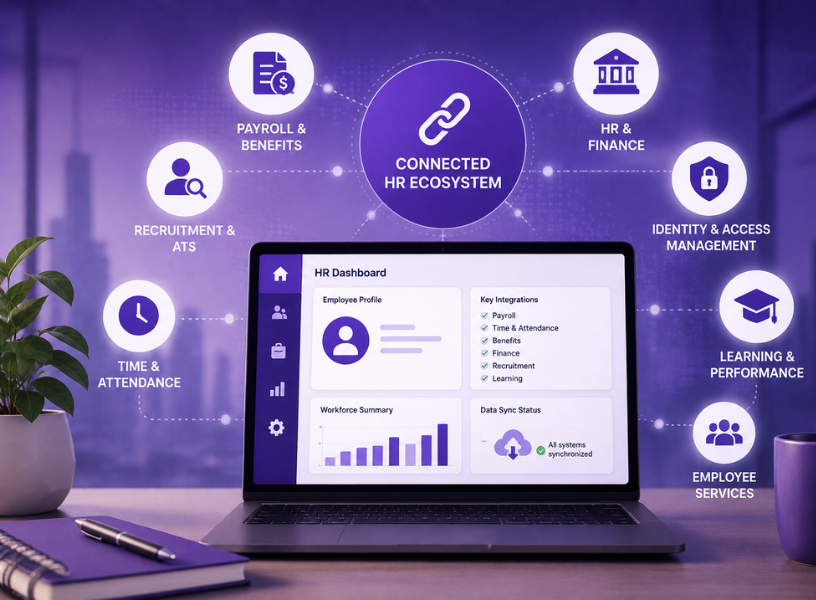
A modern HR environment may include payroll, recruitment, attendance, benefits, finance, learning, performance, and identity management systems. If these platforms cannot communicate effectively, HR teams may end up relying on spreadsheets, duplicate data entry, and manual processes.
When evaluating HRMS vendors, enterprise HR leaders should therefore examine integrations and data standards as carefully as the software's core features.
Here are the key integrations to review before selecting a human resources software provider.
Payroll is one of the most important systems to connect with your HR platform.
Your HR software should be able to exchange employee information, compensation data, deductions, benefits, and other relevant information with payroll systems.
Integration between HR and payroll and benefits software can help reduce duplicate data entry and minimize discrepancies between employee records and payroll calculations.
Ask vendors:
For enterprises operating across multiple countries, also check whether the platform can accommodate different payroll providers and local requirements.
HR and finance teams frequently work with overlapping employee and compensation data.
Integration between HR systems and financial applications can automate the transfer of payroll journals, cost-center information, employee expenses, and workforce-related financial data.
This can improve reconciliation and reduce the need for finance teams to manually re-enter HR information.
When reviewing HR system vendors, ask whether they support your existing finance ecosystem and whether integrations can be configured without extensive custom development.
Recruitment generates valuable employee data before someone even joins the organization.
An integration between the applicant tracking system and HR platform can transfer information such as candidate details, job information, compensation, and joining dates into the employee record.
This can create a smoother transition from candidate to employee and reduce repetitive data entry for HR teams.
If your organization already uses an applicant tracking system, verify whether the vendor offers a native integration or API-based connection.
Attendance data can directly affect payroll, leave balances, overtime, and workforce planning.
Your employee management software should ideally connect with time and attendance systems, including biometric devices, scheduling platforms, and workforce management tools.
Review how the system handles:
Also check whether data is transferred in real time or through scheduled synchronization.
HR systems contain sensitive employee information, so identity management is a critical integration area.
Look for compatibility with enterprise identity and access management tools through standards such as SAML, OAuth, or OpenID Connect.
Single sign-on (SSO) can make access easier for employees while allowing IT teams to manage authentication centrally.
Ask vendors whether user provisioning and deprovisioning can also be automated. This can help ensure that employees receive appropriate access when they join, change roles, or leave the organization.
Learning, performance, and talent data can provide valuable insights when connected with core HR information.
Integration can allow organizations to connect employee profiles with training records, performance outcomes, competencies, career paths, and development plans.
This creates a more complete view of workforce data and can support strategic workforce planning.
When comparing HRMS vendors, check whether integrations support two-way data exchange or simply export information from one system to another.
Benefits administration often involves external providers and specialized platforms.
An HR system should be able to exchange relevant employee eligibility and enrollment information with benefits providers where required.
Integration can reduce manual updates when employees join, leave, change roles, or become eligible for different benefits.
Ask vendors how they handle data validation, synchronization schedules, and failed transactions.
A vendor's integration strategy matters just as much as the number of integrations it advertises.
A platform with well-documented APIs and standardized data structures is generally easier to connect with new applications over time.
Review whether the vendor supports:
Avoid platforms that depend entirely on proprietary connectors if your organization expects its technology ecosystem to evolve.
Integration creates additional data flows, which means governance becomes essential.
Enterprise HR leaders should understand where employee data travels, who can access it, and how it is protected.
Evaluate encryption, access controls, audit logs, data retention, consent management, and monitoring capabilities.
The vendor should also clearly explain how third-party integrations are secured and what happens when an integration fails.
Strong governance is particularly important when HR platforms exchange sensitive employee, payroll, benefits, or identity information.
When shortlisting HR software vendors, enterprise teams can also evaluate integrated HCM platforms such as Adrenalin HCM based on how well they connect HR processes across the employee lifecycle.
Adrenalin HCM brings together areas such as core HR, payroll, attendance, leave, recruitment, performance, and employee services. For organizations assessing an HCM platform, the key consideration should be how effectively these modules and external applications can exchange data while maintaining consistency, security, and governance.
Rather than evaluating integrations solely by quantity, HR leaders should assess whether the platform can support their current technology landscape and adapt as business requirements change.
Integration requirements rarely remain static.
Your organization may adopt a new payroll provider, replace its finance system, introduce a new benefits platform, or expand into another market.
A good HR platform should therefore support future interoperability rather than only today's applications.
Ask vendors:
This helps determine whether the platform can remain useful as your technology environment evolves.
An integration is only valuable if it works reliably.
Before selecting an HR system vendor, understand how integrations are tested, monitored, and supported.
Look for error notifications, integration logs, monitoring dashboards, retry mechanisms, and clear escalation procedures.
Ask whether the vendor provides a sandbox environment for testing integrations before they reach production.
This can be particularly important for payroll, benefits, and identity integrations where incorrect data can have significant consequences.
Before choosing among HRMS vendors, confirm that the platform:
The best human resources software is not necessarily the platform with the longest feature list. For enterprise organizations, long-term value comes from interoperability, reliable data exchange, strong governance, and the ability to adapt as technology requirements evolve.
By evaluating integrations before signing a contract, HR leaders can choose an HR platform that works with their existing ecosystem rather than creating another isolated system.
Integrations allow HR platforms to exchange information with payroll, finance, recruitment, attendance, benefits, and other systems. This reduces manual data entry, improves accuracy, and creates a more connected HR technology environment.
Common integrations include payroll, finance, applicant tracking, attendance, benefits, learning, performance, identity management, and employee communication platforms.
Look for well-documented APIs, secure authentication, standard data formats, versioning, monitoring, usage limits, and clear developer documentation. These capabilities can make future integrations easier.
Every integration creates another pathway through which employee data can move. Organizations should therefore evaluate access controls, encryption, audit logs, data retention, monitoring, and security requirements for every connected system.
Not necessarily. The quality, reliability, security, and flexibility of integrations are more important than simply having a long integration list. Enterprises should prioritize integrations that support their current systems while providing flexibility for future technology changes.

Many people would say that it is absolute madness to keep on doing the same thing, time after time, expecting to get a different result or for something different to happen.
Hoover Dam and the Grand Canyon: Book yourself a seat on any of the many sightseeing tours available and go and watch the architectural marvel that is Hoover Dam built over the Grand canyon which is also a grand sight to see by itself. Black Canyon is another must see as is Lake Mead which is so beautiful just because it is a body of water all surrounded by desert-like nature. Colorado River:
While looking at the Dam and Canyon is from above, to see the true beauty of the river, you have to go down. The Colorado river is excellent for river-rafting and water sports, but you do not have to take part if it is not your thing. Instead just sit back and enjoy another of nature’s marvels.


.webp)
Who can not resist going to one of the old towns like those in the Western gun slinging movies? Your destination needs to be Old Nevada. There you can delight in an old western town right in the middle of Red Rock Canyon. They host western shootouts too so come prepared, partner! I could go on and on about other attractions like the theme park in Circus Circus, the Gilcrease Nature Sanctuary, the Henderson Bird Viewing Preserve and Mt. Charleston but I think you get the picture. In Las Vegas and hate gambling? Do not despair. Just go out and have some clean un-gambling fun.
Choosing the right HR platform is no longer just about comparing features. For enterprise organizations, the value of HR software vendors increasingly depends on how well their systems connect with existing applications, exchange data, and support long-term business needs.
A modern HR environment may include payroll, recruitment, attendance, benefits, finance, learning, performance, and identity management systems. If these platforms cannot communicate effectively, HR teams may end up relying on spreadsheets, duplicate data entry, and manual processes.
When evaluating HRMS vendors, enterprise HR leaders should therefore examine integrations and data standards as carefully as the software's core features.
Here are the key integrations to review before selecting a human resources software provider.
Payroll is one of the most important systems to connect with your HR platform.
Your HR software should be able to exchange employee information, compensation data, deductions, benefits, and other relevant information with payroll systems.
Integration between HR and payroll and benefits software can help reduce duplicate data entry and minimize discrepancies between employee records and payroll calculations.
Ask vendors:
For enterprises operating across multiple countries, also check whether the platform can accommodate different payroll providers and local requirements.
HR and finance teams frequently work with overlapping employee and compensation data.
Integration between HR systems and financial applications can automate the transfer of payroll journals, cost-center information, employee expenses, and workforce-related financial data.
This can improve reconciliation and reduce the need for finance teams to manually re-enter HR information.
When reviewing HR system vendors, ask whether they support your existing finance ecosystem and whether integrations can be configured without extensive custom development.
Recruitment generates valuable employee data before someone even joins the organization.
An integration between the applicant tracking system and HR platform can transfer information such as candidate details, job information, compensation, and joining dates into the employee record.
This can create a smoother transition from candidate to employee and reduce repetitive data entry for HR teams.
If your organization already uses an applicant tracking system, verify whether the vendor offers a native integration or API-based connection.
Attendance data can directly affect payroll, leave balances, overtime, and workforce planning.
Your employee management software should ideally connect with time and attendance systems, including biometric devices, scheduling platforms, and workforce management tools.
Review how the system handles:
Also check whether data is transferred in real time or through scheduled synchronization.
HR systems contain sensitive employee information, so identity management is a critical integration area.
Look for compatibility with enterprise identity and access management tools through standards such as SAML, OAuth, or OpenID Connect.
Single sign-on (SSO) can make access easier for employees while allowing IT teams to manage authentication centrally.
Ask vendors whether user provisioning and deprovisioning can also be automated. This can help ensure that employees receive appropriate access when they join, change roles, or leave the organization.
Learning, performance, and talent data can provide valuable insights when connected with core HR information.
Integration can allow organizations to connect employee profiles with training records, performance outcomes, competencies, career paths, and development plans.
This creates a more complete view of workforce data and can support strategic workforce planning.
When comparing HRMS vendors, check whether integrations support two-way data exchange or simply export information from one system to another.
Benefits administration often involves external providers and specialized platforms.
An HR system should be able to exchange relevant employee eligibility and enrollment information with benefits providers where required.
Integration can reduce manual updates when employees join, leave, change roles, or become eligible for different benefits.
Ask vendors how they handle data validation, synchronization schedules, and failed transactions.
A vendor's integration strategy matters just as much as the number of integrations it advertises.
A platform with well-documented APIs and standardized data structures is generally easier to connect with new applications over time.
Review whether the vendor supports:
Avoid platforms that depend entirely on proprietary connectors if your organization expects its technology ecosystem to evolve.
Integration creates additional data flows, which means governance becomes essential.
Enterprise HR leaders should understand where employee data travels, who can access it, and how it is protected.
Evaluate encryption, access controls, audit logs, data retention, consent management, and monitoring capabilities.
The vendor should also clearly explain how third-party integrations are secured and what happens when an integration fails.
Strong governance is particularly important when HR platforms exchange sensitive employee, payroll, benefits, or identity information.
When shortlisting HR software vendors, enterprise teams can also evaluate integrated HCM platforms such as Adrenalin HCM based on how well they connect HR processes across the employee lifecycle.
Adrenalin HCM brings together areas such as core HR, payroll, attendance, leave, recruitment, performance, and employee services. For organizations assessing an HCM platform, the key consideration should be how effectively these modules and external applications can exchange data while maintaining consistency, security, and governance.
Rather than evaluating integrations solely by quantity, HR leaders should assess whether the platform can support their current technology landscape and adapt as business requirements change.
Integration requirements rarely remain static.
Your organization may adopt a new payroll provider, replace its finance system, introduce a new benefits platform, or expand into another market.
A good HR platform should therefore support future interoperability rather than only today's applications.
Ask vendors:
This helps determine whether the platform can remain useful as your technology environment evolves.
An integration is only valuable if it works reliably.
Before selecting an HR system vendor, understand how integrations are tested, monitored, and supported.
Look for error notifications, integration logs, monitoring dashboards, retry mechanisms, and clear escalation procedures.
Ask whether the vendor provides a sandbox environment for testing integrations before they reach production.
This can be particularly important for payroll, benefits, and identity integrations where incorrect data can have significant consequences.
Before choosing among HRMS vendors, confirm that the platform:
The best human resources software is not necessarily the platform with the longest feature list. For enterprise organizations, long-term value comes from interoperability, reliable data exchange, strong governance, and the ability to adapt as technology requirements evolve.
By evaluating integrations before signing a contract, HR leaders can choose an HR platform that works with their existing ecosystem rather than creating another isolated system.
Integrations allow HR platforms to exchange information with payroll, finance, recruitment, attendance, benefits, and other systems. This reduces manual data entry, improves accuracy, and creates a more connected HR technology environment.
Common integrations include payroll, finance, applicant tracking, attendance, benefits, learning, performance, identity management, and employee communication platforms.
Look for well-documented APIs, secure authentication, standard data formats, versioning, monitoring, usage limits, and clear developer documentation. These capabilities can make future integrations easier.
Every integration creates another pathway through which employee data can move. Organizations should therefore evaluate access controls, encryption, audit logs, data retention, monitoring, and security requirements for every connected system.
Not necessarily. The quality, reliability, security, and flexibility of integrations are more important than simply having a long integration list. Enterprises should prioritize integrations that support their current systems while providing flexibility for future technology changes.


.webp)

.webp)

Passionately focused on people and fostering relationships for over 25 Years