
Attending a trade show can be a very effective method of promoting your company and its products. And one of the most effective ways to optimize your trade show display and increase traffic to your booth is through the use of banner stands.

Balamani
Author
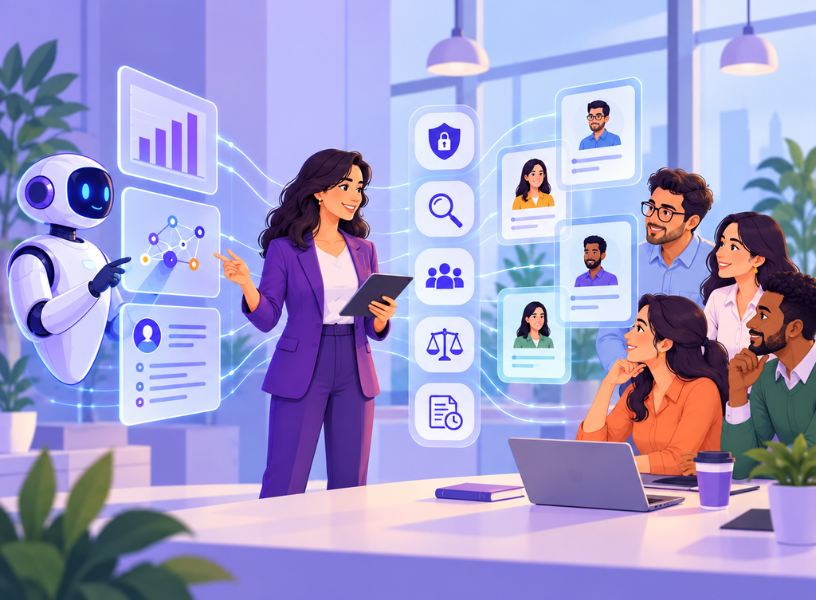
Artificial intelligence is no longer a peripheral experiment in Human Resources; it is rapidly becoming the operational backbone of how organizations attract, assess, and hire talent. Yet, as CHROs navigate a crowded landscape of AI tools, one question consistently lingers: Where should we start?
The answer is recruiting. Not because it's the simplest HR function, but because it's where the case for AI agents is clearest, the inefficiencies most visible, and the ROI most measurable.
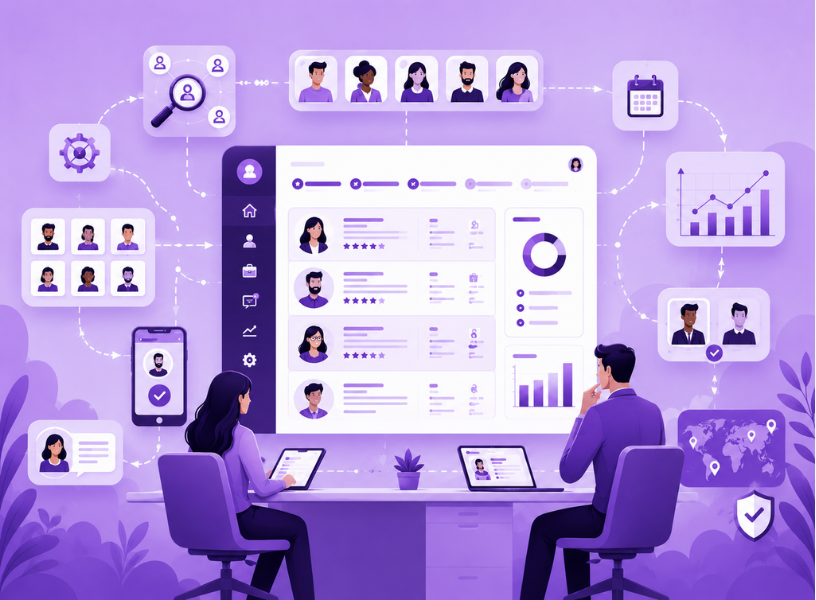
Recruiting is a high-volume, process-intensive, and data-rich process, which is exactly where AI agents thrive. Every open role generates a cascade of repeatable activity: job postings, applications, screening, interview scheduling, and offer management. Unlike complex HR functions where ambiguity prevails, recruiting offers well-defined inputs and outputs that create the perfect substrate for intelligent automation.
Traditional recruiting is burdened with inefficiencies that silently erode organizational performance. Consider the scale of the problem:
These are not small inefficiencies; they are structural gaps that cost organizations talent, time, and competitive positioning. AI agents are purpose-built to close them.
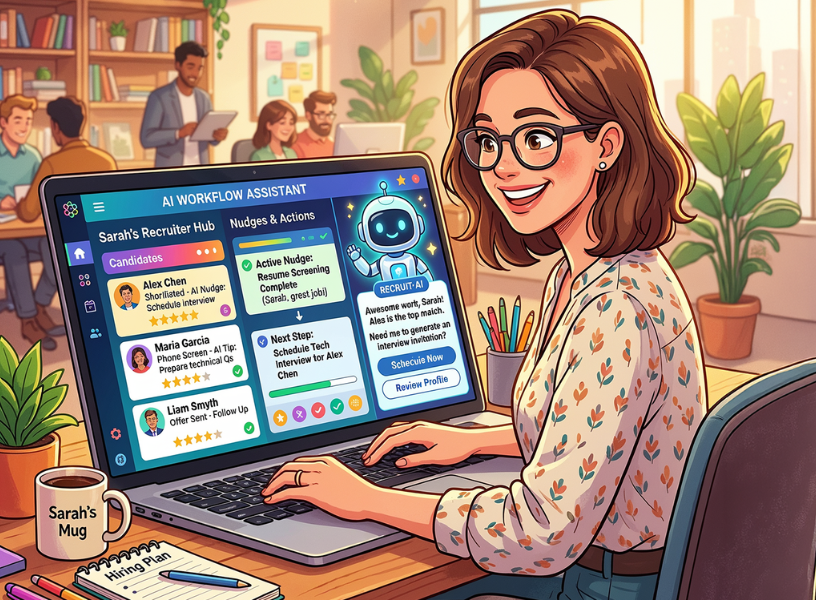
AI agents are intelligent, context-aware systems capable of reasoning and taking multi-step actions across the recruiting workflow:
For senior HR leaders, the value proposition of AI agents in recruiting extends well beyond operational efficiency. The strategic gains are substantial:
Speed as a talent advantage: In high-demand talent markets, the organization that moves fastest wins. AI agents significantly reduce time-to-hire with leading adopters reporting reductions of 30–50%, giving HR a direct competitive edge.
Scalability without proportional headcount: Whether managing 50 open roles or 5,000, AI agents scale instantly. This is particularly critical during periods of rapid growth or high attrition, where recruiting teams are stretched thin.
Better decisions, not just faster ones: AI agents surface signals that human reviewers miss. Pattern recognition across hundreds of variables, enabling hiring managers to make more consistent, evidence-based decisions.
The AI-enabled recruiting function of tomorrow will look radically different from today's. We are moving towards a world where AI agents proactively identify skill gaps before roles are formally opened, autonomously build talent pipelines for anticipated needs, and generate real-time labour market intelligence to inform workforce strategy.
Critically, this evolution is not about removing humans from the equation. The most effective AI-augmented recruiting models are ones where AI agents handle the high-volume, time-sensitive, and process-driven tasks, freeing recruiters to invest their energy in relationship-building, culture assessment, and the nuanced human judgment that no algorithm can replicate. AI raises the ceiling for what a recruiting team can accomplish; it doesn't lower the floor of what humans contribute.
Platforms like Adrenalin are built with this future in mind. Designing HCM infrastructure where AI agents are native to the workflow, not bolted on as afterthoughts. The integration of intelligent automation directly into the talent acquisition lifecycle means HR teams don't need to stitch together disparate tools; the intelligence is embedded in the system from the start.
For CHROs evaluating where to begin their AI journey, recruiting is not just a logical starting point; it is the highest-return one. The organizations winning the talent wars of the next decade are already making this move: deploying AI agents not to replace the human art of hiring, but to ensure their recruiters have the time, data, and insight to practice it at the highest level.
The question is no longer whether AI is required in recruiting. The question is how quickly your organization can make it work.

Many people would say that it is absolute madness to keep on doing the same thing, time after time, expecting to get a different result or for something different to happen.
Hoover Dam and the Grand Canyon: Book yourself a seat on any of the many sightseeing tours available and go and watch the architectural marvel that is Hoover Dam built over the Grand canyon which is also a grand sight to see by itself. Black Canyon is another must see as is Lake Mead which is so beautiful just because it is a body of water all surrounded by desert-like nature. Colorado River:
While looking at the Dam and Canyon is from above, to see the true beauty of the river, you have to go down. The Colorado river is excellent for river-rafting and water sports, but you do not have to take part if it is not your thing. Instead just sit back and enjoy another of nature’s marvels.


.webp)
Who can not resist going to one of the old towns like those in the Western gun slinging movies? Your destination needs to be Old Nevada. There you can delight in an old western town right in the middle of Red Rock Canyon. They host western shootouts too so come prepared, partner! I could go on and on about other attractions like the theme park in Circus Circus, the Gilcrease Nature Sanctuary, the Henderson Bird Viewing Preserve and Mt. Charleston but I think you get the picture. In Las Vegas and hate gambling? Do not despair. Just go out and have some clean un-gambling fun.
Artificial intelligence is no longer a peripheral experiment in Human Resources; it is rapidly becoming the operational backbone of how organizations attract, assess, and hire talent. Yet, as CHROs navigate a crowded landscape of AI tools, one question consistently lingers: Where should we start?
The answer is recruiting. Not because it's the simplest HR function, but because it's where the case for AI agents is clearest, the inefficiencies most visible, and the ROI most measurable.
Recruiting is a high-volume, process-intensive, and data-rich process, which is exactly where AI agents thrive. Every open role generates a cascade of repeatable activity: job postings, applications, screening, interview scheduling, and offer management. Unlike complex HR functions where ambiguity prevails, recruiting offers well-defined inputs and outputs that create the perfect substrate for intelligent automation.
Traditional recruiting is burdened with inefficiencies that silently erode organizational performance. Consider the scale of the problem:
These are not small inefficiencies; they are structural gaps that cost organizations talent, time, and competitive positioning. AI agents are purpose-built to close them.
AI agents are intelligent, context-aware systems capable of reasoning and taking multi-step actions across the recruiting workflow:
For senior HR leaders, the value proposition of AI agents in recruiting extends well beyond operational efficiency. The strategic gains are substantial:
Speed as a talent advantage: In high-demand talent markets, the organization that moves fastest wins. AI agents significantly reduce time-to-hire with leading adopters reporting reductions of 30–50%, giving HR a direct competitive edge.
Scalability without proportional headcount: Whether managing 50 open roles or 5,000, AI agents scale instantly. This is particularly critical during periods of rapid growth or high attrition, where recruiting teams are stretched thin.
Better decisions, not just faster ones: AI agents surface signals that human reviewers miss. Pattern recognition across hundreds of variables, enabling hiring managers to make more consistent, evidence-based decisions.
The AI-enabled recruiting function of tomorrow will look radically different from today's. We are moving towards a world where AI agents proactively identify skill gaps before roles are formally opened, autonomously build talent pipelines for anticipated needs, and generate real-time labour market intelligence to inform workforce strategy.
Critically, this evolution is not about removing humans from the equation. The most effective AI-augmented recruiting models are ones where AI agents handle the high-volume, time-sensitive, and process-driven tasks, freeing recruiters to invest their energy in relationship-building, culture assessment, and the nuanced human judgment that no algorithm can replicate. AI raises the ceiling for what a recruiting team can accomplish; it doesn't lower the floor of what humans contribute.
Platforms like Adrenalin are built with this future in mind. Designing HCM infrastructure where AI agents are native to the workflow, not bolted on as afterthoughts. The integration of intelligent automation directly into the talent acquisition lifecycle means HR teams don't need to stitch together disparate tools; the intelligence is embedded in the system from the start.
For CHROs evaluating where to begin their AI journey, recruiting is not just a logical starting point; it is the highest-return one. The organizations winning the talent wars of the next decade are already making this move: deploying AI agents not to replace the human art of hiring, but to ensure their recruiters have the time, data, and insight to practice it at the highest level.
The question is no longer whether AI is required in recruiting. The question is how quickly your organization can make it work.


.webp)


.webp)

Passionately focused on people and fostering relationships for over 25 Years