
Attending a trade show can be a very effective method of promoting your company and its products. And one of the most effective ways to optimize your trade show display and increase traffic to your booth is through the use of banner stands.

Balamani
Author
Hybrid work in Malaysia has moved well past "pandemic-era perk" status. In 2022, the Malaysian Parliament passed the Employment (Amendment) Act 2022, inserting two entirely new provisions (Sections 60P and 60Q) into the Employment Act 1955, formally recognising flexible working arrangements in Malaysian labour law for the first time. The amendment took effect on 1 January 2023: employees gained a statutory right to submit a written request for flexible working hours, days, or location, and employers took on a corresponding legal duty to respond in writing within 60 days, stating clear grounds if a request is declined (Human Resources Online, 2025).
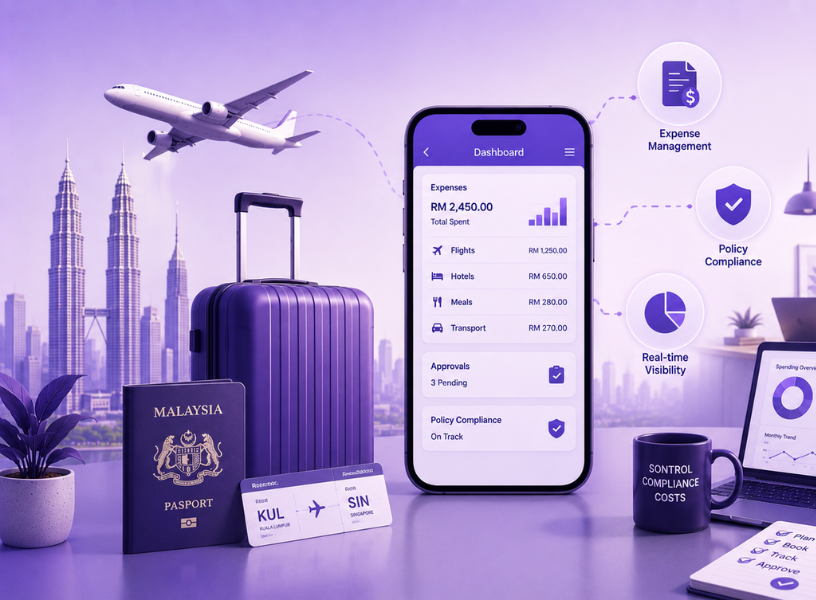
That's good news for work-life balance. But it quietly complicates something HR and finance teams rarely plan for: travel and expense (T&E) management. When "the office" is no longer a fixed place, every assumption baked into the old T&E policy - commute reimbursements, per diems, client-visit claims, inter-office travel - needs a second look.
It's tempting to assume hybrid work means less travel and fewer expense claims. In practice, it's messier than that. Employees now travel between home, office, and client sites, and sometimes other states for the occasional all-hands or collaboration day - journeys that don't fit neatly into a policy written for a five-day office commute. Approval chains get more complicated too, since the manager signing off on a claim may themselves be working from a different location that day.
Layered on top of this is a cost problem that predates hybrid work but gets worse with it: manual expense processing. Industry research from the Global Business Travel Association puts the average cost of manually processing a single expense report at around $58, with employees spending roughly 20 minutes per report and close to one in five reports containing an error that costs additional time and money to fix (GBTA). Multiply that across a distributed, hybrid workforce submitting claims irregularly instead of on a predictable weekly rhythm, and the administrative drag compounds fast.
Malaysia adds one more layer worth flagging: LHDN's e-Invoicing mandate under the MyInvois system, which is being rolled out in phases by business turnover and directly touches how expense claims and supporting documentation should be captured (ClearTax Malaysia, 2026). Under LHDN's own e-Invoice Specific Guideline, any single transaction above RM10,000 has required an individual e-Invoice rather than a consolidated one since 1 January 2026, a detail that matters for larger travel or client-entertainment claims (LHDN e-Invoice Specific Guideline). Expense processes built for paper receipts and PDF scans need to catch up.
Mobile receipt capture at the point of spend, rather than a shoebox of receipts submitted weeks later, cuts errors and speeds up reimbursement - especially important when employees aren't walking past a finance desk on their way out.
A single blanket travel policy no longer fits a workforce split across home, office, and client sites. Define clearly what's claimable for occasional in-office days, inter-city collaboration trips, and client visits from a home base.
Update expense policies so employees know what documentation to submit for larger transactions, and make sure claims data is structured well enough to support MyInvois requirements when needed.
Route approvals digitally with clear escalation rules, so a manager working from home isn't a bottleneck for a claim sitting in someone's inbox.
Centralised, digital claims data makes it far easier to catch policy leakage, delayed submissions, or recurring bottlenecks than a spreadsheet ever could.
Spreadsheets and email approvals can just about handle a fixed, office-based team. They tend to buckle under a hybrid one, where travel is unpredictable, and approvers aren't all in the same building.
This is precisely the gap Adrenalin's MAX Workforce module is built to close. It handles planned and unplanned travel for local and global employees against configurable travel policies, approval hierarchies, eligibility rules, exceptions, and currencies - paired with a claims and reimbursements workflow that lets employees track requests end-to-end while HR approves and processes them straight into payroll, cutting turnaround time. Being mobile-first, it lets employees raise a travel request or snap a receipt from wherever they're working that day. Adrenalin brings the multi-jurisdiction compliance depth that a market like Malaysia, with its evolving e-Invoicing and flexible-work rules, genuinely needs.
Malaysia's hybrid workforce isn't a temporary phase to wait out - it's now a legally recognised, rapidly growing way of working. Travel and expense management that assumes everyone commutes to the same office five days a week is already out of step with that reality. The organisations that update their T&E processes now - digitising capture, building flexible policies, and staying ahead of compliance changes like e-Invoicing - won't just avoid friction. They'll give their hybrid employees one less reason to dread the admin side of doing their jobs well.
T&E management covers how organisations plan, approve, and reimburse employee travel and business-related spending. For hybrid teams, it matters more than ever because travel patterns are less predictable - employees move between home, office, and client sites - which makes rigid, one-size-fits-all policies and manual processing far more error-prone and slow.
Malaysia's e-Invoicing rollout requires businesses, based on turnover-linked phases, to submit structured invoices through the MyInvois system, and from 1 January 2026, any single transaction above RM10,000 needs an individual e-Invoice rather than a consolidated one. This means expense claims involving larger transactions need documentation that meets e-Invoicing requirements
Not exactly. Under Sections 60P and 60Q of the Employment Act 1955 (Amendment 2022), employees have the right to formally request flexible work arrangements, and employers must respond in writing within 60 days with valid reasons if declining - but approval itself isn't mandatory, it depends on operational feasibility (Human Resources Online, 2025).
Industry data suggests manually processing a single expense report costs around $58 and takes about 20 minutes per report, with close to one in five reports containing errors that require additional time and money to fix For companies processing hundreds of claims a month, that adds up quickly.
A hybrid-ready T&E policy should clearly define what's claimable for occasional office days, inter-city travel, and client visits from a home base; support mobile, at-source receipt capture; route approvals digitally regardless of manager location; and stay aligned with local compliance requirements such as e-Invoicing documentation standards.

Many people would say that it is absolute madness to keep on doing the same thing, time after time, expecting to get a different result or for something different to happen.
Hoover Dam and the Grand Canyon: Book yourself a seat on any of the many sightseeing tours available and go and watch the architectural marvel that is Hoover Dam built over the Grand canyon which is also a grand sight to see by itself. Black Canyon is another must see as is Lake Mead which is so beautiful just because it is a body of water all surrounded by desert-like nature. Colorado River:
While looking at the Dam and Canyon is from above, to see the true beauty of the river, you have to go down. The Colorado river is excellent for river-rafting and water sports, but you do not have to take part if it is not your thing. Instead just sit back and enjoy another of nature’s marvels.


.webp)
Who can not resist going to one of the old towns like those in the Western gun slinging movies? Your destination needs to be Old Nevada. There you can delight in an old western town right in the middle of Red Rock Canyon. They host western shootouts too so come prepared, partner! I could go on and on about other attractions like the theme park in Circus Circus, the Gilcrease Nature Sanctuary, the Henderson Bird Viewing Preserve and Mt. Charleston but I think you get the picture. In Las Vegas and hate gambling? Do not despair. Just go out and have some clean un-gambling fun.
Hybrid work in Malaysia has moved well past "pandemic-era perk" status. In 2022, the Malaysian Parliament passed the Employment (Amendment) Act 2022, inserting two entirely new provisions (Sections 60P and 60Q) into the Employment Act 1955, formally recognising flexible working arrangements in Malaysian labour law for the first time. The amendment took effect on 1 January 2023: employees gained a statutory right to submit a written request for flexible working hours, days, or location, and employers took on a corresponding legal duty to respond in writing within 60 days, stating clear grounds if a request is declined (Human Resources Online, 2025).
That's good news for work-life balance. But it quietly complicates something HR and finance teams rarely plan for: travel and expense (T&E) management. When "the office" is no longer a fixed place, every assumption baked into the old T&E policy - commute reimbursements, per diems, client-visit claims, inter-office travel - needs a second look.
It's tempting to assume hybrid work means less travel and fewer expense claims. In practice, it's messier than that. Employees now travel between home, office, and client sites, and sometimes other states for the occasional all-hands or collaboration day - journeys that don't fit neatly into a policy written for a five-day office commute. Approval chains get more complicated too, since the manager signing off on a claim may themselves be working from a different location that day.
Layered on top of this is a cost problem that predates hybrid work but gets worse with it: manual expense processing. Industry research from the Global Business Travel Association puts the average cost of manually processing a single expense report at around $58, with employees spending roughly 20 minutes per report and close to one in five reports containing an error that costs additional time and money to fix (GBTA). Multiply that across a distributed, hybrid workforce submitting claims irregularly instead of on a predictable weekly rhythm, and the administrative drag compounds fast.
Malaysia adds one more layer worth flagging: LHDN's e-Invoicing mandate under the MyInvois system, which is being rolled out in phases by business turnover and directly touches how expense claims and supporting documentation should be captured (ClearTax Malaysia, 2026). Under LHDN's own e-Invoice Specific Guideline, any single transaction above RM10,000 has required an individual e-Invoice rather than a consolidated one since 1 January 2026, a detail that matters for larger travel or client-entertainment claims (LHDN e-Invoice Specific Guideline). Expense processes built for paper receipts and PDF scans need to catch up.
Mobile receipt capture at the point of spend, rather than a shoebox of receipts submitted weeks later, cuts errors and speeds up reimbursement - especially important when employees aren't walking past a finance desk on their way out.
A single blanket travel policy no longer fits a workforce split across home, office, and client sites. Define clearly what's claimable for occasional in-office days, inter-city collaboration trips, and client visits from a home base.
Update expense policies so employees know what documentation to submit for larger transactions, and make sure claims data is structured well enough to support MyInvois requirements when needed.
Route approvals digitally with clear escalation rules, so a manager working from home isn't a bottleneck for a claim sitting in someone's inbox.
Centralised, digital claims data makes it far easier to catch policy leakage, delayed submissions, or recurring bottlenecks than a spreadsheet ever could.
Spreadsheets and email approvals can just about handle a fixed, office-based team. They tend to buckle under a hybrid one, where travel is unpredictable, and approvers aren't all in the same building.
This is precisely the gap Adrenalin's MAX Workforce module is built to close. It handles planned and unplanned travel for local and global employees against configurable travel policies, approval hierarchies, eligibility rules, exceptions, and currencies - paired with a claims and reimbursements workflow that lets employees track requests end-to-end while HR approves and processes them straight into payroll, cutting turnaround time. Being mobile-first, it lets employees raise a travel request or snap a receipt from wherever they're working that day. Adrenalin brings the multi-jurisdiction compliance depth that a market like Malaysia, with its evolving e-Invoicing and flexible-work rules, genuinely needs.
Malaysia's hybrid workforce isn't a temporary phase to wait out - it's now a legally recognised, rapidly growing way of working. Travel and expense management that assumes everyone commutes to the same office five days a week is already out of step with that reality. The organisations that update their T&E processes now - digitising capture, building flexible policies, and staying ahead of compliance changes like e-Invoicing - won't just avoid friction. They'll give their hybrid employees one less reason to dread the admin side of doing their jobs well.
T&E management covers how organisations plan, approve, and reimburse employee travel and business-related spending. For hybrid teams, it matters more than ever because travel patterns are less predictable - employees move between home, office, and client sites - which makes rigid, one-size-fits-all policies and manual processing far more error-prone and slow.
Malaysia's e-Invoicing rollout requires businesses, based on turnover-linked phases, to submit structured invoices through the MyInvois system, and from 1 January 2026, any single transaction above RM10,000 needs an individual e-Invoice rather than a consolidated one. This means expense claims involving larger transactions need documentation that meets e-Invoicing requirements
Not exactly. Under Sections 60P and 60Q of the Employment Act 1955 (Amendment 2022), employees have the right to formally request flexible work arrangements, and employers must respond in writing within 60 days with valid reasons if declining - but approval itself isn't mandatory, it depends on operational feasibility (Human Resources Online, 2025).
Industry data suggests manually processing a single expense report costs around $58 and takes about 20 minutes per report, with close to one in five reports containing errors that require additional time and money to fix For companies processing hundreds of claims a month, that adds up quickly.
A hybrid-ready T&E policy should clearly define what's claimable for occasional office days, inter-city travel, and client visits from a home base; support mobile, at-source receipt capture; route approvals digitally regardless of manager location; and stay aligned with local compliance requirements such as e-Invoicing documentation standards.


.webp)

.webp)

Passionately focused on people and fostering relationships for over 25 Years