

Attending a trade show can be a very effective method of promoting your company and its products. And one of the most effective ways to optimize your trade show display and increase traffic to your booth is through the use of banner stands.

Balamani
Author
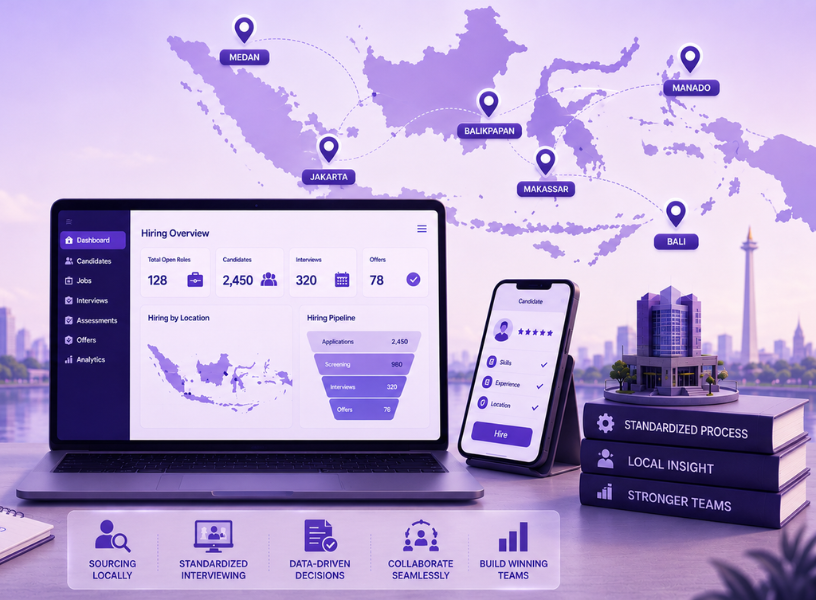
Decentralized hiring in Indonesia involves recruiting talent across the country's 38 provinces, rather than focusing solely on Jakarta. It works best when companies pair a centralized recruitment system with consistent standards, visibility, and compliance, while also providing flexibility for regional hiring managers and local recruitment partners to move quickly on the ground.
Indonesia consists of more than 17,000 islands, organized into 38 provinces and further divided into regencies and cities, with thriving talent hubs stretching from Jakarta and Surabaya to Medan, Makassar, and Bali. At the outset, it’s a genuine opportunity for companies building a national workforce, but it also means hiring rarely follows a single, centralized playbook. The businesses that win are the ones that treat this geographic diversity as an advantage.
Talent in Surabaya, Bandung, and Yogyakarta is frequently just as strong as in Jakarta, often at more competitive compensation levels, since candidates outside the capital are less likely to be juggling five competing offers at once. Companies that expand their sourcing radius beyond Jakarta tend to build richer, more resilient talent pipelines and reduce their dependence on one saturated labour market.
Scaling recruitment across provinces raises four recurring operational questions:
• Consistency versus local relevance: Maintaining a consistent employer brand and hiring bar across regional offices can be challenging, particularly when each office has its own hiring managers and local hiring norms.
• Speed: Coordinating interviews, approvals, and offers across multiple locations and time zones can stretch time-to-hire well beyond a single-city process.
• Visibility: As hiring activity becomes distributed across provinces, maintaining real-time visibility into recruitment progress across all locations becomes increasingly difficult for HR leadership.
• Compliance: Indonesia's labour framework has changed significantly since 2020.
The Job Creation Act, officially known as the Omnibus Law, was passed on 5 October 2020 with the aim of creating jobs and raising investment by reducing regulatory requirements. Among other changes, it removed provisions on sectoral minimum wage while maintaining the requirement for provincial governors to set a provincial minimum wage, meaning pay and hiring practices still need to flex province by province.
All of these are the reasons to build a recruitment process designed for distance from day one, rather than retrofitting a Jakarta-centric process for the rest of the country.
A unified digital recruitment platform addresses each of the challenges above:
Vacancy management dashboards let HR leadership track open roles across every region, while local hiring managers keep the autonomy to move quickly on the ground.
AI-assisted interview workflows help apply the same evaluation criteria nationwide, so a strong candidate in Makassar is assessed with the same rigor as one in the capital.
Many companies scaling across Indonesia rely on regional recruitment agencies that understand local labour markets. Dedicated partner portals let these agencies submit and track candidates without endless email threads.
A candidate browsing openings in Bali should feel like the company understands the local market, not like they're reading a generic corporate careers page.
Running standardized, compliant background checks across a geographically spread candidate base removes the patchwork of manual processes that regional offices often default to.
Whether someone is joining a headquarters team in Jakarta or a satellite office in Sumatra, digital pre-onboarding gives every new hire the same professional welcome.
Adrenalin's Talent Acquisition module is built around these capabilities, including vacancy management, AI-led interview management, talent partner microsites, candidate microsites, background verification integration, and pre-onboarding workflows to support multi-region hiring.
Companies that manage decentralized hiring well in Indonesia don't just fill roles faster. They build organizations less vulnerable to talent shortages in any single city, tap into cost-effective talent pools outside the traditional Jakarta market, and build employer brands that feel authentically local everywhere they operate.
Indonesia's archipelago is one of Southeast Asia's most expansive talent landscapes, and it rewards companies willing to build recruitment strategies as wide-reaching as the geography itself.
With Adrenalin's Talent Acquisition, decentralized doesn't have to mean disconnected. From Aceh to Papua, give your HR team one platform, one source of truth, and the confidence to hire great talent wherever it lives.
Want to see how Adrenalin’s Talent Acquisition can support your Indonesia hiring strategy? Get in touch with the Adrenalin team today.
Decentralized hiring is a recruitment approach where sourcing, interviewing, and hiring decisions happen across multiple regional locations rather than being run entirely from one central office or city.
Indonesia's workforce is spread across a very large archipelago of provinces and islands, with distinct regional labour markets, languages, and cost-of-living differences. A Jakarta-only hiring strategy misses a large share of available talent and tends to compete for the same limited pool of candidates.
No. Provincial governors are responsible for setting minimum wages at the provincial level and may also set minimum wages for specific regencies or cities within a province based on local economic growth and inflation, so minimum wage figures vary by region.
The Job Creation Law amended Indonesia's Labor Law and other regulations covering business permits, investment, and employment terms, including changes to overtime limits, severance calculations, and minimum wage-setting procedures. Employers hiring across provinces need HR processes that can adapt to these changes at the regional level. 2020 Omnibus Law on Job Creation - Wikipedia
A recruitment platform with centralized dashboards, standardized interview workflows, regional partner access, and integrated background verification helps HR teams maintain consistent hiring standards while giving regional teams the flexibility to hire quickly.

Many people would say that it is absolute madness to keep on doing the same thing, time after time, expecting to get a different result or for something different to happen.
Hoover Dam and the Grand Canyon: Book yourself a seat on any of the many sightseeing tours available and go and watch the architectural marvel that is Hoover Dam built over the Grand canyon which is also a grand sight to see by itself. Black Canyon is another must see as is Lake Mead which is so beautiful just because it is a body of water all surrounded by desert-like nature. Colorado River:
While looking at the Dam and Canyon is from above, to see the true beauty of the river, you have to go down. The Colorado river is excellent for river-rafting and water sports, but you do not have to take part if it is not your thing. Instead just sit back and enjoy another of nature’s marvels.


.webp)
Who can not resist going to one of the old towns like those in the Western gun slinging movies? Your destination needs to be Old Nevada. There you can delight in an old western town right in the middle of Red Rock Canyon. They host western shootouts too so come prepared, partner! I could go on and on about other attractions like the theme park in Circus Circus, the Gilcrease Nature Sanctuary, the Henderson Bird Viewing Preserve and Mt. Charleston but I think you get the picture. In Las Vegas and hate gambling? Do not despair. Just go out and have some clean un-gambling fun.
Decentralized hiring in Indonesia involves recruiting talent across the country's 38 provinces, rather than focusing solely on Jakarta. It works best when companies pair a centralized recruitment system with consistent standards, visibility, and compliance, while also providing flexibility for regional hiring managers and local recruitment partners to move quickly on the ground.
Indonesia consists of more than 17,000 islands, organized into 38 provinces and further divided into regencies and cities, with thriving talent hubs stretching from Jakarta and Surabaya to Medan, Makassar, and Bali. At the outset, it’s a genuine opportunity for companies building a national workforce, but it also means hiring rarely follows a single, centralized playbook. The businesses that win are the ones that treat this geographic diversity as an advantage.
Talent in Surabaya, Bandung, and Yogyakarta is frequently just as strong as in Jakarta, often at more competitive compensation levels, since candidates outside the capital are less likely to be juggling five competing offers at once. Companies that expand their sourcing radius beyond Jakarta tend to build richer, more resilient talent pipelines and reduce their dependence on one saturated labour market.
Scaling recruitment across provinces raises four recurring operational questions:
• Consistency versus local relevance: Maintaining a consistent employer brand and hiring bar across regional offices can be challenging, particularly when each office has its own hiring managers and local hiring norms.
• Speed: Coordinating interviews, approvals, and offers across multiple locations and time zones can stretch time-to-hire well beyond a single-city process.
• Visibility: As hiring activity becomes distributed across provinces, maintaining real-time visibility into recruitment progress across all locations becomes increasingly difficult for HR leadership.
• Compliance: Indonesia's labour framework has changed significantly since 2020.
The Job Creation Act, officially known as the Omnibus Law, was passed on 5 October 2020 with the aim of creating jobs and raising investment by reducing regulatory requirements. Among other changes, it removed provisions on sectoral minimum wage while maintaining the requirement for provincial governors to set a provincial minimum wage, meaning pay and hiring practices still need to flex province by province.
All of these are the reasons to build a recruitment process designed for distance from day one, rather than retrofitting a Jakarta-centric process for the rest of the country.
A unified digital recruitment platform addresses each of the challenges above:
Vacancy management dashboards let HR leadership track open roles across every region, while local hiring managers keep the autonomy to move quickly on the ground.
AI-assisted interview workflows help apply the same evaluation criteria nationwide, so a strong candidate in Makassar is assessed with the same rigor as one in the capital.
Many companies scaling across Indonesia rely on regional recruitment agencies that understand local labour markets. Dedicated partner portals let these agencies submit and track candidates without endless email threads.
A candidate browsing openings in Bali should feel like the company understands the local market, not like they're reading a generic corporate careers page.
Running standardized, compliant background checks across a geographically spread candidate base removes the patchwork of manual processes that regional offices often default to.
Whether someone is joining a headquarters team in Jakarta or a satellite office in Sumatra, digital pre-onboarding gives every new hire the same professional welcome.
Adrenalin's Talent Acquisition module is built around these capabilities, including vacancy management, AI-led interview management, talent partner microsites, candidate microsites, background verification integration, and pre-onboarding workflows to support multi-region hiring.
Companies that manage decentralized hiring well in Indonesia don't just fill roles faster. They build organizations less vulnerable to talent shortages in any single city, tap into cost-effective talent pools outside the traditional Jakarta market, and build employer brands that feel authentically local everywhere they operate.
Indonesia's archipelago is one of Southeast Asia's most expansive talent landscapes, and it rewards companies willing to build recruitment strategies as wide-reaching as the geography itself.
With Adrenalin's Talent Acquisition, decentralized doesn't have to mean disconnected. From Aceh to Papua, give your HR team one platform, one source of truth, and the confidence to hire great talent wherever it lives.
Want to see how Adrenalin’s Talent Acquisition can support your Indonesia hiring strategy? Get in touch with the Adrenalin team today.
Decentralized hiring is a recruitment approach where sourcing, interviewing, and hiring decisions happen across multiple regional locations rather than being run entirely from one central office or city.
Indonesia's workforce is spread across a very large archipelago of provinces and islands, with distinct regional labour markets, languages, and cost-of-living differences. A Jakarta-only hiring strategy misses a large share of available talent and tends to compete for the same limited pool of candidates.
No. Provincial governors are responsible for setting minimum wages at the provincial level and may also set minimum wages for specific regencies or cities within a province based on local economic growth and inflation, so minimum wage figures vary by region.
The Job Creation Law amended Indonesia's Labor Law and other regulations covering business permits, investment, and employment terms, including changes to overtime limits, severance calculations, and minimum wage-setting procedures. Employers hiring across provinces need HR processes that can adapt to these changes at the regional level. 2020 Omnibus Law on Job Creation - Wikipedia
A recruitment platform with centralized dashboards, standardized interview workflows, regional partner access, and integrated background verification helps HR teams maintain consistent hiring standards while giving regional teams the flexibility to hire quickly.

%20%20-%20hero.png)


.webp)


.webp)

Passionately focused on people and fostering relationships for over 25 Years