
.png)
Attending a trade show can be a very effective method of promoting your company and its products. And one of the most effective ways to optimize your trade show display and increase traffic to your booth is through the use of banner stands.

Balamani
Author
For many HR leaders, agentic AI feels strangely familiar.
It sounds like a natural extension of what has come before - automation, chatbots, copilots, predictive models. The language is new, but the promise feels recognizable: faster processes, fewer manual tasks, better efficiency.
And yet, something feels off.
Despite increasing exposure to agentic AI, many CHROs struggle to articulate how it is fundamentally different from earlier technologies - and why it demands a different kind of leadership response. The result is a growing tension: pressure to act on agentic AI, paired with uncertainty about what acting means.
That tension is not accidental. It points to a deeper issue.
Before agentic AI becomes an implementation challenge, it is a clarity challenge.
HR has spent decades adapting to new technologies. From early desktop automation to workflow-driven systems and machine-learning models, each wave promised to remove friction from HR operations.
Agentic AI appears to follow the same trajectory - until it doesn’t.
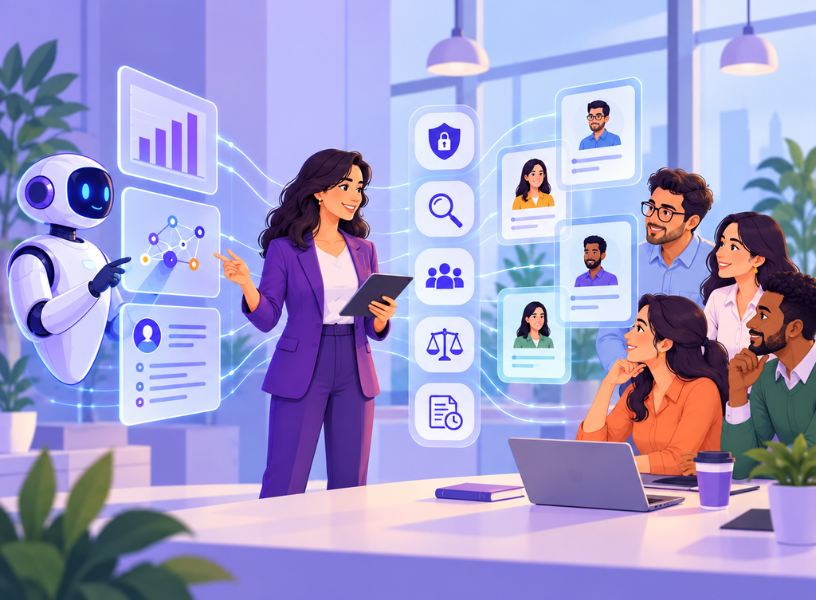
Unlike earlier tools, agentic systems are not limited to executing predefined steps or offering suggestions. They are designed to understand intent, plan actions, and execute workflows across systems with a degree of autonomy. In other words, they do not simply support work. They increasingly participate in it.
This distinction is subtle but critical.
Most HR technologies have functioned as extensions of human effort. Agentic AI begins to function as a substitute for certain forms of execution and coordination. That shift changes the nature of responsibility, oversight, and decision-making in ways that traditional automation never did.
When leaders treat agentic AI as “better automation,” they miss this shift entirely.
The conversation around agentic AI is saturated with noise. Assistants, copilots, bots, and agents are often used interchangeably, creating the illusion that this is simply another incremental step.
As a result, many HR leaders find themselves caught between extremes:
This is not a failure of curiosity or capability. It is a consequence of trying to interpret a structural shift using old mental models.
The confusion is amplified because HR is often the first function where agentic AI is deployed at scale - service desks, recruiting workflows, employee queries. These early use cases make the change feel operational when the implications are organizational.
The most important shift introduced by agentic AI is not speed or scale. It is agency.
When systems can plan and act, several assumptions begin to erode:
In practical terms, this means HR leaders are no longer just choosing tools. They are implicitly making decisions about:
These questions cannot be answered through pilots alone. They require deliberate leadership thinking.
In conversations about agentic AI, urgency is often framed as speed of adoption. But speed without clarity introduces its own risks.
Organizations that move quickly without redefining roles, escalation paths, and decision boundaries often experience a familiar pattern: throughput increases, but cognitive and managerial load rise alongside it. Automation absorbs volume, but humans are left managing exceptions, ambiguity, and risk without sufficient design support.
On the other hand, waiting for perfect certainty is equally problematic. As agentic capabilities mature, decisions made by default - rather than by design - begin to shape the organization quietly. Roles drift. Accountability blurs. Trust erodes incrementally.
The challenge for HR leaders is not choosing between action and caution. It is choosing deliberate action grounded in clarity.
For CHROs navigating this moment, the most important questions are not technical.
They are structural:
These are not future questions. They are already emerging wherever agentic systems are introduced, even in limited form.
Agentic AI will not wait for perfect understanding. It will continue to evolve, integrate, and expand across workflows.
What will differentiate organizations is not how quickly they deploy agents, but how clearly, they define their role in the system of work.
For HR leaders, this moment represents a shift in responsibility. Beyond implementing technology, CHROs are increasingly required to shape how work is designed, how judgment is preserved, and how accountability scales in a human-plus-AI environment.
Clarity, in this context, is not hesitation. It is leadership.
And it is the most important prerequisite before acting.

Many people would say that it is absolute madness to keep on doing the same thing, time after time, expecting to get a different result or for something different to happen.
Hoover Dam and the Grand Canyon: Book yourself a seat on any of the many sightseeing tours available and go and watch the architectural marvel that is Hoover Dam built over the Grand canyon which is also a grand sight to see by itself. Black Canyon is another must see as is Lake Mead which is so beautiful just because it is a body of water all surrounded by desert-like nature. Colorado River:
While looking at the Dam and Canyon is from above, to see the true beauty of the river, you have to go down. The Colorado river is excellent for river-rafting and water sports, but you do not have to take part if it is not your thing. Instead just sit back and enjoy another of nature’s marvels.


.webp)
Who can not resist going to one of the old towns like those in the Western gun slinging movies? Your destination needs to be Old Nevada. There you can delight in an old western town right in the middle of Red Rock Canyon. They host western shootouts too so come prepared, partner! I could go on and on about other attractions like the theme park in Circus Circus, the Gilcrease Nature Sanctuary, the Henderson Bird Viewing Preserve and Mt. Charleston but I think you get the picture. In Las Vegas and hate gambling? Do not despair. Just go out and have some clean un-gambling fun.
For many HR leaders, agentic AI feels strangely familiar.
It sounds like a natural extension of what has come before - automation, chatbots, copilots, predictive models. The language is new, but the promise feels recognizable: faster processes, fewer manual tasks, better efficiency.
And yet, something feels off.
Despite increasing exposure to agentic AI, many CHROs struggle to articulate how it is fundamentally different from earlier technologies - and why it demands a different kind of leadership response. The result is a growing tension: pressure to act on agentic AI, paired with uncertainty about what acting means.
That tension is not accidental. It points to a deeper issue.
Before agentic AI becomes an implementation challenge, it is a clarity challenge.
HR has spent decades adapting to new technologies. From early desktop automation to workflow-driven systems and machine-learning models, each wave promised to remove friction from HR operations.
Agentic AI appears to follow the same trajectory - until it doesn’t.
Unlike earlier tools, agentic systems are not limited to executing predefined steps or offering suggestions. They are designed to understand intent, plan actions, and execute workflows across systems with a degree of autonomy. In other words, they do not simply support work. They increasingly participate in it.
This distinction is subtle but critical.
Most HR technologies have functioned as extensions of human effort. Agentic AI begins to function as a substitute for certain forms of execution and coordination. That shift changes the nature of responsibility, oversight, and decision-making in ways that traditional automation never did.
When leaders treat agentic AI as “better automation,” they miss this shift entirely.
The conversation around agentic AI is saturated with noise. Assistants, copilots, bots, and agents are often used interchangeably, creating the illusion that this is simply another incremental step.
As a result, many HR leaders find themselves caught between extremes:
This is not a failure of curiosity or capability. It is a consequence of trying to interpret a structural shift using old mental models.
The confusion is amplified because HR is often the first function where agentic AI is deployed at scale - service desks, recruiting workflows, employee queries. These early use cases make the change feel operational when the implications are organizational.
The most important shift introduced by agentic AI is not speed or scale. It is agency.
When systems can plan and act, several assumptions begin to erode:
In practical terms, this means HR leaders are no longer just choosing tools. They are implicitly making decisions about:
These questions cannot be answered through pilots alone. They require deliberate leadership thinking.
In conversations about agentic AI, urgency is often framed as speed of adoption. But speed without clarity introduces its own risks.
Organizations that move quickly without redefining roles, escalation paths, and decision boundaries often experience a familiar pattern: throughput increases, but cognitive and managerial load rise alongside it. Automation absorbs volume, but humans are left managing exceptions, ambiguity, and risk without sufficient design support.
On the other hand, waiting for perfect certainty is equally problematic. As agentic capabilities mature, decisions made by default - rather than by design - begin to shape the organization quietly. Roles drift. Accountability blurs. Trust erodes incrementally.
The challenge for HR leaders is not choosing between action and caution. It is choosing deliberate action grounded in clarity.
For CHROs navigating this moment, the most important questions are not technical.
They are structural:
These are not future questions. They are already emerging wherever agentic systems are introduced, even in limited form.
Agentic AI will not wait for perfect understanding. It will continue to evolve, integrate, and expand across workflows.
What will differentiate organizations is not how quickly they deploy agents, but how clearly, they define their role in the system of work.
For HR leaders, this moment represents a shift in responsibility. Beyond implementing technology, CHROs are increasingly required to shape how work is designed, how judgment is preserved, and how accountability scales in a human-plus-AI environment.
Clarity, in this context, is not hesitation. It is leadership.
And it is the most important prerequisite before acting.


.webp)


.webp)

Passionately focused on people and fostering relationships for over 25 Years