

Attending a trade show can be a very effective method of promoting your company and its products. And one of the most effective ways to optimize your trade show display and increase traffic to your booth is through the use of banner stands.

Balamani
Author
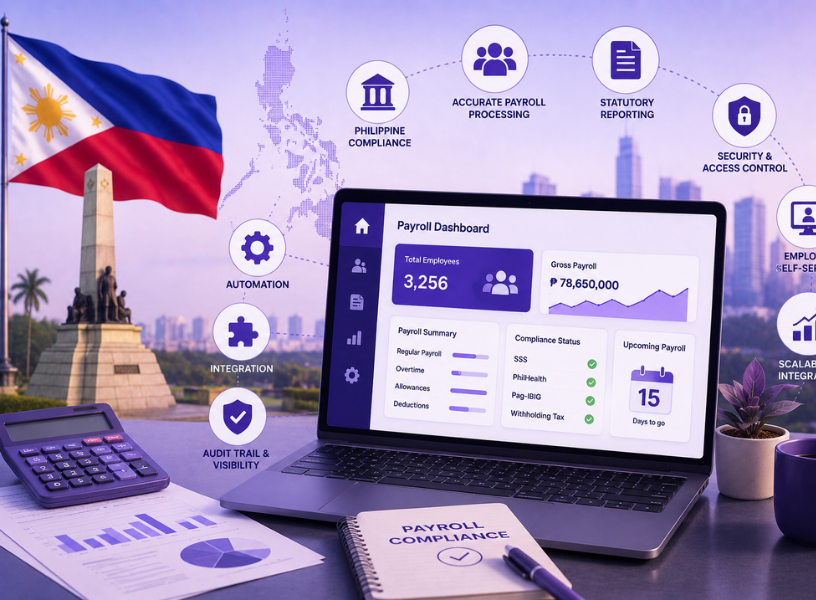
For enterprise HR teams, choosing payroll management software is a decision about compliance, data accuracy, controls, integrations and the organization's ability to process payroll consistently as the workforce grows.
The Philippines adds local complexity that vendors and HR teams must account for. Payroll may need to accommodate regional wage orders, statutory contributions, withholding tax requirements and employee data privacy. Regional wage orders illustrate this well: the National Wages and Productivity Commission (NWPC) maintains wage orders by region, and these can change or be contested on short notice. NCR's most recent wage order, for example, was signed and published in mid-2026, took effect for a period, and then had its implementation paused by a court injunction while the matter is litigated. (Wages & Productivity Commission) That kind of volatility is exactly why payroll systems need configurable, auditable wage management rather than hard-coded rates a point this article returns to below.
“The right payroll system should not only calculate pay; it should provide a controlled, auditable process from employee data through payroll approval and statutory reporting.”
Start with the fundamentals: can the system support Philippine payroll rules accurately and keep pace with regulatory changes?
Your assessment should cover:
• Withholding tax on compensation
• BIR reporting and employee certificates
• SSS contributions
• PhilHealth contributions
• Pag-IBIG requirements
• Applicable wage orders
• 13th-month pay and other statutory calculations
The BIR's Form 2316, for example, captures compensation, taxable and non-taxable income, employee statutory contributions and tax withheld. (Bir Cdn)
Ask vendors how statutory rules are maintained, tested and updated rather than simply asking whether they are "compliant."
Enterprise payroll rarely follows one simple calculation.
A robust system should handle different employee groups, pay frequencies, earnings, deductions, allowances, overtime, leave-related adjustments and other organization-specific rules without excessive manual intervention.
This matters because payroll exceptions increase as workforce structures become more complex. The goal of employee payroll processing should be repeatable accuracy, not spreadsheet-based correction after every payroll run.
Philippine minimum wage requirements vary by region and can change through wage orders. The NWPC currently publishes wage information across the country's regional wage boards. (Wages & Productivity Commission)
Recent events in the National Capital Region underline why this matters for enterprise payroll specifically. A new NCR wage order was signed and published in mid-2026 and initially took effect, only for a Regional Trial Court to issue first a temporary restraining order and then a preliminary injunction pausing its enforcement while the case is heard. As of this writing, whether and when the increase should be applied remains an open legal question, and DOLE has indicated it will continue pursuing remedies to have the order enforced. Employers should confirm the current status directly with DOLE or the NWPC before adjusting payroll, rather than relying on the original effective date alone.
For enterprise HR, this kind of scenario means payroll software should allow wage rules to be managed according to applicable locations and employee categories — and should be able to hold, flag, or roll back a rate change quickly if its legal status shifts.
• How are wage-order changes implemented?
• Can effective dates be configured, suspended, or reversed if an order is challenged or paused?
• Can historical rates be retained alongside the disputed rate?
• Can payroll teams identify employees affected by a change and by a later reversal?
Payroll management software should reduce the need for HR teams to calculate statutory deductions manually.
SSS, for instance, states that its contribution rate is 15% of the applicable Monthly Salary Credit, a rate that took full effect on 1 January 2025 and continues to apply, with employer and employee shares split 10%/5%. PhilHealth's premium rate has likewise held steady at 5%, with a ₱10,000 income floor and ₱100,000 ceiling, carrying through into 2026 with no further scheduled increase.
The important evaluation question is not simply whether a calculation exists, but whether the system can apply the correct rules consistently and provide a clear calculation trail.
Payroll depends on accurate upstream information.
An enterprise solution should connect payroll with relevant HR processes such as:
• Employee master data
• Time and attendance
• Leave
• Compensation
• Benefits
• Organization structures
• Employee lifecycle transactions
The objective is to minimise duplicate data entry and ensure approved employee changes flow into payroll through controlled processes.
Payroll is a high-risk process because a small data or configuration error can affect many employees simultaneously.
Look for controls such as:
• Role-based access
• Approval workflows
• Payroll locking
• Change histories
• Exception reporting
• Segregation of duties
• Audit logs
A good enterprise payroll platform should make it possible to answer a basic question quickly: who changed what, when, and what impact did it have on payroll? This becomes especially valuable when a statutory change like a contested wage order needs to be applied, held, or unwound across an entire employee population without losing the record of what happened and why.
Payroll accuracy is important, but employee visibility matters too.
Self-service capabilities can allow employees to access payslips, compensation information and relevant payroll records without creating unnecessary HR service requests.
This is particularly useful for large organizations where payroll teams need to manage high transaction volumes while maintaining employee access to information.
Payroll systems hold highly sensitive employee information, including compensation and identification data.
The Philippines' Data Privacy Act requires organizations processing personal information to follow principles including transparency, legitimate purpose and proportionality. The National Privacy Commission also highlights access management, security measures, data retention and appropriate controls over people handling personal data.
When assessing Philippines payroll vendors, therefore, ask about:
• Access controls
• Encryption and security practices
• Audit logging
• Data retention
• User permissions
• Incident response
• Data processing responsibilities
Finally, assess what happens before and after payroll is processed.
Enterprise HR teams need more than a payslip generator. They may require payroll registers, statutory reports, reconciliation, cost analysis, exception reports and management dashboards.
The system should also scale with organizational growth without making payroll progressively harder to control.
Before selecting payroll software in the Philippines, ask vendors to demonstrate the following using realistic enterprise scenarios:
1. Compliance: Can it accommodate current Philippine statutory and wage requirements including rules that are actively being litigated or amended?
2. Processing: Can it manage complex employee payroll processing?
3. Integration: Can payroll data flow securely from connected HR processes?
4. Controls: Can HR audit changes, approvals and exceptions?
5. Security: How is sensitive employee information protected?
6. Reporting: Can payroll teams reconcile and investigate results?
7. Scalability: Can the platform support workforce and organizational growth?
For enterprise HR, payroll software in the Philippines should be evaluated as a business control system, not merely a payroll calculator.
The strongest assessment considers local compliance, processing flexibility, regional wage requirements, statutory contributions, integrations, auditability, employee access, data privacy and reporting.
Before comparing Philippines payroll vendors, document your organization's payroll rules, employee groups, integrations, approval controls and compliance requirements. Then use those requirements to test each solution against real payroll scenarios including how it would handle a wage order that changes, or is contested, mid-cycle.
This approach helps HR leaders evaluate HR and payroll solutions on what matters most: accurate pay, controlled processes, compliance confidence and the ability to scale.
Enterprise HR should prioritize Philippine statutory compliance, flexible payroll processing, regional wage support, integrations, audit controls, data security, reporting and scalability. The system should also provide a transparent calculation and approval trail so payroll teams can investigate discrepancies efficiently.
Regional wage support is important because minimum wage rates are established through regional wage orders that can differ across locations — and can also be delayed, paused, or contested after they're issued, as recently happened with a National Capital Region wage order. A payroll system should allow applicable rates and effective dates to be managed, and reversed if needed, rather than relying on manual spreadsheet updates.
Payroll software can automate calculations and reporting based on configured Philippine tax and statutory rules. It should support requirements such as withholding tax, BIR documentation and statutory contributions while maintaining an audit trail. HR teams should still validate current requirements with the relevant authorities or qualified advisers.
Common integrations include employee master data, time and attendance, leave, compensation, benefits and finance-related processes. Integration reduces duplicate data entry and helps ensure that approved employee changes are reflected consistently in payroll.
HR should evaluate vendors against real business scenarios rather than feature lists alone. Test statutory calculations, wage changes (including contested or reversed changes), payroll exceptions, approvals, integrations, reporting, security and audit trails. This reveals whether the solution can support the organization's actual payroll operating model.

Many people would say that it is absolute madness to keep on doing the same thing, time after time, expecting to get a different result or for something different to happen.
Hoover Dam and the Grand Canyon: Book yourself a seat on any of the many sightseeing tours available and go and watch the architectural marvel that is Hoover Dam built over the Grand canyon which is also a grand sight to see by itself. Black Canyon is another must see as is Lake Mead which is so beautiful just because it is a body of water all surrounded by desert-like nature. Colorado River:
While looking at the Dam and Canyon is from above, to see the true beauty of the river, you have to go down. The Colorado river is excellent for river-rafting and water sports, but you do not have to take part if it is not your thing. Instead just sit back and enjoy another of nature’s marvels.


.webp)
Who can not resist going to one of the old towns like those in the Western gun slinging movies? Your destination needs to be Old Nevada. There you can delight in an old western town right in the middle of Red Rock Canyon. They host western shootouts too so come prepared, partner! I could go on and on about other attractions like the theme park in Circus Circus, the Gilcrease Nature Sanctuary, the Henderson Bird Viewing Preserve and Mt. Charleston but I think you get the picture. In Las Vegas and hate gambling? Do not despair. Just go out and have some clean un-gambling fun.
For enterprise HR teams, choosing payroll management software is a decision about compliance, data accuracy, controls, integrations and the organization's ability to process payroll consistently as the workforce grows.
The Philippines adds local complexity that vendors and HR teams must account for. Payroll may need to accommodate regional wage orders, statutory contributions, withholding tax requirements and employee data privacy. Regional wage orders illustrate this well: the National Wages and Productivity Commission (NWPC) maintains wage orders by region, and these can change or be contested on short notice. NCR's most recent wage order, for example, was signed and published in mid-2026, took effect for a period, and then had its implementation paused by a court injunction while the matter is litigated. (Wages & Productivity Commission) That kind of volatility is exactly why payroll systems need configurable, auditable wage management rather than hard-coded rates a point this article returns to below.
“The right payroll system should not only calculate pay; it should provide a controlled, auditable process from employee data through payroll approval and statutory reporting.”
Start with the fundamentals: can the system support Philippine payroll rules accurately and keep pace with regulatory changes?
Your assessment should cover:
• Withholding tax on compensation
• BIR reporting and employee certificates
• SSS contributions
• PhilHealth contributions
• Pag-IBIG requirements
• Applicable wage orders
• 13th-month pay and other statutory calculations
The BIR's Form 2316, for example, captures compensation, taxable and non-taxable income, employee statutory contributions and tax withheld. (Bir Cdn)
Ask vendors how statutory rules are maintained, tested and updated rather than simply asking whether they are "compliant."
Enterprise payroll rarely follows one simple calculation.
A robust system should handle different employee groups, pay frequencies, earnings, deductions, allowances, overtime, leave-related adjustments and other organization-specific rules without excessive manual intervention.
This matters because payroll exceptions increase as workforce structures become more complex. The goal of employee payroll processing should be repeatable accuracy, not spreadsheet-based correction after every payroll run.
Philippine minimum wage requirements vary by region and can change through wage orders. The NWPC currently publishes wage information across the country's regional wage boards. (Wages & Productivity Commission)
Recent events in the National Capital Region underline why this matters for enterprise payroll specifically. A new NCR wage order was signed and published in mid-2026 and initially took effect, only for a Regional Trial Court to issue first a temporary restraining order and then a preliminary injunction pausing its enforcement while the case is heard. As of this writing, whether and when the increase should be applied remains an open legal question, and DOLE has indicated it will continue pursuing remedies to have the order enforced. Employers should confirm the current status directly with DOLE or the NWPC before adjusting payroll, rather than relying on the original effective date alone.
For enterprise HR, this kind of scenario means payroll software should allow wage rules to be managed according to applicable locations and employee categories — and should be able to hold, flag, or roll back a rate change quickly if its legal status shifts.
• How are wage-order changes implemented?
• Can effective dates be configured, suspended, or reversed if an order is challenged or paused?
• Can historical rates be retained alongside the disputed rate?
• Can payroll teams identify employees affected by a change and by a later reversal?
Payroll management software should reduce the need for HR teams to calculate statutory deductions manually.
SSS, for instance, states that its contribution rate is 15% of the applicable Monthly Salary Credit, a rate that took full effect on 1 January 2025 and continues to apply, with employer and employee shares split 10%/5%. PhilHealth's premium rate has likewise held steady at 5%, with a ₱10,000 income floor and ₱100,000 ceiling, carrying through into 2026 with no further scheduled increase.
The important evaluation question is not simply whether a calculation exists, but whether the system can apply the correct rules consistently and provide a clear calculation trail.
Payroll depends on accurate upstream information.
An enterprise solution should connect payroll with relevant HR processes such as:
• Employee master data
• Time and attendance
• Leave
• Compensation
• Benefits
• Organization structures
• Employee lifecycle transactions
The objective is to minimise duplicate data entry and ensure approved employee changes flow into payroll through controlled processes.
Payroll is a high-risk process because a small data or configuration error can affect many employees simultaneously.
Look for controls such as:
• Role-based access
• Approval workflows
• Payroll locking
• Change histories
• Exception reporting
• Segregation of duties
• Audit logs
A good enterprise payroll platform should make it possible to answer a basic question quickly: who changed what, when, and what impact did it have on payroll? This becomes especially valuable when a statutory change like a contested wage order needs to be applied, held, or unwound across an entire employee population without losing the record of what happened and why.
Payroll accuracy is important, but employee visibility matters too.
Self-service capabilities can allow employees to access payslips, compensation information and relevant payroll records without creating unnecessary HR service requests.
This is particularly useful for large organizations where payroll teams need to manage high transaction volumes while maintaining employee access to information.
Payroll systems hold highly sensitive employee information, including compensation and identification data.
The Philippines' Data Privacy Act requires organizations processing personal information to follow principles including transparency, legitimate purpose and proportionality. The National Privacy Commission also highlights access management, security measures, data retention and appropriate controls over people handling personal data.
When assessing Philippines payroll vendors, therefore, ask about:
• Access controls
• Encryption and security practices
• Audit logging
• Data retention
• User permissions
• Incident response
• Data processing responsibilities
Finally, assess what happens before and after payroll is processed.
Enterprise HR teams need more than a payslip generator. They may require payroll registers, statutory reports, reconciliation, cost analysis, exception reports and management dashboards.
The system should also scale with organizational growth without making payroll progressively harder to control.
Before selecting payroll software in the Philippines, ask vendors to demonstrate the following using realistic enterprise scenarios:
1. Compliance: Can it accommodate current Philippine statutory and wage requirements including rules that are actively being litigated or amended?
2. Processing: Can it manage complex employee payroll processing?
3. Integration: Can payroll data flow securely from connected HR processes?
4. Controls: Can HR audit changes, approvals and exceptions?
5. Security: How is sensitive employee information protected?
6. Reporting: Can payroll teams reconcile and investigate results?
7. Scalability: Can the platform support workforce and organizational growth?
For enterprise HR, payroll software in the Philippines should be evaluated as a business control system, not merely a payroll calculator.
The strongest assessment considers local compliance, processing flexibility, regional wage requirements, statutory contributions, integrations, auditability, employee access, data privacy and reporting.
Before comparing Philippines payroll vendors, document your organization's payroll rules, employee groups, integrations, approval controls and compliance requirements. Then use those requirements to test each solution against real payroll scenarios including how it would handle a wage order that changes, or is contested, mid-cycle.
This approach helps HR leaders evaluate HR and payroll solutions on what matters most: accurate pay, controlled processes, compliance confidence and the ability to scale.
Enterprise HR should prioritize Philippine statutory compliance, flexible payroll processing, regional wage support, integrations, audit controls, data security, reporting and scalability. The system should also provide a transparent calculation and approval trail so payroll teams can investigate discrepancies efficiently.
Regional wage support is important because minimum wage rates are established through regional wage orders that can differ across locations — and can also be delayed, paused, or contested after they're issued, as recently happened with a National Capital Region wage order. A payroll system should allow applicable rates and effective dates to be managed, and reversed if needed, rather than relying on manual spreadsheet updates.
Payroll software can automate calculations and reporting based on configured Philippine tax and statutory rules. It should support requirements such as withholding tax, BIR documentation and statutory contributions while maintaining an audit trail. HR teams should still validate current requirements with the relevant authorities or qualified advisers.
Common integrations include employee master data, time and attendance, leave, compensation, benefits and finance-related processes. Integration reduces duplicate data entry and helps ensure that approved employee changes are reflected consistently in payroll.
HR should evaluate vendors against real business scenarios rather than feature lists alone. Test statutory calculations, wage changes (including contested or reversed changes), payroll exceptions, approvals, integrations, reporting, security and audit trails. This reveals whether the solution can support the organization's actual payroll operating model.


.webp)


.webp)

Passionately focused on people and fostering relationships for over 25 Years