
Attending a trade show can be a very effective method of promoting your company and its products. And one of the most effective ways to optimize your trade show display and increase traffic to your booth is through the use of banner stands.

Balamani
Author
For enterprise HR teams, choosing between payroll software vendors in Indonesia is about much more than automating monthly salary calculations.
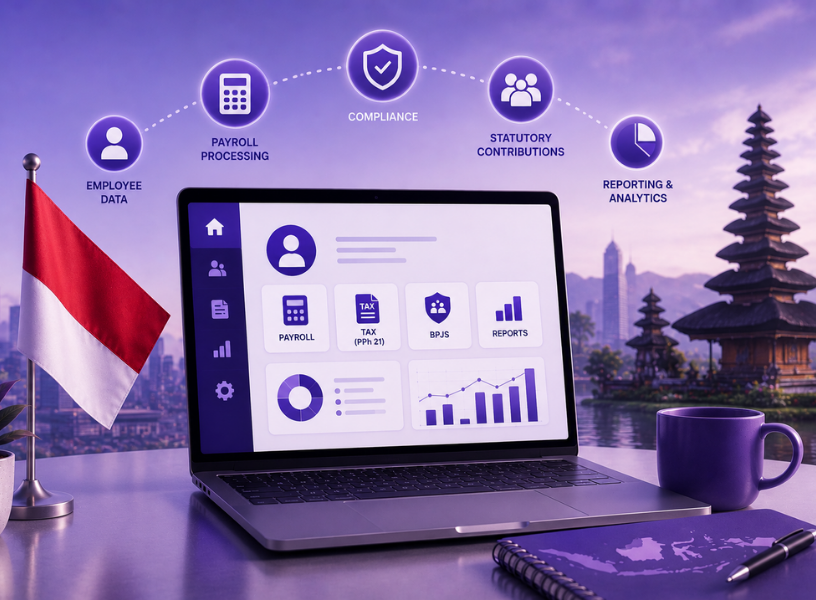
Indonesian payroll involves income tax, social security contributions, employee classifications, allowances, deductions, reporting and employee data. At enterprise scale, those requirements also need to connect with the wider HRMS environment.
The result is an important distinction: good payroll software should not simply calculate pay correctly; it should create a reliable chain of data from employee records to payroll, statutory reporting and management information.
This is particularly important for organisations with multiple entities, large workforces or complex HR processes.
Below are eight payroll basics enterprise HR teams should understand and test before shortlisting Indonesian payroll providers.
PPh Pasal 21 is a core consideration when evaluating payroll management software in Indonesia.
The Directorate General of Taxes (DJP) states that employers are responsible for withholding PPh 21 from employment-related income such as salaries, wages, allowances and other payments to employees.
That means an enterprise payroll platform needs to handle more than a simple percentage-based deduction.
HR and payroll teams should examine how a system handles:
The tax environment can also change. For example, Indonesia introduced a 2026 PPh 21 government-borne incentive for employees meeting specific criteria in certain industries and income bands. The measure applies for tax periods from January through December 2026. (pajak.go.id)
This illustrates why enterprise buyers should ask how a payroll provider manages regulatory changes, not simply whether its software is compliant today.
Social security administration is another fundamental payroll requirement.
BPJS Ketenagakerjaan publishes contribution requirements for employment-related programmes, including work accident, death, old-age and pension security. Current published information, for example, specifies employer and employee contribution rates for JHT and JP and different rates for employment injury protection depending on risk level. (bpjsketenagakerjaan.go.id)
For HR teams, the key question is whether the software can correctly apply the relevant rules to different employees.
Ask vendors to demonstrate:
Where BPJS Kesehatan is also part of the payroll process, ensure the platform can accommodate the applicable health insurance deductions and employer obligations.
Do not rely on a vendor's generic claim of "BPJS support". Ask for a live calculation using representative employee profiles.
Enterprise employee salary management often involves far more than monthly base salary.
Depending on the organisation, payroll may need to process:
The payroll engine should be able to distinguish between different pay components and apply the relevant tax and statutory treatment.
This is especially important for organisations with multiple employee groups.
A sales employee, factory employee, executive and expatriate may have very different compensation structures.
Ask shortlisted Indonesian payroll providers to demonstrate how the system handles these differences without requiring excessive manual calculations.
Payroll should not become a separate data island.
For enterprise organisations, information typically originates in several HR processes. Employee master data may sit in an HRMS, attendance information may come from a workforce management system, and compensation changes may be managed through HR workflows.
The payroll platform then needs reliable information from those sources.
At minimum, assess integration for:
The important question is not simply whether two systems can "integrate".
Ask:
What data moves between them, how often does it move, how are errors identified and who owns the correction process?
An integration that silently transfers incorrect employee information can create more risk than a manual process with strong controls.
Payroll systems contain highly sensitive employee information.
Indonesia's Personal Data Protection Law, Law No. 27 of 2022, establishes a national framework for protecting personal data. The law covers personal data processing and sets principles around matters such as lawful and transparent processing, accuracy, security and accountability.
For payroll software, this makes access control and data governance important evaluation criteria.
Ask providers about:
The organisation should also establish internal rules defining who can view, modify and approve payroll information.
A payroll platform should make those controls enforceable rather than relying entirely on internal procedures.
Enterprise payroll teams need visibility into how payroll results were produced.
A strong payroll solution should provide reporting that helps payroll teams reconcile results, investigate discrepancies and demonstrate appropriate controls.
Useful reporting capabilities may include:
Auditability is especially important when payroll is connected to an HRMS.
Suppose an employee's salary changes unexpectedly. Payroll administrators should be able to identify when the change occurred, what source system generated it, who approved it and how it affected the payroll calculation.
That level of traceability is much more valuable than simply having a large collection of standard reports.
One of the most important questions for payroll software vendors in Indonesia is how they manage change.
Tax rules, social security requirements, reporting processes and government incentives can change over time.
The 2026 PPh 21 government-borne incentive is a useful example. It applies only to employers and employees meeting specified criteria, including particular industries and income conditions.
A payroll provider should have a defined process for identifying, implementing, testing and communicating relevant statutory changes.
Ask:
This should be part of vendor due diligence, not an assumption made after implementation.
Enterprise organisations should decide whether payroll should operate as a standalone application or as part of a wider HR and payroll software environment.
A standalone payroll solution can make sense when payroll is the primary requirement and existing HR systems already work well.
An integrated platform can be attractive when the organisation wants employee data, payroll, HR processes and employee self-service to operate within a more connected environment.
Adrenalin HCM is an example of the integrated HCM approach. Its current platform describes payroll as an enterprise payroll processing capability, including multicurrency payroll, multiple pay modes, statutory compliance, a tax estimator, benefits and claims administration and employee payslip access. (myadrenalin.com)
For an enterprise evaluating Adrenalin HCM or another integrated platform, the important question is not simply whether payroll is included.
The evaluation should establish whether the platform can support the organisation's Indonesian payroll requirements, connect payroll with its HR processes and provide appropriate configuration and statutory support.
In other words,
Integration should be assessed as an operating-model decision, not just a software feature.
Before shortlisting vendors, create a practical scorecard covering the eight areas above.
Then ask every provider to demonstrate the same scenarios.
For example:
Scenario 1: A new employee joins halfway through a payroll period.
Scenario 2: An employee receives a salary increase and variable allowance.
Scenario 3: A bonus is added to the payroll.
Scenario 4: An employee changes status or employment details.
Scenario 5: A statutory rule changes and payroll must reflect the new requirement.
For every scenario, ask the provider to show the calculation, approval workflow, statutory treatment, reporting output and audit trail.
This is more revealing than a standard product demonstration.
There is no universal answer.
A standalone payroll platform may be appropriate if the organisation already has a mature HRMS and needs a specialist payroll engine.
An integrated HR and payroll software platform may be more suitable if the organisation wants to reduce duplicate employee records and connect core HR, payroll, employee self-service and related workflows.
The decision should consider:
Enterprise buyers should compare the full technology architecture rather than the licence price of one payroll application.
For enterprise HR teams, understanding Indonesian payroll basics is essential before choosing between payroll software vendors in Indonesia.
PPh 21, BPJS contributions, employee salary structures, HRMS integration, data protection, reporting and statutory updates all affect the reliability of payroll processing.
The strongest evaluation process starts with the organisation's actual workforce and payroll scenarios.
Instead of asking vendors to show every feature, ask them to demonstrate how the platform handles your employee data, payroll calculations, statutory requirements, integrations and exceptions.
For organisations considering an integrated HCM approach, platforms such as Adrenalin HCM provide an example of how payroll can sit within a wider HR technology environment. The same evaluation discipline should still apply: validate Indonesian requirements, test real scenarios and assess the platform against the organisation's long-term operating model.
The goal is not simply to automate salary calculations.
It is to create a payroll process that is accurate, auditable, secure and connected to the wider employee lifecycle.
Enterprises should assess PPh 21 handling, BPJS contribution capabilities, employee salary management, HRMS integration, reporting, data protection, statutory update processes and implementation support. Vendors should be asked to demonstrate realistic payroll scenarios rather than relying on feature lists. Enterprises should also evaluate whether the solution can support future workforce growth, additional entities and changing payroll requirements without creating excessive manual work.
PPh 21 is the income tax withholding mechanism applicable to employment-related income for individuals subject to the relevant Indonesian tax rules. Employers are responsible for withholding applicable PPh 21 from salaries, wages, allowances and other qualifying payments. Payroll systems therefore need to support the applicable calculation and reporting requirements. Because tax rules and special government incentives can change, employers should verify current requirements with the Directorate General of Taxes.
HRMS integration helps ensure that payroll receives accurate employee information from connected HR processes. Changes to salary, employee status, department, leave, attendance or other payroll-related data can affect payroll calculations. Without reliable integration, HR teams may need to re-enter information manually, increasing the risk of errors. Enterprise buyers should therefore assess data flows, validation, error handling, frequency of synchronisation and auditability rather than simply asking whether systems have an integration.
The right choice depends on the organisation's technology architecture and payroll complexity. Standalone payroll software may work well when an enterprise already has a mature HRMS and requires specialist payroll capabilities. An integrated platform may be more suitable when the organisation wants connected employee records, HR workflows, payroll and employee self-service. Platforms such as Adrenalin HCM illustrate the integrated approach, but the choice should be based on demonstrated requirements rather than platform type alone.
Indonesian payroll providers should be evaluated using a weighted scorecard covering statutory compliance, payroll calculations, HRMS integration, security, reporting, workforce scenarios, implementation and total cost of ownership. Each provider should demonstrate the same employee and payroll scenarios so that HR teams can compare actual workflows. Organisations should also ask how statutory updates are monitored, tested and deployed because payroll compliance requirements can change over time.

Many people would say that it is absolute madness to keep on doing the same thing, time after time, expecting to get a different result or for something different to happen.
Hoover Dam and the Grand Canyon: Book yourself a seat on any of the many sightseeing tours available and go and watch the architectural marvel that is Hoover Dam built over the Grand canyon which is also a grand sight to see by itself. Black Canyon is another must see as is Lake Mead which is so beautiful just because it is a body of water all surrounded by desert-like nature. Colorado River:
While looking at the Dam and Canyon is from above, to see the true beauty of the river, you have to go down. The Colorado river is excellent for river-rafting and water sports, but you do not have to take part if it is not your thing. Instead just sit back and enjoy another of nature’s marvels.


.webp)
Who can not resist going to one of the old towns like those in the Western gun slinging movies? Your destination needs to be Old Nevada. There you can delight in an old western town right in the middle of Red Rock Canyon. They host western shootouts too so come prepared, partner! I could go on and on about other attractions like the theme park in Circus Circus, the Gilcrease Nature Sanctuary, the Henderson Bird Viewing Preserve and Mt. Charleston but I think you get the picture. In Las Vegas and hate gambling? Do not despair. Just go out and have some clean un-gambling fun.
For enterprise HR teams, choosing between payroll software vendors in Indonesia is about much more than automating monthly salary calculations.
Indonesian payroll involves income tax, social security contributions, employee classifications, allowances, deductions, reporting and employee data. At enterprise scale, those requirements also need to connect with the wider HRMS environment.
The result is an important distinction: good payroll software should not simply calculate pay correctly; it should create a reliable chain of data from employee records to payroll, statutory reporting and management information.
This is particularly important for organisations with multiple entities, large workforces or complex HR processes.
Below are eight payroll basics enterprise HR teams should understand and test before shortlisting Indonesian payroll providers.
PPh Pasal 21 is a core consideration when evaluating payroll management software in Indonesia.
The Directorate General of Taxes (DJP) states that employers are responsible for withholding PPh 21 from employment-related income such as salaries, wages, allowances and other payments to employees.
That means an enterprise payroll platform needs to handle more than a simple percentage-based deduction.
HR and payroll teams should examine how a system handles:
The tax environment can also change. For example, Indonesia introduced a 2026 PPh 21 government-borne incentive for employees meeting specific criteria in certain industries and income bands. The measure applies for tax periods from January through December 2026. (pajak.go.id)
This illustrates why enterprise buyers should ask how a payroll provider manages regulatory changes, not simply whether its software is compliant today.
Social security administration is another fundamental payroll requirement.
BPJS Ketenagakerjaan publishes contribution requirements for employment-related programmes, including work accident, death, old-age and pension security. Current published information, for example, specifies employer and employee contribution rates for JHT and JP and different rates for employment injury protection depending on risk level. (bpjsketenagakerjaan.go.id)
For HR teams, the key question is whether the software can correctly apply the relevant rules to different employees.
Ask vendors to demonstrate:
Where BPJS Kesehatan is also part of the payroll process, ensure the platform can accommodate the applicable health insurance deductions and employer obligations.
Do not rely on a vendor's generic claim of "BPJS support". Ask for a live calculation using representative employee profiles.
Enterprise employee salary management often involves far more than monthly base salary.
Depending on the organisation, payroll may need to process:
The payroll engine should be able to distinguish between different pay components and apply the relevant tax and statutory treatment.
This is especially important for organisations with multiple employee groups.
A sales employee, factory employee, executive and expatriate may have very different compensation structures.
Ask shortlisted Indonesian payroll providers to demonstrate how the system handles these differences without requiring excessive manual calculations.
Payroll should not become a separate data island.
For enterprise organisations, information typically originates in several HR processes. Employee master data may sit in an HRMS, attendance information may come from a workforce management system, and compensation changes may be managed through HR workflows.
The payroll platform then needs reliable information from those sources.
At minimum, assess integration for:
The important question is not simply whether two systems can "integrate".
Ask:
What data moves between them, how often does it move, how are errors identified and who owns the correction process?
An integration that silently transfers incorrect employee information can create more risk than a manual process with strong controls.
Payroll systems contain highly sensitive employee information.
Indonesia's Personal Data Protection Law, Law No. 27 of 2022, establishes a national framework for protecting personal data. The law covers personal data processing and sets principles around matters such as lawful and transparent processing, accuracy, security and accountability.
For payroll software, this makes access control and data governance important evaluation criteria.
Ask providers about:
The organisation should also establish internal rules defining who can view, modify and approve payroll information.
A payroll platform should make those controls enforceable rather than relying entirely on internal procedures.
Enterprise payroll teams need visibility into how payroll results were produced.
A strong payroll solution should provide reporting that helps payroll teams reconcile results, investigate discrepancies and demonstrate appropriate controls.
Useful reporting capabilities may include:
Auditability is especially important when payroll is connected to an HRMS.
Suppose an employee's salary changes unexpectedly. Payroll administrators should be able to identify when the change occurred, what source system generated it, who approved it and how it affected the payroll calculation.
That level of traceability is much more valuable than simply having a large collection of standard reports.
One of the most important questions for payroll software vendors in Indonesia is how they manage change.
Tax rules, social security requirements, reporting processes and government incentives can change over time.
The 2026 PPh 21 government-borne incentive is a useful example. It applies only to employers and employees meeting specified criteria, including particular industries and income conditions.
A payroll provider should have a defined process for identifying, implementing, testing and communicating relevant statutory changes.
Ask:
This should be part of vendor due diligence, not an assumption made after implementation.
Enterprise organisations should decide whether payroll should operate as a standalone application or as part of a wider HR and payroll software environment.
A standalone payroll solution can make sense when payroll is the primary requirement and existing HR systems already work well.
An integrated platform can be attractive when the organisation wants employee data, payroll, HR processes and employee self-service to operate within a more connected environment.
Adrenalin HCM is an example of the integrated HCM approach. Its current platform describes payroll as an enterprise payroll processing capability, including multicurrency payroll, multiple pay modes, statutory compliance, a tax estimator, benefits and claims administration and employee payslip access. (myadrenalin.com)
For an enterprise evaluating Adrenalin HCM or another integrated platform, the important question is not simply whether payroll is included.
The evaluation should establish whether the platform can support the organisation's Indonesian payroll requirements, connect payroll with its HR processes and provide appropriate configuration and statutory support.
In other words,
Integration should be assessed as an operating-model decision, not just a software feature.
Before shortlisting vendors, create a practical scorecard covering the eight areas above.
Then ask every provider to demonstrate the same scenarios.
For example:
Scenario 1: A new employee joins halfway through a payroll period.
Scenario 2: An employee receives a salary increase and variable allowance.
Scenario 3: A bonus is added to the payroll.
Scenario 4: An employee changes status or employment details.
Scenario 5: A statutory rule changes and payroll must reflect the new requirement.
For every scenario, ask the provider to show the calculation, approval workflow, statutory treatment, reporting output and audit trail.
This is more revealing than a standard product demonstration.
There is no universal answer.
A standalone payroll platform may be appropriate if the organisation already has a mature HRMS and needs a specialist payroll engine.
An integrated HR and payroll software platform may be more suitable if the organisation wants to reduce duplicate employee records and connect core HR, payroll, employee self-service and related workflows.
The decision should consider:
Enterprise buyers should compare the full technology architecture rather than the licence price of one payroll application.
For enterprise HR teams, understanding Indonesian payroll basics is essential before choosing between payroll software vendors in Indonesia.
PPh 21, BPJS contributions, employee salary structures, HRMS integration, data protection, reporting and statutory updates all affect the reliability of payroll processing.
The strongest evaluation process starts with the organisation's actual workforce and payroll scenarios.
Instead of asking vendors to show every feature, ask them to demonstrate how the platform handles your employee data, payroll calculations, statutory requirements, integrations and exceptions.
For organisations considering an integrated HCM approach, platforms such as Adrenalin HCM provide an example of how payroll can sit within a wider HR technology environment. The same evaluation discipline should still apply: validate Indonesian requirements, test real scenarios and assess the platform against the organisation's long-term operating model.
The goal is not simply to automate salary calculations.
It is to create a payroll process that is accurate, auditable, secure and connected to the wider employee lifecycle.
Enterprises should assess PPh 21 handling, BPJS contribution capabilities, employee salary management, HRMS integration, reporting, data protection, statutory update processes and implementation support. Vendors should be asked to demonstrate realistic payroll scenarios rather than relying on feature lists. Enterprises should also evaluate whether the solution can support future workforce growth, additional entities and changing payroll requirements without creating excessive manual work.
PPh 21 is the income tax withholding mechanism applicable to employment-related income for individuals subject to the relevant Indonesian tax rules. Employers are responsible for withholding applicable PPh 21 from salaries, wages, allowances and other qualifying payments. Payroll systems therefore need to support the applicable calculation and reporting requirements. Because tax rules and special government incentives can change, employers should verify current requirements with the Directorate General of Taxes.
HRMS integration helps ensure that payroll receives accurate employee information from connected HR processes. Changes to salary, employee status, department, leave, attendance or other payroll-related data can affect payroll calculations. Without reliable integration, HR teams may need to re-enter information manually, increasing the risk of errors. Enterprise buyers should therefore assess data flows, validation, error handling, frequency of synchronisation and auditability rather than simply asking whether systems have an integration.
The right choice depends on the organisation's technology architecture and payroll complexity. Standalone payroll software may work well when an enterprise already has a mature HRMS and requires specialist payroll capabilities. An integrated platform may be more suitable when the organisation wants connected employee records, HR workflows, payroll and employee self-service. Platforms such as Adrenalin HCM illustrate the integrated approach, but the choice should be based on demonstrated requirements rather than platform type alone.
Indonesian payroll providers should be evaluated using a weighted scorecard covering statutory compliance, payroll calculations, HRMS integration, security, reporting, workforce scenarios, implementation and total cost of ownership. Each provider should demonstrate the same employee and payroll scenarios so that HR teams can compare actual workflows. Organisations should also ask how statutory updates are monitored, tested and deployed because payroll compliance requirements can change over time.


.webp)


.webp)

Passionately focused on people and fostering relationships for over 25 Years