
Attending a trade show can be a very effective method of promoting your company and its products. And one of the most effective ways to optimize your trade show display and increase traffic to your booth is through the use of banner stands.

Balamani
Author
Organizations today face mounting pressure to attract top talent, retain employees, improve workforce productivity, and make faster, data-driven decisions. As these challenges become more complex, enterprise HR teams are increasingly turning to AI HR software to streamline operations and support strategic workforce planning.
However, evaluating AI-powered HR platforms isn't as simple as comparing feature lists or reading "best software" rankings. Different solutions excel in different areas, from recruitment and onboarding to workforce analytics and employee engagement. Understanding the practical use cases of AI helps HR leaders identify which capabilities align with their organization's goals.
Modern AI solutions go beyond basic automation. They combine human resources automation, predictive insights, intelligent recruitment, advanced HR analytics, and workforce management AI to improve decision-making across the employee lifecycle. Rather than replacing HR professionals, these tools empower them to focus on higher-value initiatives while reducing repetitive administrative tasks.
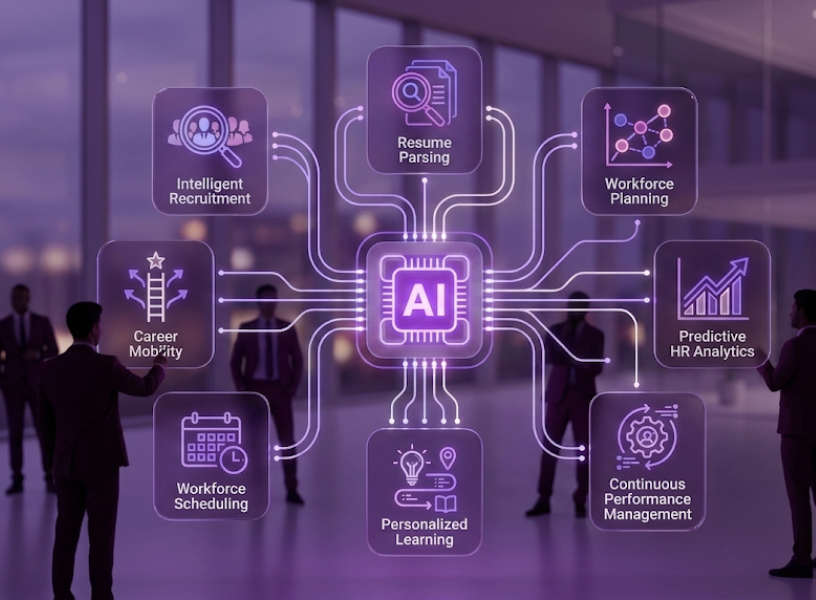
Before comparing HR tech vendors, enterprise buyers should understand the core business problems AI HR software is designed to solve. Below are eight key use cases every HR leader should know.
Recruitment remains one of the most time-consuming functions within HR. Enterprise organizations often receive thousands of applications for a single hiring campaign, making manual resume reviews both inefficient and inconsistent.
AI HR software addresses this challenge through intelligent recruitment capabilities that automatically analyze resumes, identify relevant qualifications, and rank candidates based on predefined job requirements. Instead of spending hours filtering applications, recruiters receive prioritized shortlists that help them focus on the most promising candidates.
Beyond keyword matching, many AI-powered recruitment platforms evaluate experience, certifications, career progression, and transferable skills to identify strong applicants who might otherwise be overlooked. Some solutions can also recommend suitable candidates for multiple open positions, improving internal hiring efficiency.
By reducing administrative effort during the screening process, recruiters gain more time to conduct meaningful interviews, build candidate relationships, and make informed hiring decisions. The result is a faster recruitment process, improved hiring quality, and a better experience for both recruiters and applicants.
The modern workforce is evolving rapidly, and job titles alone no longer provide an accurate picture of a candidate's capabilities. Many organizations are shifting toward skills-based hiring, making AI an increasingly valuable recruitment tool.
AI HR software can automatically extract structured information from resumes, including education, work history, certifications, technical competencies, and soft skills. This data is then used to match candidates with available roles based on actual capabilities rather than simple keyword searches.
Skills-based matching also supports internal mobility by identifying existing employees who possess the qualifications needed for new opportunities. Instead of recruiting externally for every position, organizations can uncover hidden talent within their workforce and encourage career development.
For enterprises managing large talent pools, this capability improves hiring accuracy while helping reduce recruitment costs and employee turnover.
Strategic workforce planning requires organizations to anticipate future talent needs rather than react to staffing shortages after they occur.
Modern AI HR software uses predictive models and historical workforce data to forecast hiring demand, identify potential skill gaps, estimate attrition risks, and support succession planning initiatives. These insights allow HR leaders to make proactive decisions that align workforce strategies with broader business objectives.
For example, predictive analytics may identify departments experiencing unusually high turnover or forecast increased staffing requirements during seasonal business cycles. HR teams can then prepare recruitment campaigns, learning initiatives, or workforce restructuring plans before operational challenges arise.
By combining historical performance with real-time workforce insights, predictive HR analytics enables organizations to make more confident planning decisions while reducing uncertainty.
Enterprise HR departments spend considerable time responding to routine employee inquiries involving leave balances, payroll information, company policies, expense claims, and benefits administration.
AI-powered virtual assistants and intelligent chatbots simplify these interactions through human resources automation. Employees can access answers instantly without waiting for HR support, while HR teams spend less time managing repetitive administrative requests.
Automation also extends to routine workflows such as onboarding documentation, policy acknowledgements, approval routing, and compliance reminders. Instead of manually coordinating each process, AI helps ensure tasks are completed consistently and on schedule.
Reducing administrative workload allows HR professionals to focus on strategic initiatives such as employee development, culture, workforce planning, and leadership support rather than transactional activities.
Annual performance reviews often provide limited value because feedback arrives long after meaningful improvements could have been made.
AI HR software supports continuous performance management by collecting ongoing feedback, identifying performance trends, and highlighting opportunities for coaching throughout the year. Managers receive data-driven insights that help them recognize achievements, address concerns earlier, and create personalized development plans.
Some platforms analyze project outcomes, peer feedback, learning progress, and engagement indicators to recommend targeted training or mentoring opportunities. Rather than relying solely on subjective evaluations, managers gain a more complete understanding of employee performance.
Continuous feedback also supports employee engagement by encouraging regular conversations between managers and team members, helping organizations foster a stronger culture of growth and development.
As technology and business priorities evolve, employees must continuously develop new skills. AI-powered learning platforms help organizations deliver more personalized development experiences.
Instead of assigning identical training programs to every employee, AI recommends courses, certifications, mentoring opportunities, and career pathways based on individual skills, job roles, performance history, and career aspirations.
Personalized learning encourages employees to build relevant capabilities while helping organizations address emerging skill shortages. AI can also recommend internal vacancies that align with an employee's experience and development goals, increasing opportunities for career progression without leaving the organization.
Supporting internal mobility not only improves employee satisfaction but also reduces recruitment costs by filling positions with existing talent whenever possible.
Enterprise HR leaders are expected to demonstrate measurable business impact. This requires access to reliable workforce data rather than isolated operational reports.
Advanced HR analytics consolidates information from recruitment, performance management, learning systems, payroll, and employee engagement platforms to provide comprehensive workforce insights.
Organizations can monitor key metrics such as:
AI enhances these analytics by identifying trends, detecting anomalies, and highlighting areas requiring management attention. Instead of manually interpreting large datasets, HR leaders receive actionable recommendations that support evidence-based decision-making.
These insights help executives align workforce investments with broader organizational objectives while continuously measuring HR performance.
Large enterprises often manage thousands of employees across multiple locations, departments, and shift patterns. Coordinating staffing while balancing employee preferences, operational demands, and compliance requirements can quickly become overwhelming.
Workforce management AI helps optimize scheduling by forecasting labor demand, recommending staffing levels, and automating shift assignments based on availability, skills, and business requirements.
AI can also identify scheduling conflicts, monitor overtime trends, and support workforce planning during peak business periods. By continuously analyzing workforce data, organizations improve resource utilization while reducing unnecessary labor costs.
For industries such as healthcare, manufacturing, retail, hospitality, and logistics, workforce management AI enables more efficient operations while helping maintain service quality and employee satisfaction.
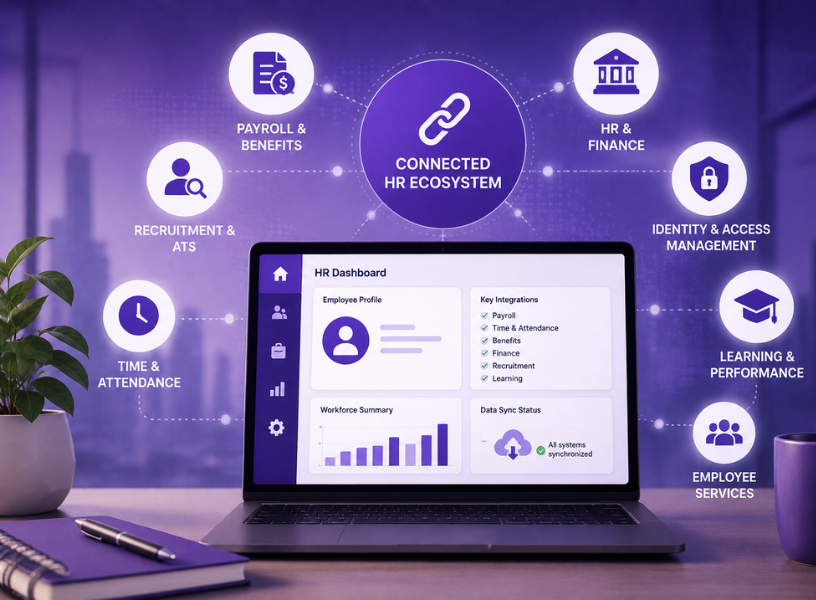
Understanding AI use cases is only the first step. Enterprise buyers should also evaluate how well a platform integrates with their existing HR technology ecosystem and supports long-term organizational goals.
When comparing HR tech vendors, consider the following:
The most effective AI HR software is not necessarily the one with the longest feature list. Instead, it is the solution that aligns with your organization's workforce strategy, supports measurable business outcomes, and evolves alongside changing business needs.
AI is transforming human resources from an administrative function into a strategic business partner. Modern AI HR software enables organizations to improve recruitment, automate repetitive HR processes, deliver personalized employee experiences, strengthen workforce planning, and generate actionable insights through advanced analytics.
For enterprise HR leaders, understanding these eight use cases provides a stronger foundation for evaluating technology investments beyond generic software comparisons. By focusing on business outcomes rather than marketing claims, organizations can select AI solutions that enhance operational efficiency, improve employee experiences, and support long-term workforce success.
As AI capabilities continue to mature, organizations that invest thoughtfully in the right HR technology will be better positioned to attract top talent, retain skilled employees, and build a more agile workforce for the future.

Many people would say that it is absolute madness to keep on doing the same thing, time after time, expecting to get a different result or for something different to happen.
Hoover Dam and the Grand Canyon: Book yourself a seat on any of the many sightseeing tours available and go and watch the architectural marvel that is Hoover Dam built over the Grand canyon which is also a grand sight to see by itself. Black Canyon is another must see as is Lake Mead which is so beautiful just because it is a body of water all surrounded by desert-like nature. Colorado River:
While looking at the Dam and Canyon is from above, to see the true beauty of the river, you have to go down. The Colorado river is excellent for river-rafting and water sports, but you do not have to take part if it is not your thing. Instead just sit back and enjoy another of nature’s marvels.


.webp)
Who can not resist going to one of the old towns like those in the Western gun slinging movies? Your destination needs to be Old Nevada. There you can delight in an old western town right in the middle of Red Rock Canyon. They host western shootouts too so come prepared, partner! I could go on and on about other attractions like the theme park in Circus Circus, the Gilcrease Nature Sanctuary, the Henderson Bird Viewing Preserve and Mt. Charleston but I think you get the picture. In Las Vegas and hate gambling? Do not despair. Just go out and have some clean un-gambling fun.
Organizations today face mounting pressure to attract top talent, retain employees, improve workforce productivity, and make faster, data-driven decisions. As these challenges become more complex, enterprise HR teams are increasingly turning to AI HR software to streamline operations and support strategic workforce planning.
However, evaluating AI-powered HR platforms isn't as simple as comparing feature lists or reading "best software" rankings. Different solutions excel in different areas, from recruitment and onboarding to workforce analytics and employee engagement. Understanding the practical use cases of AI helps HR leaders identify which capabilities align with their organization's goals.
Modern AI solutions go beyond basic automation. They combine human resources automation, predictive insights, intelligent recruitment, advanced HR analytics, and workforce management AI to improve decision-making across the employee lifecycle. Rather than replacing HR professionals, these tools empower them to focus on higher-value initiatives while reducing repetitive administrative tasks.
Before comparing HR tech vendors, enterprise buyers should understand the core business problems AI HR software is designed to solve. Below are eight key use cases every HR leader should know.
Recruitment remains one of the most time-consuming functions within HR. Enterprise organizations often receive thousands of applications for a single hiring campaign, making manual resume reviews both inefficient and inconsistent.
AI HR software addresses this challenge through intelligent recruitment capabilities that automatically analyze resumes, identify relevant qualifications, and rank candidates based on predefined job requirements. Instead of spending hours filtering applications, recruiters receive prioritized shortlists that help them focus on the most promising candidates.
Beyond keyword matching, many AI-powered recruitment platforms evaluate experience, certifications, career progression, and transferable skills to identify strong applicants who might otherwise be overlooked. Some solutions can also recommend suitable candidates for multiple open positions, improving internal hiring efficiency.
By reducing administrative effort during the screening process, recruiters gain more time to conduct meaningful interviews, build candidate relationships, and make informed hiring decisions. The result is a faster recruitment process, improved hiring quality, and a better experience for both recruiters and applicants.
The modern workforce is evolving rapidly, and job titles alone no longer provide an accurate picture of a candidate's capabilities. Many organizations are shifting toward skills-based hiring, making AI an increasingly valuable recruitment tool.
AI HR software can automatically extract structured information from resumes, including education, work history, certifications, technical competencies, and soft skills. This data is then used to match candidates with available roles based on actual capabilities rather than simple keyword searches.
Skills-based matching also supports internal mobility by identifying existing employees who possess the qualifications needed for new opportunities. Instead of recruiting externally for every position, organizations can uncover hidden talent within their workforce and encourage career development.
For enterprises managing large talent pools, this capability improves hiring accuracy while helping reduce recruitment costs and employee turnover.
Strategic workforce planning requires organizations to anticipate future talent needs rather than react to staffing shortages after they occur.
Modern AI HR software uses predictive models and historical workforce data to forecast hiring demand, identify potential skill gaps, estimate attrition risks, and support succession planning initiatives. These insights allow HR leaders to make proactive decisions that align workforce strategies with broader business objectives.
For example, predictive analytics may identify departments experiencing unusually high turnover or forecast increased staffing requirements during seasonal business cycles. HR teams can then prepare recruitment campaigns, learning initiatives, or workforce restructuring plans before operational challenges arise.
By combining historical performance with real-time workforce insights, predictive HR analytics enables organizations to make more confident planning decisions while reducing uncertainty.
Enterprise HR departments spend considerable time responding to routine employee inquiries involving leave balances, payroll information, company policies, expense claims, and benefits administration.
AI-powered virtual assistants and intelligent chatbots simplify these interactions through human resources automation. Employees can access answers instantly without waiting for HR support, while HR teams spend less time managing repetitive administrative requests.
Automation also extends to routine workflows such as onboarding documentation, policy acknowledgements, approval routing, and compliance reminders. Instead of manually coordinating each process, AI helps ensure tasks are completed consistently and on schedule.
Reducing administrative workload allows HR professionals to focus on strategic initiatives such as employee development, culture, workforce planning, and leadership support rather than transactional activities.
Annual performance reviews often provide limited value because feedback arrives long after meaningful improvements could have been made.
AI HR software supports continuous performance management by collecting ongoing feedback, identifying performance trends, and highlighting opportunities for coaching throughout the year. Managers receive data-driven insights that help them recognize achievements, address concerns earlier, and create personalized development plans.
Some platforms analyze project outcomes, peer feedback, learning progress, and engagement indicators to recommend targeted training or mentoring opportunities. Rather than relying solely on subjective evaluations, managers gain a more complete understanding of employee performance.
Continuous feedback also supports employee engagement by encouraging regular conversations between managers and team members, helping organizations foster a stronger culture of growth and development.
As technology and business priorities evolve, employees must continuously develop new skills. AI-powered learning platforms help organizations deliver more personalized development experiences.
Instead of assigning identical training programs to every employee, AI recommends courses, certifications, mentoring opportunities, and career pathways based on individual skills, job roles, performance history, and career aspirations.
Personalized learning encourages employees to build relevant capabilities while helping organizations address emerging skill shortages. AI can also recommend internal vacancies that align with an employee's experience and development goals, increasing opportunities for career progression without leaving the organization.
Supporting internal mobility not only improves employee satisfaction but also reduces recruitment costs by filling positions with existing talent whenever possible.
Enterprise HR leaders are expected to demonstrate measurable business impact. This requires access to reliable workforce data rather than isolated operational reports.
Advanced HR analytics consolidates information from recruitment, performance management, learning systems, payroll, and employee engagement platforms to provide comprehensive workforce insights.
Organizations can monitor key metrics such as:
AI enhances these analytics by identifying trends, detecting anomalies, and highlighting areas requiring management attention. Instead of manually interpreting large datasets, HR leaders receive actionable recommendations that support evidence-based decision-making.
These insights help executives align workforce investments with broader organizational objectives while continuously measuring HR performance.
Large enterprises often manage thousands of employees across multiple locations, departments, and shift patterns. Coordinating staffing while balancing employee preferences, operational demands, and compliance requirements can quickly become overwhelming.
Workforce management AI helps optimize scheduling by forecasting labor demand, recommending staffing levels, and automating shift assignments based on availability, skills, and business requirements.
AI can also identify scheduling conflicts, monitor overtime trends, and support workforce planning during peak business periods. By continuously analyzing workforce data, organizations improve resource utilization while reducing unnecessary labor costs.
For industries such as healthcare, manufacturing, retail, hospitality, and logistics, workforce management AI enables more efficient operations while helping maintain service quality and employee satisfaction.
Understanding AI use cases is only the first step. Enterprise buyers should also evaluate how well a platform integrates with their existing HR technology ecosystem and supports long-term organizational goals.
When comparing HR tech vendors, consider the following:
The most effective AI HR software is not necessarily the one with the longest feature list. Instead, it is the solution that aligns with your organization's workforce strategy, supports measurable business outcomes, and evolves alongside changing business needs.
AI is transforming human resources from an administrative function into a strategic business partner. Modern AI HR software enables organizations to improve recruitment, automate repetitive HR processes, deliver personalized employee experiences, strengthen workforce planning, and generate actionable insights through advanced analytics.
For enterprise HR leaders, understanding these eight use cases provides a stronger foundation for evaluating technology investments beyond generic software comparisons. By focusing on business outcomes rather than marketing claims, organizations can select AI solutions that enhance operational efficiency, improve employee experiences, and support long-term workforce success.
As AI capabilities continue to mature, organizations that invest thoughtfully in the right HR technology will be better positioned to attract top talent, retain skilled employees, and build a more agile workforce for the future.


.webp)


.webp)

Passionately focused on people and fostering relationships for over 25 Years