
Attending a trade show can be a very effective method of promoting your company and its products. And one of the most effective ways to optimize your trade show display and increase traffic to your booth is through the use of banner stands.

Balamani
Author
For the past two years, HR leaders have focused on one question: Should we adopt AI? By 2026, that question will be outdated. The real challenge now is not whether to use AI, but how much authority AI should have inside the organization.
Not all AI is the same. Some tools help employees work faster. Others can run workflows. A new generation of “agentic AI” can plan, act, and optimize with minimal human prompting. That means HR leaders need a smarter framework for adoption - one based on AI agency levels.
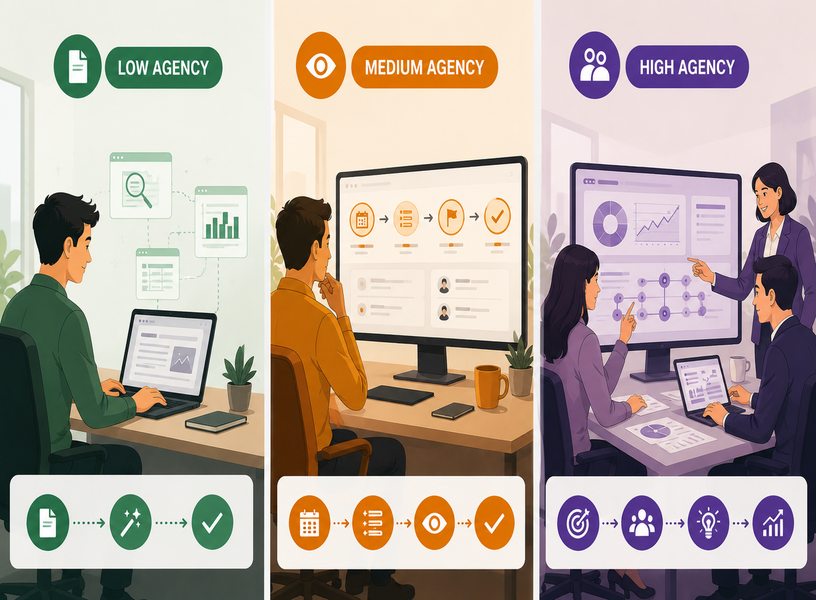
An AI agency refers to how independently an AI system can operate, make decisions, and take action.
Think of it in three levels:
Low-Agency AI = Assists humans
Medium-Agency AI = Executes tasks within rules
High-Agency AI = Acts autonomously toward goals
This lens helps HR leaders decide where AI adds value—and where human judgment must remain central.
Low-agency AI works like an assistant. It responds to prompts, creates drafts, summarizes data, or helps employees complete tasks faster.
Examples in HR include:
This is already delivering measurable value. SHRM’s 2026 research found that most HR professionals report medium or high productivity gains from AI tools. (SHRM)
For HR leaders, low-agency AI should become the baseline. It reduces administrative burden and frees teams to focus on higher-value work such as coaching, culture, and workforce planning.
Medium-agency AI goes beyond assistance. It can take action within defined guardrails.
Examples include:
This is where many organizations will see the biggest operational returns. It reduces cycle times, improves employee experience, and scales HR support without linear headcount growth.
However, medium-agency AI also introduces real risks – bias, opaque decision-making, and employee distrust if systems are not transparent.
HR must ensure that workflows remain explainable and auditable.
High-agency AI is the newest frontier. These systems can plan, coordinate across tools, and pursue goals with limited supervision.
Potential HR use cases include:
This is powerful – but it will be dangerous if misused.
Recent executive surveys show many companies are adopting AI faster than they can govern it, with 80% saying they would likely fail an AI governance audit. (Axios)
That is a warning sign.
High-agency AI should never be given unchecked control over promotions, layoffs, compensation, or disciplinary decisions. These are human accountability zones.
The higher the people impact, the lower the acceptable AI autonomy.
For example:
AI can support decisions. It cannot own them.
AI governance is not just an IT issue. It is an HR issue.
Because HR already owns:
As AI becomes embedded into work, HR leaders must define the rules of engagement: where AI assists, where it executes, and where it stops.
AI will not be leading the future of HR. However, HR leaders who understand AI better than everyone else will be leading the future.
The winning organizations will know when AI should assist, when it should operate, and when it should never be left alone.
In the years ahead, the competitive advantage will not be AI adoption.
It will be an AI authority design.

Many people would say that it is absolute madness to keep on doing the same thing, time after time, expecting to get a different result or for something different to happen.
Hoover Dam and the Grand Canyon: Book yourself a seat on any of the many sightseeing tours available and go and watch the architectural marvel that is Hoover Dam built over the Grand canyon which is also a grand sight to see by itself. Black Canyon is another must see as is Lake Mead which is so beautiful just because it is a body of water all surrounded by desert-like nature. Colorado River:
While looking at the Dam and Canyon is from above, to see the true beauty of the river, you have to go down. The Colorado river is excellent for river-rafting and water sports, but you do not have to take part if it is not your thing. Instead just sit back and enjoy another of nature’s marvels.


.webp)
Who can not resist going to one of the old towns like those in the Western gun slinging movies? Your destination needs to be Old Nevada. There you can delight in an old western town right in the middle of Red Rock Canyon. They host western shootouts too so come prepared, partner! I could go on and on about other attractions like the theme park in Circus Circus, the Gilcrease Nature Sanctuary, the Henderson Bird Viewing Preserve and Mt. Charleston but I think you get the picture. In Las Vegas and hate gambling? Do not despair. Just go out and have some clean un-gambling fun.
For the past two years, HR leaders have focused on one question: Should we adopt AI? By 2026, that question will be outdated. The real challenge now is not whether to use AI, but how much authority AI should have inside the organization.
Not all AI is the same. Some tools help employees work faster. Others can run workflows. A new generation of “agentic AI” can plan, act, and optimize with minimal human prompting. That means HR leaders need a smarter framework for adoption - one based on AI agency levels.
An AI agency refers to how independently an AI system can operate, make decisions, and take action.
Think of it in three levels:
Low-Agency AI = Assists humans
Medium-Agency AI = Executes tasks within rules
High-Agency AI = Acts autonomously toward goals
This lens helps HR leaders decide where AI adds value—and where human judgment must remain central.
Low-agency AI works like an assistant. It responds to prompts, creates drafts, summarizes data, or helps employees complete tasks faster.
Examples in HR include:
This is already delivering measurable value. SHRM’s 2026 research found that most HR professionals report medium or high productivity gains from AI tools. (SHRM)
For HR leaders, low-agency AI should become the baseline. It reduces administrative burden and frees teams to focus on higher-value work such as coaching, culture, and workforce planning.
Medium-agency AI goes beyond assistance. It can take action within defined guardrails.
Examples include:
This is where many organizations will see the biggest operational returns. It reduces cycle times, improves employee experience, and scales HR support without linear headcount growth.
However, medium-agency AI also introduces real risks – bias, opaque decision-making, and employee distrust if systems are not transparent.
HR must ensure that workflows remain explainable and auditable.
High-agency AI is the newest frontier. These systems can plan, coordinate across tools, and pursue goals with limited supervision.
Potential HR use cases include:
This is powerful – but it will be dangerous if misused.
Recent executive surveys show many companies are adopting AI faster than they can govern it, with 80% saying they would likely fail an AI governance audit. (Axios)
That is a warning sign.
High-agency AI should never be given unchecked control over promotions, layoffs, compensation, or disciplinary decisions. These are human accountability zones.
The higher the people impact, the lower the acceptable AI autonomy.
For example:
AI can support decisions. It cannot own them.
AI governance is not just an IT issue. It is an HR issue.
Because HR already owns:
As AI becomes embedded into work, HR leaders must define the rules of engagement: where AI assists, where it executes, and where it stops.
AI will not be leading the future of HR. However, HR leaders who understand AI better than everyone else will be leading the future.
The winning organizations will know when AI should assist, when it should operate, and when it should never be left alone.
In the years ahead, the competitive advantage will not be AI adoption.
It will be an AI authority design.


.webp)


.webp)

Passionately focused on people and fostering relationships for over 25 Years