

“The best way to predict the future is to create it.” – Peter Drucker
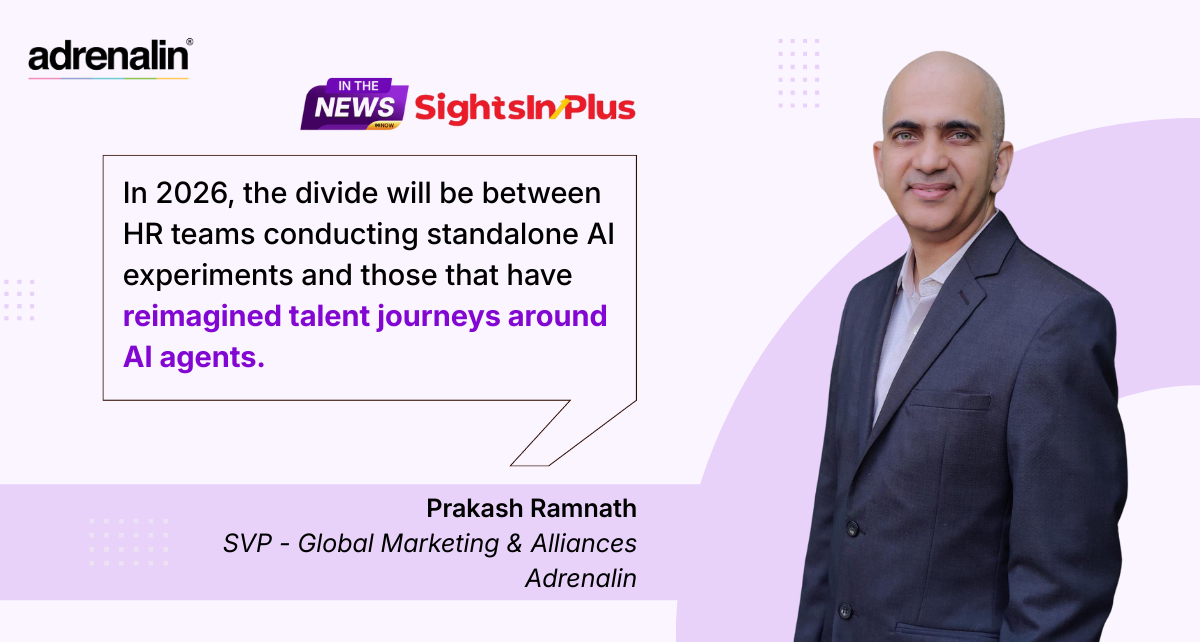
By 2026, the gap between companies that “have AI” and those that run on AI agents will be impossible to ignore.
Let's picture two boardrooms.
In the first, a CHRO arrives with a familiar deck: engagement scores, attrition charts, diversity ratios. The numbers are neat but static; a rearview mirror of what has already happened. The organisation has an “AI chatbot” answering FAQs, a recommendation engine buried in the LMS, and a pilot project proudly featured in the annual report.
In the second boardroom, the CHRO walks in with no slides. An AI agent has already distributed a narrative brief to every attendee’s device. It explains, in plain language, where workforce risks are emerging, which teams are thriving, and what interventions will move the needle; complete with projected impact scenarios and trade-offs. As directors ask questions, the CHRO doesn’t toggle between spreadsheets and tools; the agent answers, simulates, and refines in real time.
Both organisations can claim to be “using AI in HR.”
Only one has re-architected HR around a network of AI agents that co-own outcomes.
This is the story of that second organisation; and the seven AI agent bets its CHRO and CIO made that turned HR from a function into an intelligent, adaptive system.
It began with surprises the leadership team no longer wanted: a spike in regretted attrition; a missed opportunity to redeploy people; a talent shortage “no one saw coming.”
The CHRO and CIO decided static dashboards were not enough.
They wired data from HRMS, collaboration tools, performance systems, and external talent markets, and stood up their first serious AI agent; the Workforce Intelligence Agent.
The first time it spoke up, it told a story rather than showing a chart:
“Attrition risk among mid-level engineers in Region B has doubled in the last 60 days. The primary drivers are compensation compression and limited internal mobility. Here are three interventions, with projected six-month impact and cost.”
Leaders stopped asking, “What happened last quarter?” and started asking, “What is likely to happen next; and what can we do about it?”
Laggards still print reports. This organisation let the reports talk back through an agent that continuously analyzed, narrated, and simulated the workforce in motion.
A major client expanded its contract; the sales leader insisted they needed 40 new roles. Recruiters braced for another frantic external search.
The CHRO turned to the Talent Orchestration Agent.
Even as job descriptions were being drafted, the agent scanned project histories, performance reviews, learning records, and collaboration patterns. Then it came back with a quiet revelation:
“You plan to open 40 roles. I have identified 27 internal employees whose skills, performance, and aspirations closely match these roles. Here are the top 15, with proposed transition plans and backfill strategies.”
Years of underused capability suddenly became visible.
Over time, the Talent Orchestration Agent became the company’s internal head-hunter; balancing external hiring with smart internal moves, learning recommendations, and project gigs. People stopped being static holders of titles and became evolving portfolios of skills.
Others launched “AI powered marketplaces.” This company deployed an agent that orchestrated talent flows in real time and learned from which matches actually worked.
The real test came in a 1-1.
A high performing analyst showed signs of disengagement, shorter emails, less initiative. Her manager sensed something was wrong but wasn’t sure how to approach it.
Before the meeting, a window appeared in the manager’s workspace. The Manager Co-Pilot Agent had noticed the same signals.
“Your team member A has maintained high performance, but engagement indicators have dipped for six weeks. Similar patterns often precede attrition. Here are three ways to open the conversation, based on what has worked best in your culture. Here are policy options if flexibility or role redesign comes up.”
The agent did not replace judgment; it made the manager more prepared and more human.
Across thousands of micro-moments; feedback, conflicts, policy questions; the Co-Pilot Agent absorbed institutional experience and scaled the organisation’s best leadership instincts.
Elsewhere, HR still fielded endless queries. Here, an AI agent sat beside every manager, lifting the floor of people leadership at scale.
Employees noticed the next shift during a hiring wave in a new market.
Previously, onboarding meant portals, forms, and fragmented instructions. On paper, the process was “world class”; in reality, it felt like bureaucracy.
With the Employee Experience Agent, a different pattern emerged.
As soon as a new hire signed, the agent orchestrated tasks across HR, IT, finance, and the hiring manager; personalising content by role, location, and seniority; and anticipating questions:
“Your laptop arrives Tuesday. Here is your onboarding calendar, adjusted for your time zone. Based on your role, here are three colleagues you should meet in your first month and why.”
Months later, when that employee returned from parental leave, the same agent reappeared with tailored policy information, flexible work options, and a conversation guide for the manager.
Employees stopped seeing HR as a set of disjointed processes and started experiencing a curated, responsive journey; even though most orchestration was handled by an AI agent.
Others re-skinned portals. This organisation built an experience fabric, with an agent as the invisible conductor of every key moment.
Global expansion brought regulatory and policy complexity. Each promotion, exit, transfer, or contract change carried risk.
In the old world, issues surfaced late; in audits, complaints, or headlines. In the new world, the Compliance and Policy Guardian Agent watched critical actions as they happened.
A manager in a new country initiated a termination. Before submission, the agent intervened:
“This action may breach local notice regulations and internal due process policy. Here are compliant pathways with required steps and documentation. HR has been alerted for review.”
The intervention took seconds; the avoided risk was significant.
Crucially, the agent did not just say “no”; it suggested how to do the right thing in context, with reference to precedent and local nuance.
Laggards rely on annual training. Leaders embed a guardian agent directly into workflows, turning compliance into an ambient capability.
A strategic pivot demanded new capabilities that were scarce. Instead of a long consulting cycle, the CHRO and CIO activated the Learning & Capability Agent. It mapped reality; parsing histories, outcomes, learning data, and contributions to build a live skills graph. Then it overlaid strategy:
“To support the new model, these capabilities are critical. Here is your current depth in each. Here are targeted capability-building paths; combining content, stretch assignments, and role transitions; with projected impact over 6, 12, and 18 months.”
The agent prescribed experiences tied to real work; then tracked whether they changed performance, mobility, and retention.
Within a year, the board wasn’t reviewing course completions but the speed of measurable skills shifts.
Others added another LMS. This organisation built a capability operating system driven by an AI agent.
With several agents now active, a new question arose; who orchestrates the orchestrators?
The answer was the HR Operating System Agent.
It did not face employees directly. Instead, it coordinated the ecosystem:
From a single console, the CHRO saw where agents intervened, what value they created, and could tune guardrails and priorities; when agents should act autonomously and when they should only advise.
This was no longer about “adding AI features.” It was about running an agentic HR operating system on top of HCM, where AI agents quietly shaped decisions, journeys, and outcomes every day.
By 2026, peers were still announcing pilots and “AI powered” HR modules. They talked about AI first HR.
This organisation had spent the prior years doing something harder; acting.
Efficiency improved; but the deeper shift was strategic; better talent bets, faster capability pivots, more consistent leadership, fewer unforced compliance errors.
The dividing line in 2026 is and will be simple.
The story above is already being written in parts. The remaining question is whether your organisation will be known for talking about AI in HR; or for quietly building the agentic backbone that will define the next decade.
“The best way to predict the future is to create it.” – Peter Drucker
By 2026, the gap between companies that “have AI” and those that run on AI agents will be impossible to ignore.
Let's picture two boardrooms.
In the first, a CHRO arrives with a familiar deck: engagement scores, attrition charts, diversity ratios. The numbers are neat but static; a rearview mirror of what has already happened. The organisation has an “AI chatbot” answering FAQs, a recommendation engine buried in the LMS, and a pilot project proudly featured in the annual report.
In the second boardroom, the CHRO walks in with no slides. An AI agent has already distributed a narrative brief to every attendee’s device. It explains, in plain language, where workforce risks are emerging, which teams are thriving, and what interventions will move the needle; complete with projected impact scenarios and trade-offs. As directors ask questions, the CHRO doesn’t toggle between spreadsheets and tools; the agent answers, simulates, and refines in real time.
Both organisations can claim to be “using AI in HR.”
Only one has re-architected HR around a network of AI agents that co-own outcomes.
This is the story of that second organisation; and the seven AI agent bets its CHRO and CIO made that turned HR from a function into an intelligent, adaptive system.
It began with surprises the leadership team no longer wanted: a spike in regretted attrition; a missed opportunity to redeploy people; a talent shortage “no one saw coming.”
The CHRO and CIO decided static dashboards were not enough.
They wired data from HRMS, collaboration tools, performance systems, and external talent markets, and stood up their first serious AI agent; the Workforce Intelligence Agent.
The first time it spoke up, it told a story rather than showing a chart:
“Attrition risk among mid-level engineers in Region B has doubled in the last 60 days. The primary drivers are compensation compression and limited internal mobility. Here are three interventions, with projected six-month impact and cost.”
Leaders stopped asking, “What happened last quarter?” and started asking, “What is likely to happen next; and what can we do about it?”
Laggards still print reports. This organisation let the reports talk back through an agent that continuously analyzed, narrated, and simulated the workforce in motion.
A major client expanded its contract; the sales leader insisted they needed 40 new roles. Recruiters braced for another frantic external search.
The CHRO turned to the Talent Orchestration Agent.
Even as job descriptions were being drafted, the agent scanned project histories, performance reviews, learning records, and collaboration patterns. Then it came back with a quiet revelation:
“You plan to open 40 roles. I have identified 27 internal employees whose skills, performance, and aspirations closely match these roles. Here are the top 15, with proposed transition plans and backfill strategies.”
Years of underused capability suddenly became visible.
Over time, the Talent Orchestration Agent became the company’s internal head-hunter; balancing external hiring with smart internal moves, learning recommendations, and project gigs. People stopped being static holders of titles and became evolving portfolios of skills.
Others launched “AI powered marketplaces.” This company deployed an agent that orchestrated talent flows in real time and learned from which matches actually worked.
The real test came in a 1-1.
A high performing analyst showed signs of disengagement, shorter emails, less initiative. Her manager sensed something was wrong but wasn’t sure how to approach it.
Before the meeting, a window appeared in the manager’s workspace. The Manager Co-Pilot Agent had noticed the same signals.
“Your team member A has maintained high performance, but engagement indicators have dipped for six weeks. Similar patterns often precede attrition. Here are three ways to open the conversation, based on what has worked best in your culture. Here are policy options if flexibility or role redesign comes up.”
The agent did not replace judgment; it made the manager more prepared and more human.
Across thousands of micro-moments; feedback, conflicts, policy questions; the Co-Pilot Agent absorbed institutional experience and scaled the organisation’s best leadership instincts.
Elsewhere, HR still fielded endless queries. Here, an AI agent sat beside every manager, lifting the floor of people leadership at scale.
Employees noticed the next shift during a hiring wave in a new market.
Previously, onboarding meant portals, forms, and fragmented instructions. On paper, the process was “world class”; in reality, it felt like bureaucracy.
With the Employee Experience Agent, a different pattern emerged.
As soon as a new hire signed, the agent orchestrated tasks across HR, IT, finance, and the hiring manager; personalising content by role, location, and seniority; and anticipating questions:
“Your laptop arrives Tuesday. Here is your onboarding calendar, adjusted for your time zone. Based on your role, here are three colleagues you should meet in your first month and why.”
Months later, when that employee returned from parental leave, the same agent reappeared with tailored policy information, flexible work options, and a conversation guide for the manager.
Employees stopped seeing HR as a set of disjointed processes and started experiencing a curated, responsive journey; even though most orchestration was handled by an AI agent.
Others re-skinned portals. This organisation built an experience fabric, with an agent as the invisible conductor of every key moment.
Global expansion brought regulatory and policy complexity. Each promotion, exit, transfer, or contract change carried risk.
In the old world, issues surfaced late; in audits, complaints, or headlines. In the new world, the Compliance and Policy Guardian Agent watched critical actions as they happened.
A manager in a new country initiated a termination. Before submission, the agent intervened:
“This action may breach local notice regulations and internal due process policy. Here are compliant pathways with required steps and documentation. HR has been alerted for review.”
The intervention took seconds; the avoided risk was significant.
Crucially, the agent did not just say “no”; it suggested how to do the right thing in context, with reference to precedent and local nuance.
Laggards rely on annual training. Leaders embed a guardian agent directly into workflows, turning compliance into an ambient capability.
A strategic pivot demanded new capabilities that were scarce. Instead of a long consulting cycle, the CHRO and CIO activated the Learning & Capability Agent. It mapped reality; parsing histories, outcomes, learning data, and contributions to build a live skills graph. Then it overlaid strategy:
“To support the new model, these capabilities are critical. Here is your current depth in each. Here are targeted capability-building paths; combining content, stretch assignments, and role transitions; with projected impact over 6, 12, and 18 months.”
The agent prescribed experiences tied to real work; then tracked whether they changed performance, mobility, and retention.
Within a year, the board wasn’t reviewing course completions but the speed of measurable skills shifts.
Others added another LMS. This organisation built a capability operating system driven by an AI agent.
With several agents now active, a new question arose; who orchestrates the orchestrators?
The answer was the HR Operating System Agent.
It did not face employees directly. Instead, it coordinated the ecosystem:
From a single console, the CHRO saw where agents intervened, what value they created, and could tune guardrails and priorities; when agents should act autonomously and when they should only advise.
This was no longer about “adding AI features.” It was about running an agentic HR operating system on top of HCM, where AI agents quietly shaped decisions, journeys, and outcomes every day.
By 2026, peers were still announcing pilots and “AI powered” HR modules. They talked about AI first HR.
This organisation had spent the prior years doing something harder; acting.
Efficiency improved; but the deeper shift was strategic; better talent bets, faster capability pivots, more consistent leadership, fewer unforced compliance errors.
The dividing line in 2026 is and will be simple.
The story above is already being written in parts. The remaining question is whether your organisation will be known for talking about AI in HR; or for quietly building the agentic backbone that will define the next decade.